


“It’ll change your life,” a good friend of mine is fond of saying, to lend a touch of credence to a recommendation. And in most cases he’s been right. Whether it’s a good meal, movie, whiskey, podcast, video, song, sermon, album, or book, most of his recommendations have been good enough that the experiences I’ve undertaken at his suggestion have left a mark beyond mere entertainment or additions to the contextual fabric of life, two otherwise worthy ends. These experiences have, to varying degrees, changed the way I think, feel, act, or abstain.
Therefore, in lieu of a “Best Books of [Fill In The Year],” I’m following in the footsteps of Matthew Kelly, an author who has maintained a list of the “top 20” books that have changed his life. Although in my case I was unable to limit that number to 20 (or 30), I hereby submit 40 Books That Changed My Life (in the Financial LIFE Planning post below), in four distinct alphabetical categories: fiction, non-fiction, spiritual, and vocational.
Perhaps you’ll find something you might consider reading over the holidays to inspire you in the New Year—or if you’re prone to last-minute shopping, I’ve linked them all to give you 40 prospective gift options for the readers among your family and friends.
Additionally, Tony and I talked through three lessons we each learned in this week’s Podcast, before Tony ends the year with an upbeat Weekly Market Update, Financial Stress Is Falling and Markets Are Listening.
This will be our final newsletter edition for 2025, so we wish you and yours a Merry Christmas, Happy Hanukkah, and a Happy New Year!
Tim
Tim Maurer, CFP®, RLP®
Chief Advisory Officer
In this Net Worthwhile® Weekly you'll find:
Financial LIFE Planning:
40 Books That Changed My Life
NWWW Podcast:
3 Literary Lessons Learned In 2025
Quote O' The Week:
Gregory Boyle
Weekly Market Update:
Financial Stress Is Falling and Markets Are Listening
Financial LIFE Planning
40 Books That Changed My Life

Fiction
Fiction is the category that wouldn’t have existed on my list only 15 years ago, because I’d fallen prey to the silly notion that fictional books, by their very nature, can’t actually change our lives for the better. How foolish I was to think that!
Cutting For Stone, by Abraham Verghese, was recommended to me by my #1 book referral friend. While most times, I wait until I’ve heard a recommendation from three credible sources, I’ll add anything she recommends to my reading list. Cutting For Stone is an epic masterpiece featuring “twin brothers born of a secret union of a beautiful Indian nun and a brash British surgeon.” I know, it sounds a bit like the start of an international soap opera, but the story and writing were good enough to keep me engaged for all 600+ pages. I may have been aided by the fact that I listened to this particular book—again based on my friend’s suggestion that the many words that were foreign to my ear would sing when well narrated—but I think I’d have stuck it out just as well in print.

Jayber Crow, by Wendell Berry, opened my mind to a whole new form of reading, writing, and living. Wendell Berry is an American philosopher, essayist, poet, and fictional author whose creation of an autobiographically-inspired town, Port William, has made me yearn for a more deliberate, tangible, and meaningful life. Jayber was Port William’s barber from 1937 until 1969…and that’s about all I can tell you, if I’m to hold myself to Berry’s “ORDER BY THE AUTHOR,” a notice written to readers in the preamble: “Persons attempting to find a ‘text’ in this book will be prosecuted; persons attempting to find a ‘subtext’ in it will be banished; persons attempting to explain, interpret, explicate, analyze, deconstruct, or otherwise ‘understand’ it will be exiled to a desert island in the company only of other explainers.” All I can tell you is that I’ve read and enjoyed many of the Port William series now, but none has had an impact on my like Jayber Crow, although I’m barred from attempting to tell you how or why!
A Prayer For Owen Meany was my introduction to John Irving’s work, and I enjoyed it so much, I’m afraid to read anything else he’s written lest I spoil it. Although not on the grand scale of Cutting For Stone, I’d nonetheless refer to A Prayer For Owen Meany as an epic, too, although mostly confined to the small town of Gravesend, New Hampshire. While Irving seems much more inclined than Berry to allow his worldview to charge through the text, in this case through the lens of an often heart-wrenching confluence of coming-of-age stories, you don’t have to agree with the author’s opinions to acknowledge the brilliance of his writing.
The Rent Collector, by Camron Wright, though a work of fiction, is based on so much eye-opening fact that it almost brought me to my knees, both in thanksgiving and repentance for lacking self-awareness. Maybe especially because my vocation is to help people of means find more meaning in their money management, this story of a family living in “the largest municipal waste dump in all of Cambodia,” was a potent reminder that the third-world is actually most of the world–and that the incremental improvements and advantages that most of us reading this post are daily seeking, however worthwhile, are luxuries beyond the imagination of most of the world’s population. Having spent some time in a similar community on the other side of the world, La Chureca, Nicaragua, I shouldn’t have needed a reminder, but maybe that’s why The Rent Collector hit me so hard.
The Shack, by William Young, is controversial, primarily because it fictionalizes representations of each member of the Trinity–God the Father, Christ the Son, and the Holy Spirit–in ways that are, well, unexpected. But it’s a work of fiction, not of doctrine. I found that it stretched and informed my faith in only helpful ways, but I will warn you in advance that if you are a parent, it’s very difficult to get through the first couple chapters.
Non-Fiction
Non-fiction is my comfort zone, but what I have found is that the most compelling non-fiction reads more like fiction. That’s where the following books and authors shine:
1776 is by the master of biographical non-fiction, David McCullough. It is a condensed biography of George Washington, centered on an especially pivotal year in his, and all of our, lives. I’ll never forgetting completing the book–sitting on a beach in Ocean City, New Jersey, many years ago–because I just wanted it to keep going!
American Ulysses, by Ronald White, nearly replaced 1776 in my Top 30 collection when I finished it in 2020. While the story-telling rose nearly to the level of McCullough’s, I was even more impressed with the subject, Ulysses S. Grant. While Washington’s seemed almost as a story of destiny—a larger-than-life figure who lived up to the regularly high expectations that everyone had for him—Grant possessed almost none of those qualities and well outgrew everyone’s expectations of him. But what impressed me the most about Grant, especially during the tumultuous year of 2020 when I read it, was that he was a man willing to publicly change his mind on a highly divisive topic. Pointedly, while Washington never publicly acted on his private misgivings about the horrors of slavery during his lifetime, Grant did, and in so doing, he went from being a slave owner (by marriage) to becoming a champion for the formerly enslaved whom Frederick Douglass referred to as “the vigilant, firm, impartial, and wise protector of my race.”
How The Irish Saved Civilization, by Thomas Cahill, is like drinking a Guinness on St. Patrick’s Day while eating corned beef and cabbage. Never mind the fact that the March 17th holiday and its accompanying meal are both American inventions, Cahill’s book includes the true significance of St. Patrick and tells the surprisingly untold story of how Irish monks saved much of the world’s ancient writings from the ravages of the Dark Ages.
Man’s Search for Meaning is a bracing reminder that success, like happiness, cannot be chased without being lost. Drawing from his survival of the Holocaust and his work as a psychiatrist, Viktor Frankl dismantles our culture’s fixation on comparison, achievement, and visible markers of winning, arguing instead that meaning, found in service to causes and people beyond ourselves, is the true engine of a well-lived life. Few books so powerfully reframe suffering as purposeful, ambition as derivative, and success as something that ensues only when we stop aiming directly at it—a lesson with profound implications not just for life, but for how we think about money, work, and what it actually means to be doing well.
Surrender is far more than a rock memoir; it’s a meditation on friendship, faith, ambition, and love, told by the frontman of my favorite band of all time. While most great bands seem to come with a companion story of ego, excess, and mutual disdain, Bono tells a markedly different story about U2—one rooted in enduring friendship, shared purpose, and a relentless pursuit of love in its deepest and most demanding forms. What struck me most is the quiet suggestion that U2 didn’t become the biggest band in the world in spite of those bonds, but because of them. Surrender invites us to reconsider our assumptions about greatness, reminding us that what sustains creative excellence over decades is not self-indulgence or bravado, but commitment—to one another, to meaning, and to something larger than ourselves. And while I do own the hardback, I also highly recommend the audiobook, because it’s read by the author…and he has a great Irish accent.
Tattoos on the Heart is one of those rare books that doesn’t just inform you; it quietly dismantles you. Drawing from decades spent alongside the marginalized, the wounded, and the written-off gang members of the most dangerous community in Los Angeles, Father Gregory Boyle bears witness to a truth that is both disarming and demanding: Transformation happens through kinship, not strategy. This is not a book about fixing people or saving the world, but about standing close enough to be changed yourself. I know it’s changed me.
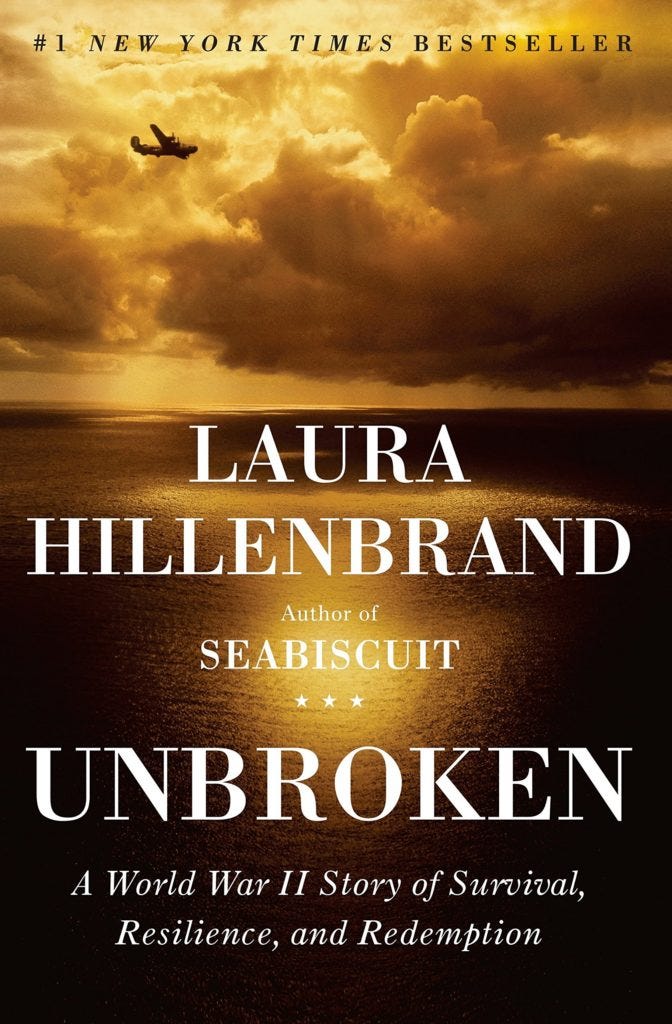
If I had to choose a single book to recommend from this entire list, it would have to be Unbroken, by Laura Hillenbrand. If it was a work of fiction, we’d all accuse Hillenbrand of gratuitous hyperbole–but this is the true story of Louis Zamperini, a World War II veteran who, himself, lived several impossible lives in one. I can’t tell you how many times I thought, “You’ve got to be kidding me! Is this real?”
When Breath Becomes Air, by Paul Kalanithi, is a title that I can’t even write without a moment of pause for a deep inhale and exhale. This autobiographical story of an inspired brain surgeon who learns he has stage IV lung cancer is especially compelling because it is honest, and difficult, and especially because his wife, Lucy, had to write its final chapter.
Spiritual
Perhaps I don’t often write about my faith because, 46 years into this life, I still feel like such a beginner in this arena, but spiritual reading comprises a large part of my literary consumption–and, therefore, a large chunk of this list. I’ll warn my friends who are not practicing Christians that, while not all of my spiritual reading comes from Christian authors, the entirety of this list does; and I’ll warn my readers who are practicing Christians that I’ll almost surely offend your doctrinal sensibilities with the relatively ecumenical–and perhaps eccentric–collection of authors here. But at least I’ll be an equal-opportunity offender, whether your preference is more liberal or conservative theology.
Addicted to Mediocrity, by Franky Schaeffer, is an older book (original copyright 1981), but its message may be even more prescient today. It’s a historical account of the influence of Christians and Christianity on the arts that effectively argues that Christianity in the 20th century and beyond has given up a once prominent place in the arts and settled for, as the title suggests, mediocrity. Schaeffer doesn’t pull any punches. I’ve found this book to be both a salve and a call to action for Christian artists and patrons of the arts.
Blue Like Jazz, is an autobiographical account of a portion of Donald Miller’s life and faith walk. Like a couple other authors in this list, Miller is occasionally criticized for his theology–but he never claimed to be a theologian. And his story, an incredibly well-written story, has been freeing to many, myself included. Plus, he might win the award for the best title!

Celebration of Discipline is written by Richard Foster, a Quaker. And while most of the authors representing the Spiritual section of this list have helped some of us free our faith from the binds of legalism and unhelpful certainty, Foster gently reminds us of the surprising freedom, even the celebration, to be found in many of the historical disciplines of the church.
A newer addition to this list is a book I might recommend as my new favorite in this category, because it seems to be the ultimate summary message for the founder of my faith (Jesus). Indeed, I believe His calling for His followers is to love Everybody, Always, a book by Bob Goff that has now been added to my very short list of books that I aim to read annually—because I believe its message is so important in drawing me back to the elegant simplicity from which my heart naturally seems to drift. Goff is an author, speaker, and former lawyer whose life and work center on a disarmingly simple conviction: that the most credible expression of Christian faith is a commitment to love people generously, joyfully, and without exception—everybody, always.
Falling Upward, by Friar Richard Rohr, is the most recent addition to this list, and a book that I expect to inspire an outsized amount of life change for me, personally–because it’s hitting me right where I am in life. He uses philosophy, mythology, Scripture, and the Christian mystic tradition to frame an understanding of “the two halves of life” through a non-dualistic lens. The highest compliment I can give the book, unlike any other on this list, is that the moment I finished it, I restarted it.
The Mountain of Silence is written by Kyriacos Markides, a Greek national who came to the United States to study and promptly became an atheist. Then, he returned to Greece, and the monks of Mount Athos, specifically, where a charismatic Orthodox monk inspired him to discover his faith anew.
The Practice of the Presence of God, by Brother Lawrence of the Resurrection, was my introduction to an approach to a relationship with God that feels decidedly “Eastern,” for a faith tradition that seems to have been so heavily influenced by the Western mindset (and heart-set) for the last, oh, several hundred years or so.
The Ragamuffin Gospel, by Brennan Manning, is a medicinal ode to the central tenet of the Christian faith–grace. Its inviting honesty inspired a mini-movement within the Christian realm, and has had a meaningful impact on me as well.
The Screwtape Letters, written by the most famous atheist turned Christian apologist, C.S. Lewis, is a witty, punchy, and shockingly relevant fictional discussion between an elder demon and a novice, just learning the ropes about how to waylay Christian seekers. You could almost take your pick of C.S. Lewis books and add them to this list, but Screwtape is as entertaining as it is touching and informing.
Velvet Elvis was Rob Bell’s first book, and while some of Bell’s later work has landed him on the naughty, if not heretical, list of some other prominent Christian thought leaders, this book had more of an influence on me and my faith in my early thirties than anything other than the Good Book itself. Personally, I think Rob Bell has always been more of a provocateur than a heretic, but his invitation that God is big enough for all of our doubts and welcomes every last one of our questions created a new plane of understanding for me in my faith journey.
You Are What You Love is a newer book by modern-day philosopher, James K. A. Smith, enlightening us on “the spiritual power of habit.” Especially well suited for fans of Charles Duhigg’s The Power of Habit and James Clear’s Atomic Habits, Smith helps us see through the spiritual lens how we can transform habits into life-giving rituals.
Vocational
One of the things in life for which I am most thankful is that my occupation is also my vocation. And how could it not? As a financial planner, my job is to help people discern what’s most important in life and then optimally position their tangible resources in support of those intangible priorities and values. It’s a craft and a calling that takes a lifetime to master, and therefore, every one of the books I’ve already listed has taught me something about how to do my job better and how to better understand my clients, readers, and students. To finish out the 30 Books that have changed my life, here are 10 that fall into the occupational–or vocational–category:
Advice That Sticks is a masterclass in the often-overlooked truth that insight alone rarely leads to change. Dr. Moira Somers draws from psychology, neuroscience, and real-world advisory experience to show why good advice so often fails—and how it can begin to work. For anyone whose vocation involves helping others make better decisions (especially around money), this book reframes the role of the advisor from expert problem-solver to trusted guide, reminding us that lasting change happens not when people are told what to do, but when they feel understood, respected, and empowered to act.
The Courage to Be Disliked is a deceptively simple, dialogue-driven book that applies Alfred Adler’s psychology to the real work of living and deciding, especially around money. Its core ideas—the separation of tasks, the three life tasks of friendship, work, and love, and a forward-looking, purpose-driven view of human behavior—offer a liberating framework for taking responsibility where we have control and releasing anxiety where we do not. Read through a financial life planning lens, it dismantles the myths of determinism and self-labeling (“I’m just not good with money”) and replaces them with something far more demanding and hopeful: the courage to choose change. You can learn more about How “The Courage To Be Disliked” Can Help Increase Your Wealth by clicking HERE.
Die With Zero is a book so potently written that I dubbed it The Book The Financial Industry Likely Doesn’t Want You To Read in a Forbes article. It’s a provocative and (I believe) necessary counterweight to the default assumptions of personal finance, challenging the idea that success is measured by how much money we leave behind rather than how fully we live. Bill Perkins argues that money is stored life energy meant to be intentionally converted into experiences, generosity, and meaning during our lifetime, not stockpiled until it’s too late to enjoy or share. Read through the lens of financial life planning, the book presses us to think less about maximizing net worth and more about maximizing return on experience, asking a disquieting but essential question: What good is a well-funded life if we never actually live it?
The Effective Executive, by Peter Drucker, while unfortunately paternalistic in tone (because it was written at a time when virtually all professionals were men), is the information worker’s original productivity foundation on which all others were built. I didn’t realize this until Tim Ferris, another of my favorite authors, listed it as one of the most influential books in his life and work–and in it I found the origin of most of the insight that has since been shared in all the other productivity books I’ve read. I should’ve started with Drucker!
The Elements of Style, by William Strunk and E. B. White, is THE definitive grammar and writing book. When I taught at my alma mater, Towson University, the first thing I realized was that I needed to go back and thank my high school English teacher (who was forced to endure my shenanigans for three out of the four years of high school)–because what I was finding was that my junior and senior college students simply couldn’t write well. So I made “Strunk and White’s” one of two *required* texts for the class. Furthermore, I insisted that no matter how smart you were, if you couldn’t write a proper email or research paper, it didn’t matter; so I graded them for their writing and style in addition to their technical aptitude. I still try to go back and read this short book every couple of years–and still anticipate that I’d get less than an “A” in Strunk and White’s class if it existed. I’ll keep working at it.
Freakonomics, co-authored by Steven Levitt and Stephen Dubner, was the first book on economics that I ever read that was a literal page turner. I know that sounds dorky, but it was both informative and entertaining. Every chapter was a thought-provoking story–like the one about how most drug dealers live with their moms and don’t make more than minimum-wage workers flipping burgers. “Eureka!” I thought. Finance and economics doesn’t have to be dry and boring.

Give and Take is just one of multiple works of Adam Grant’s that could be on this list, but his evidence-based insistence in this book, that we can do well by doing good, was only fuel to the fire for my belief that true financial planning is a helping profession, and that this mindset could also be applied across a broad spectrum of industries.
Give to Grow is a compelling reframing of business development for professionals who bristle at the language and posture of “sales,” that borrows from Give and Take. Former actuary, Mo Bunnell replaces transactional tactics with an evidence-based, relationship-first approach grounded in genuine generosity, intellectual humility, and disciplined follow-through. Drawing on behavioral science and decades of advisory work, the book makes a persuasive case that winning the work is not a necessary evil separate from doing the work, but a natural extension of caring deeply about other people’s problems and helping them solve them well. For anyone who views their work as both a craft and a calling, Give to Grow offers a way to build a thriving practice without compromising a fiduciary ethic—or your integrity. You can also check out a podcast episode that I hosted featuring the author—Sales Without The Sleaze.
The Financial Wisdom of Ebenezer Scrooge was my first real invitation into the world of behavioral finance. Using Dickens’ familiar parable as a psychological case study, Rick Kahler, Ted Klontz, and Brad Klontz show that our financial lives are shaped far less by spreadsheets and math than by unexamined stories, scripts, and emotional wiring. I had the privilege of studying these concepts directly with Rick and Ted early in my career, and this book helped give form to a conviction that has only strengthened over time: Personal finance is more personal than finance. For me, it marked the beginning of a lifelong exploration into why we do what we do with our resources—and how greater awareness can lead to genuine change.
Leadership and Self-Deception is a “business book” written as a fictional parable, one of several authored by the Arbinger Institute. I’ve probably read it three times and have used it as a discussion topic for numerous “learning groups” comprised of 20 to 30 amazing financial advisors from across the country. The best part about this book is that it teaches you as much about life outside of work as it does inside.
Lighting the Torch, by George Kinder, is very similar in its broad application. While written for financial advisors interested in re-engineering their practices to focus more on the qualitative drivers in our work (which is actually most of our work, however invisible), my first lesson from the book–and the many hours I’ve spent under the tutelage of the Kinder Institute–was that what I had learned should not only make me a better advisor, but a better husband, father, friend, and co-worker as well. (Unfortunately, this book is out of print and very hard to acquire at a reasonable price, so consider The Seven Stages of Money Maturity if you can’t find it.)
The Millionaire Next Door, by Stanley and Danko, is another older book that still resonates and informs. (But isn’t that the sign of any great art or writing–that it stands the test of time?) It’s the readable research-based book that taught us that most millionaires typically don’t look like the stereotype. They’re not the lawyers driving luxury automobiles and paying for country club memberships–not that there’s anything wrong with that–but the under-the-radar regular Joes whom you’re more likely to see driving a Jeep Cherokee. This book has been an inspiration to many savers, and informative for advisors (like me) who predominantly serve a clientele made up of, you guessed it, the proverbial Millionaire Next Door.
Nudge, by Sunstein and Thaler, is the applied version of the next book I’ll mention. It is Professor Richard Thaler, at the University of Chicago, who is credited with having dubbed the term “behavioral economics,” a hybrid of psychology and finance, and if I could go back and do college all over, I’d have majored in this field, rather than finance–because while finance helps us know what to do, it’s behavioral economics and finance that help us understand why people do–and don’t do–what they know.
Thinking, Fast and Slow, by Daniel Kahneman, is the work around which everything else that is labeled as behavioral economics revolves. Yes, there have been complements, applications (like Nudge), and reinterpretations of the work of Kahneman (and his late research partner, Amos Tversky), but they were the OGs, the pioneers of this uncharted space. Personally, this book lit a fire in me. For years, I’d been suggesting that personal finance was more personal than finance, but this observation was largely anecdotal. Once I read Thinking, Fast and Slow, I realized that it was scientific fact!
Unreasonable Hospitality was recommended to me as “the most important book for financial advisors to read,” which is strange, because it has nothing to do with financial planning. But it has everything to do with providing the highest level client experience imaginable. It is also a bracing invitation to adopt what Will Guidara calls the charitable assumption: choosing, again and again, to assume the best of people, especially when their behavior makes that choice hardest. Drawing from his leadership at Eleven Madison Park, Guidara shows how generosity of spirit, curiosity over condemnation, and disciplined empathy can transform not just service and culture, but relationships of every kind. Read through a financial life planning lens, the book exposes how often we misread others’ actions by defaulting to judgment rather than context, and offers a practical antidote to the relational damage caused by comparison, blame, and suspicion. At its core, this is a book about trust as a multiplier—and about how love, freely chosen, can quietly change everything.
The War of Art, written by Steven Pressfield, doesn’t have anything to do with economics, finance, or even numbers. It’s about how to “break through the blocks and win your inner creative battles.” It’s short, but very, very sweet. And without its encouragement–and occasional insistence–you wouldn’t be reading this post!
These books fuel my own writing—indeed, most of them did give me insight and inspiration to write two books: The Ultimate Financial Plan (Wiley), co-authored the best-selling author, Jim Stovall, and more recently, Simple Money (Baker)–my first solo book, and my attempt to integrate the wisdom of behavioral finance into the practice of personal finance.
I hope you find one or more—who knows, maybe one from each section—of the books listed above, and I hope they change your life for the better as well. And if you’d like to share with me YOUR list of books that have changed your life, please hit reply!
And if you’d like to share a version of the book list itself, click HERE.
Happy Reading in 2026!
NWWW Podcast
Tony and I sat down together—in person for a change—to reflect on the lessons that shaped our year. Drawing from behavioral economics, philosophy, and hard-won experience, we share what stuck with us and the books that made the biggest impact. This episode is less about market predictions (which we never offer anyway!) and more about the mindsets that help us navigate uncertainty, make better decisions, and live more meaningfully:
Quote O' The Week
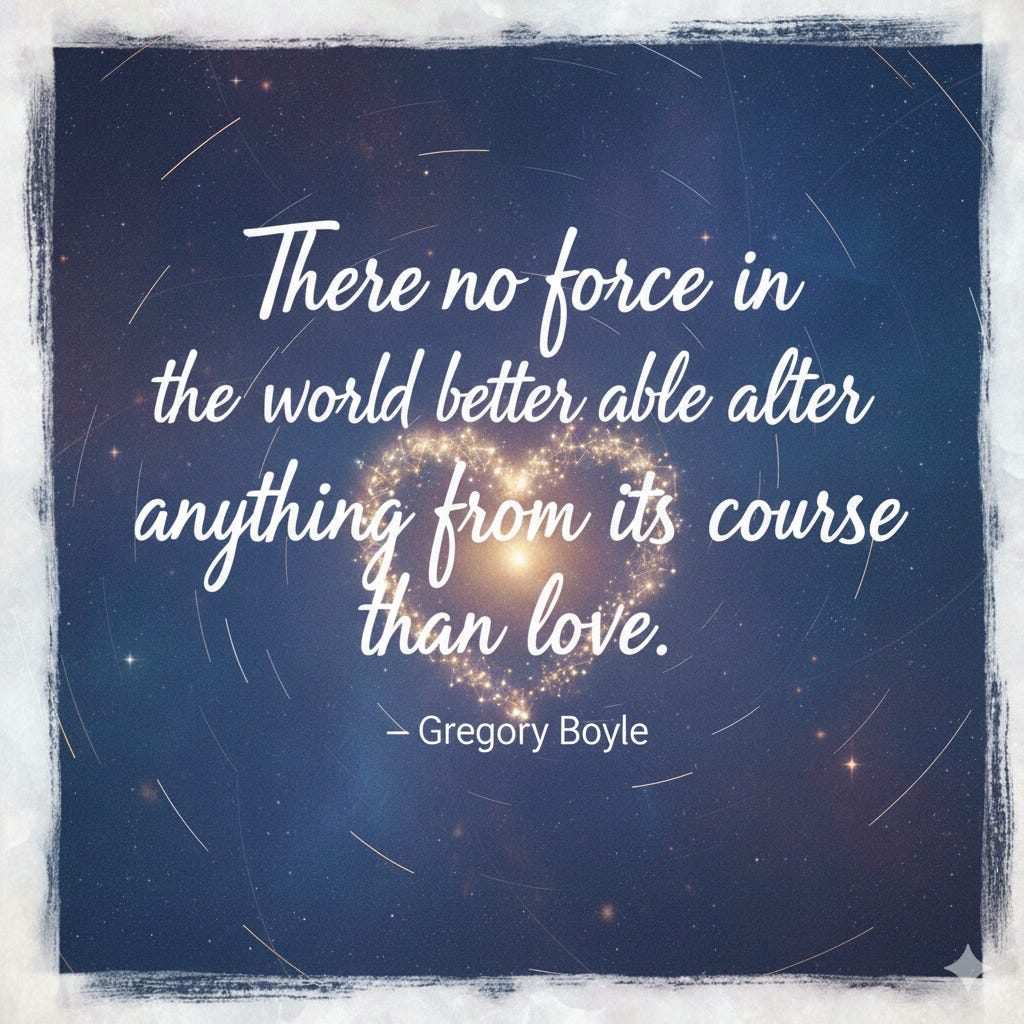
Father Gregory Boyle is the Jesuit priest who founded Homeboy Industries—the world's largest gang intervention and rehabilitation program—and whose tender, heartbreaking memoir Tattoos on the Heart distills the wisdom gained from walking with "homies" through transformation and tragedy, including presiding over the funerals of more than 250 young people he loved.
Weekly Market Update
Markets were mixed, but mostly down this past week. Let’s see what Santa brings us next week:
+ 0.10% .SPX (500 U.S. large companies)
- 0.90% IWD (U.S. large value companies)
- 1.21% IWM (U.S. small companies)
- 1.59% IWN (U.S. small value companies)
- 1.39% EFV (International value companies)
- 1.31% SCZ (International small companies)
+ 0.00% VGIT (U.S. intermediate-term Treasury bonds
Financial Stress Is Falling and Markets Are Listening
Contributed by Tony Welch, CFA®, CFP®, CMT, Chief Investment Officer, SignatureFD
One of the cleanest ways to understand the current market environment is to step away from rate headlines and look at financial stress itself.
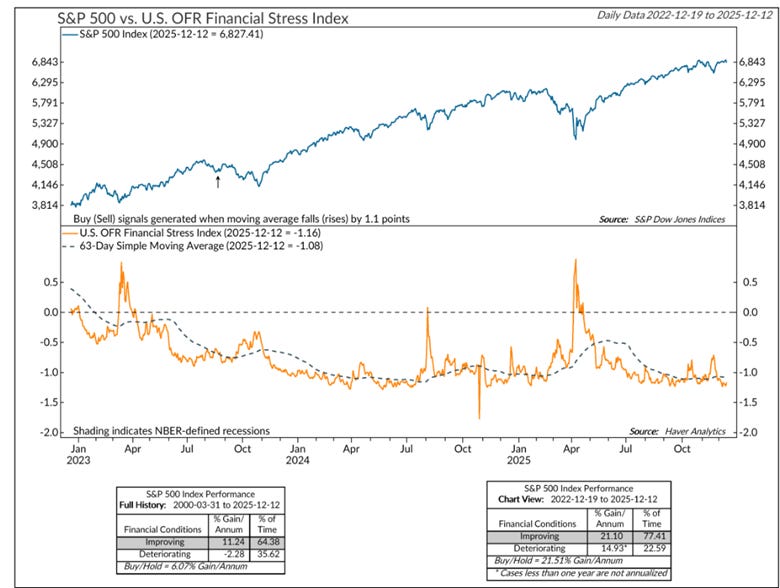
The chart below plots the S&P 500 against the U.S. Office of Financial Research (OFR) Financial Stress Index, and the relationship is hard to ignore. As financial stress has trended lower, remaining firmly in negative territory, the equity market has continued to grind higher. This matters because markets don’t end bull runs when stress is low. They end when liquidity tightens, credit spreads widen, and borrowing costs rise. None of those conditions are present today.
According to the data embedded in the chart, periods of improving financial conditions have historically delivered substantially stronger equity returns than periods of deterioration. Since late 2022, the S&P 500 has spent the majority of its time in the “improving conditions” regime, which aligns with the steady advance in prices shown in the top panel.
This dovetails neatly with what the Fed has been signaling. Rate cuts after long pauses have historically been equity-positive, and the Fed has now cut rates six times in this cycle. Just as important, policymakers have been explicit that rate hikes are not anyone’s base case, removing a key historical trigger for bear markets. Meanwhile, the Fed’s Treasury bill purchases are quietly supporting liquidity, helping keep financial stress contained rather than allowing it to build beneath the surface.
While the Fed may pause in early 2026, policymakers remain sensitive to labor-market weakness and confident that inflation pressures are easing. Markets reacted not because of the rate cut itself, but because the policy backdrop remains flexible and supportive rather than restrictive.
Put simply, the chart shows what headlines often obscure: financial conditions are doing the heavy lifting. This also helps explain recent market behavior. Leadership is broadening, small- and mid-cap stocks are participating, and credit markets remain calm. That combination is consistent with a market energized by improving liquidity, not one running on speculative excess.
The takeaway from this chart is straightforward. With financial stress low and trending favorably, the bar for a sustained equity downturn remains high. Volatility will happen, corrections will occur, but history suggests that bear markets are born from tightening conditions, not easing ones. For now, the data says stress is falling, not rising and markets are responding accordingly.
Chart O’ The Week
The Message from Our Indicators
The latest economic data paints a picture of gradual cooling in key areas of the labor market without outright deterioration, consistent with a neutral monetary backdrop. The U.S. unemployment rate ticked up to 4.6% in November, the highest level since 2021, as the labor market lost jobs in October and added a modest 64,000 in November, highlighting slowing momentum in employment gains. Initial jobless claims declined modestly but remain historically moderate, suggesting layoffs have not surged even as hiring softens. Wage growth has slowed, reflecting a cooler labor market that may be more balanced than earlier in the year.
On the price front, inflation trends continue to show disinflationary progress, with the Consumer Price Index rising 2.7% year-over-year in November and core inflation easing, surprising some expectations. However, economists caution that this release may be distorted by the prior prolonged government shutdown, and critical components, like shelter costs, could be understated. Small business sentiment edged higher in November, with the NFIB Small Business Optimism Index rising modestly, though concerns about labor quality and uncertainty in capital plans persist.
Financial markets have responded positively to the inflation data, with major equity indices advancing after softer-than-expected CPI figures, reinforcing market views that the Fed may remain accommodative if inflation continues to ease. Technology and growth-oriented sectors have shown resilience, supported by strong earnings from pockets of innovation and artificial intelligence–related firms, which have helped sustain the broader uptrend.
Recent miscellaneous indicators offer supportive context: builder sentiment in housing ticked up to an eight-month high, even though it remains below neutral, suggesting housing activity may be stabilizing alongside lower mortgage rates; and broader forecasts point to modestly higher GDP growth expectations in 2026 relative to prior projections.
In all, the message from our indicators remains constructive, with a neutral monetary outlook, gradual moderation in inflation, and a bullish trend in markets. These signals are consistent with continued expansion into 2026, though labor market softness and data distortions from earlier disruptions warrant careful monitoring.
WISHING YOU THE HAPPIEST OF HOLIDAYS!
Tim