

A friend recently gave me one of my favorite gifts that didn’t even cost her a cent—a book recommendation. Rabbi Abraham Joshua Heschel’s The Sabbath is barely more than 100 pages, but, boy, does it pack a punch.
Like all the best authors and speakers, he takes his deep area of expertise—in this case, Jewish theology—and finds a way to make me feel like I’m sitting across the table from a sage who knows me and my own faith tradition, which is different from his.
While there’s much in The Sabbath to apply in our lives, personally and spiritually, it amazes me how much of it is instructive for our financial life planning and how we allocate our most precious resources, both tangible and intangible.
It’s a short, but I hope powerful, Financial LIFE Planning post this week, and we left plenty of room for our resident Chief Investment Officer, Tony Welch, to update us on a crazy—yes, even crazier than usual—week in the markets, where Big Tech led the markets off of a, well, cliff.
Thanks for joining us!
Tim
Tim Maurer, CFP®, RLP®
Partner
In this Net Worthwhile® Weekly you'll find:
Financial LIFE Planning:
A Pre-Holiday Reminder From An Ecumenical Rabbi
Quote O' The Week:
Frederick Buechner
Weekly Market Update
When Will Anthropic Reach the Indexes?
Financial LIFE Planning
A Pre-Holiday Reminder From An Ecumenical Rabbi
Abraham Joshua Heschel on Why Moments Matter More Than Things
In many ways, it seems Heschel, who first published The Sabbath in 1951, is trying to free us from the laborious toil related to the acquisition of the tangible—our things and stuff in all of their forms—in pursuit of the joy and peace to be found in the gift of luxurious time.

Indeed, speaking with a soft but authoritative voice, he reminds us of a truth that we seem to know as children but forget as responsible adults:
There is a realm of time where the goal is not to have but to be, not to own but to give, not to control but to share, not to subdue but to be in accord.
And this admonishment is on page one of the prologue, for goodness’ sake! He suggests further:
We have often suffered from degradation by poverty, now we are threatened with degradation through power. There is happiness in the love of labor, there is misery in the love of gain. Many hearts and pitchers are broken at the fountain of profit. Selling himself into slavery to things, man becomes a utensil that is broken at the fountain.
Shoot, I don’t want to be a utensil!
But the Heschel quote that inspired this post is the one I believe we—certainly I—need to be reminded of on this final Sunday before Thanksgiving and the hectic holiday whirlwind on its heels:
We must not forget that it is not a thing that lends significance to a moment; it is the moment that lends significance to things.
Isn’t that beautiful?
Note that this is not a prophetic railing against the things that inevitably populate our days and holidays. It’s not a repudiation of work (quite the opposite, really). Nor is it a judgment against profit or gain.
It’s the love of these that Heschel warns us against, and not as a finger-waving theologian, but as a shepherd who knows his flock will live a fuller, deeper, richer, and more meaningful life if they properly order their loves. If we strip our stuff of all significance other than the elevation of the moments we spend.
We’ve all got a slew of those moments to come this holiday season. May we let the moments lend significance to the things, and not the other way around.
Quote O' The Week
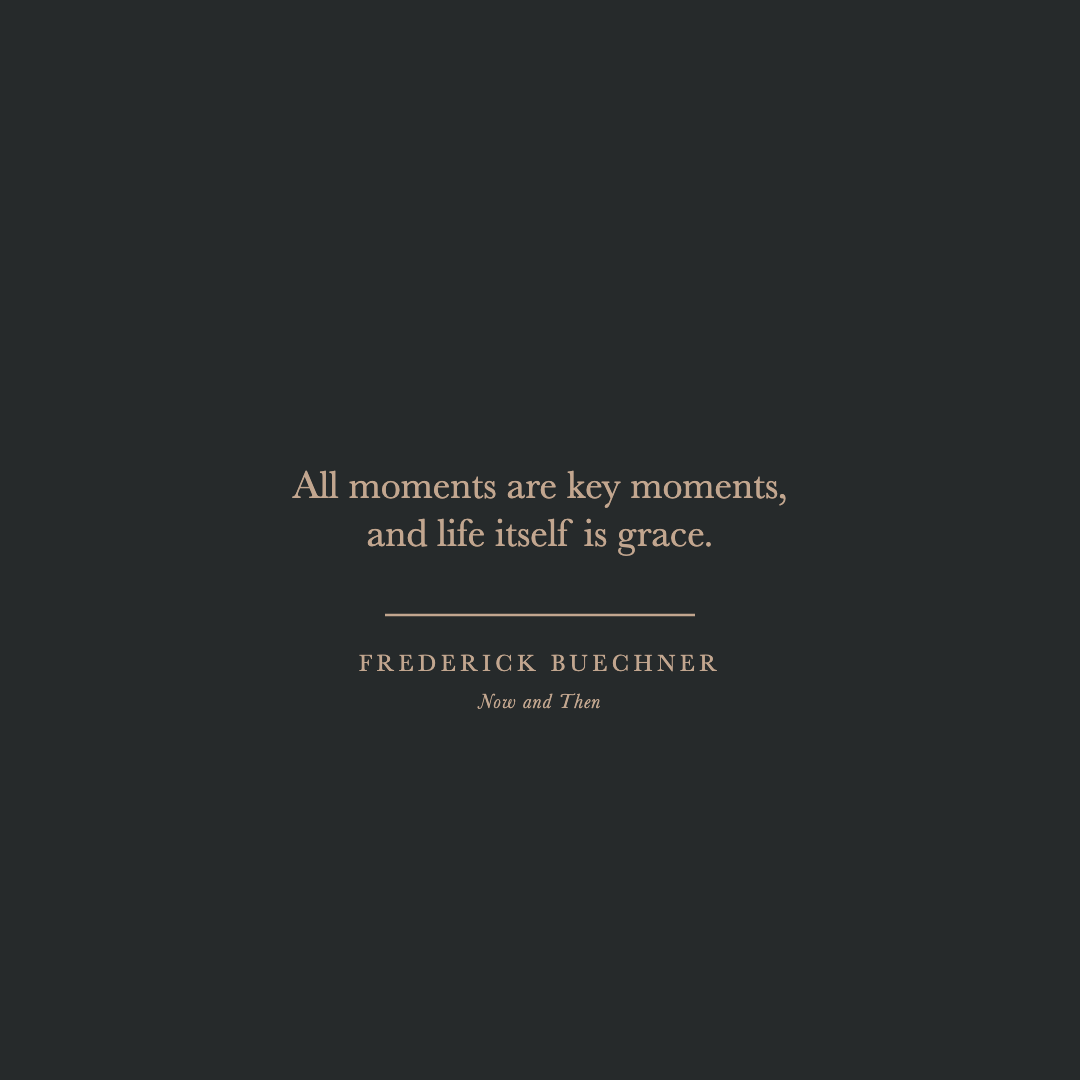
Frederick Buechner (1926–2022) was born in New York City and died at the age of 96 in his Rupert, Vermont, home. While he didn’t write about it directly for decades, Buechner’s father took his life when Frederick was only 10—a theme that shows up in much of his work, including Now and Then, where this week’s quote comes from.
He was already a successful young novelist in the mid ‘50s when he heard a sermon from George Buttrick at Madison Avenue Presbyterian Church that changed the course of his life forever. He was ultimately ordained a minister, himself, in 1958 before building the religion department at Phillips Exeter Academy, where he taught for nine years.
He wrote 38 books in total and his novel, Godric, was a Pulitzer finalist. And while the quote below is more pertinent to this week’s post, my favorite of Buechner’s quotes is this one about vocation from Wishful Thinking: “[T]he place God calls you to is the place where your deep gladness and the world's deep hunger meet.”
So what’s your “deep gladness”?
Weekly Market Update
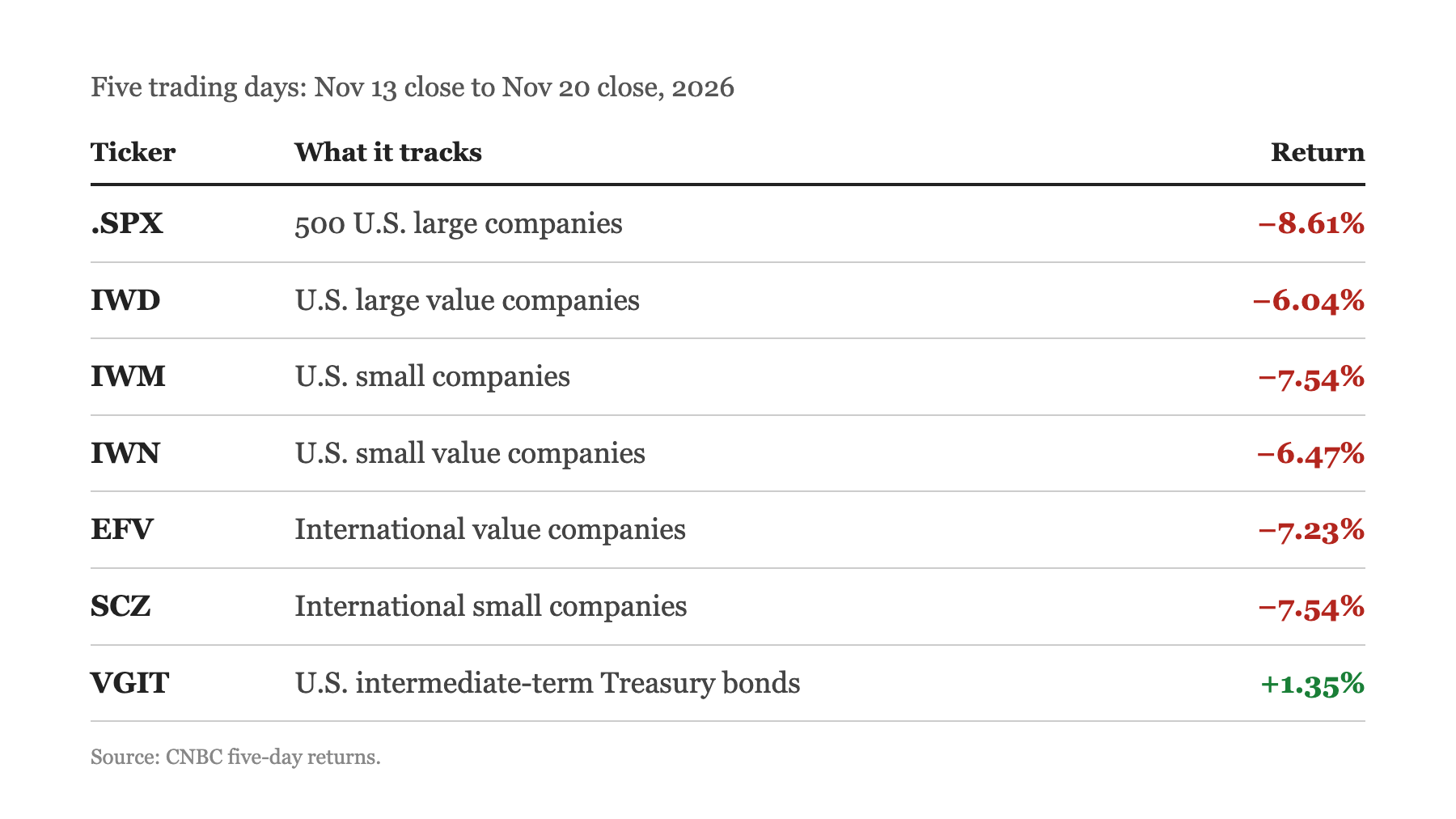
As big as last week was UP, this week was DOWN far more:
When Will Anthropic Reach the Indexes?
Contributed by Tony Welch, CFA®, CFP®, Chief Investment Officer, SignatureFD
Anthropic, the company behind the Claude artificial intelligence platform, IPO’d on Thursday. The company priced at $83 per share, raising about $81 billion at a valuation of about $1.5 trillion- very impressive numbers. Anthropic is now one of the largest companies in the world, so it would make sense to expect the stock to be a big driver of the indexes. However, index inclusion rules differ by provider, but they generally focus on free float (the shares available for public trading) in determining the percentage allocation to a company. So, at $81 billion, Anthropic’s impact is far less than the full $1.5 trillion valuation.
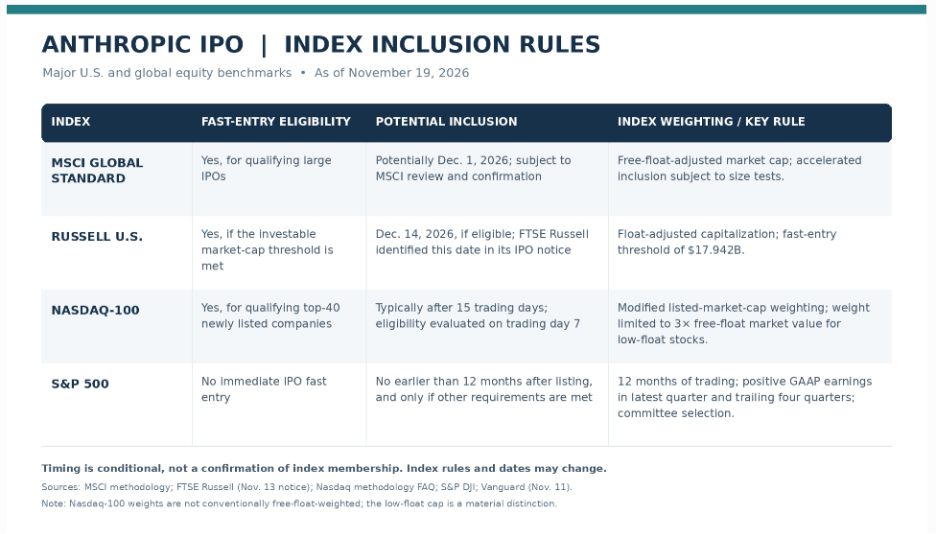
What about when Anthropic will be included in the indexes? That also differs by providers, with some now allowing fast entry into their index. The table below was fittingly created by Claude. It breaks down the inclusion rules for four of the biggest index providers. Note that MSCI, Russell, and Nasdaq have fast-entry inclusion rules. Standard & Poor’s does not. Additionally, S&P puts a positive earnings screen on its companies for inclusion.
Once upon a time, companies would IPO at smaller market caps and grow through the public markets. Nowadays, it has become common for companies to stay private for longer, growing to a large or even mega-cap stock before the IPO. Because of that dynamic, index inclusion rules are more important to pay attention to. ETFs that track these indexes can differ in their performance given their differences in IPO methodology, so it’s important for investors to understand the inclusion rules.
Chart O’ The Week
Volatility has picked up in spades as the market tries to weigh several major developments over the past few weeks. And of course, when we say “volatility,” we all know that’s just code for a “correction.” The sweeping election results put Democrats in charge, not just of Congress, but many new state legislatures as well. That result has injected uncertainty into the AI buildout, as many of those candidates included some form of hostility toward data centers in their respective messages. And the scandal surrounding Jensen Huang has put immense pressure on one of the world’s largest companies and AI beneficiaries, Nvidia.
Trying to put this correction in context, as of this writing, the S&P 500 has corrected about -8%. The market averages a little more than three -5% corrections in any given year. And it averages a little over one -10% correction each year. Pullbacks like this are quite normal, but they feel like the end of the world in real time, every time. So we find it valuable to lean on our objective indicators when the going gets tough. On that score, there has been some deterioration worth watching but not enough, in our view, to change our long-standing bullish message.
Perhaps the most impactful development worth watching is inflation. Consumer inflation is still running too hot for the Fed’s taste, so we believe more rate hikes remain likely. And producer inflation has shown a notable acceleration, which has historically been a headwind for stock prices. But we see a possible path for softening inflation pressure in 2027. The extent to which the Fed needs to tighten may influence returns in the year ahead.
Historically, stocks have continued to perform well when the Fed has delivered a muted hiking cycle. However, faster, more aggressive cycles have tended to be met with corrective market activity. That could be particularly true next year as much of this year’s economic growth has come from corporate investment. Thus far, higher rates have not squashed AI buildout demand, but an investment slowdown is a risk.
One of the biggest market tailwinds right now is corporate earnings. The Q3 season is nearly wrapped up. Of the companies that have reported, growth has been 33%. The very strong earnings growth has allowed stocks to have a positive (so far) year while still seeing narrowing valuations. A lower starting valuation has historically meant a stronger forward return, so that may be good news for investors. But that doesn’t mean those returns will come in a straight line.
Regardless, we would end this week reminding investors that corrections never feel normal, but they really are. All bear markets have started with a -10% correction, but historically most of them have gone on to reconcile higher. Corporate fundamentals remain strong, but inflation and interest rates are important variables to watch in the year ahead.
Just because the markets took their lumps this week doesn’t mean your weekend needs to be tarnished!
Tim
Glad to see you were moved. I've continued to grapple with what the finite offers the infinite. “Eternity utters a day.”