


I spent most of this week in the mountains of Utah, gathered with a group of financial advisors wrestling with a theme that feels especially relevant right now: How do you make plans in the face of irreducible uncertainty? It’s a good question, and we’ll have more on that in a future edition.
In the meantime, St. Patrick’s Day arrives Tuesday, so I decided to have some fun and create a video reprise of a recent post rooted in Celtic mythology and wisdom from poet David Whyte and Friar Richard Rohr. It’s about fight, flight, and a third way most of us haven’t considered, especially when money is involved. Worth a watch, even if you caught the written article the first time around.
And on the investment side, our resident market commentator Tony Welch is making the case for energy as a defensive sector in this Weekly Market Update. It’s a counterintuitive angle that’s worth your attention, particularly in a moment when “defensive” needs some rethinking.
Glad to be home. Let’s get into it.
Tim
Tim Maurer, CFP®, RLP®
Chief Advisory Officer
In this Net Worthwhile® Weekly you'll find:
Financial LIFE Planning:
An Irish Tribute
Quote O' The Week:
W. B. Yeats
Weekly Market Update:
Disinflation Trend Is Something To Watch
Financial LIFE Planning
An Irish Tribute
With St. Patrick’s Day nearly upon us, it felt right to revisit this piece — rooted in Celtic myth, David Whyte, and a question worth sitting with: When conflict arises, is fighting (or fleeing) really our only options?
In this short video, I address:
The legend of the Tuatha De Danann, the ancient pre-Celtic tribe who, when the invaders came, simply turned sideways into the light
Why money so often becomes the great divider — in marriages, families, and institutions
Three responses to conflict: fight, flee, and a third way most of us haven’t practiced
A real-world example of what “turning sideways” can look like at home
References:
David Whyte, What To Remember When Waking (audio series)
Richard Rohr on the danger of duality and the creative tension of the third way
A question to sit with:
Is there a conflict in your life right now, financial or otherwise, where you could turn sideways into the light instead of fighting or fleeing?
And if you’d prefer the written version of this video post, please click HERE.
Quote O' The Week
Nobel Prize-winning Irish poet W.B. Yeats spent his life insisting that imagination, not force, was humanity's most revolutionary act.

Weekly Market Update
While not as dramatic a down week as the previous, we’re still in the red across the investing spectrum again this week:
- 1.60% .SPX (500 U.S. large companies)
- 1.37% IWD (U.S. large value companies)
- 1.71% IWM (U.S. small companies)
- 1.97% IWN (U.S. small value companies)
- 2.01% EFV (International value companies)
- 3.75% SCZ (International small companies)
- 0.63% VGIT (U.S. intermediate-term Treasury bonds
Energy As A Defensive Sector?
Contributed by Tony Welch, CFA®, CFP®, CMT, Chief Investment Officer, SignatureFD
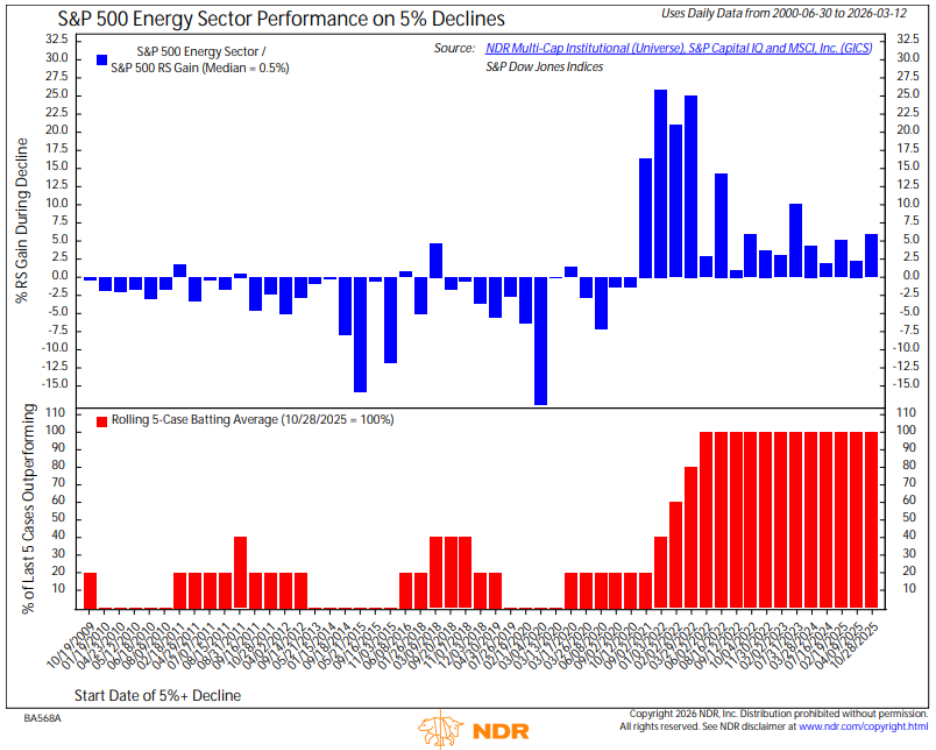
Pre-COVID, the economy’s biggest problem was sluggish growth, not inflation. Therefore, the Energy sector was an aggressive exposure, often underperforming during broad market corrections. But that environment changed drastically with the pandemic, its supply-chain issues, and the large infusions of consumer stimulus. Since 2020, the economic battle hasn’t been sluggish growth; rather, it has shifted to inflation.
As the chart below shows, when the S&P 500 has been in a correction since the pandemic, Energy has been an outperformer. This underscores the shift from growth concerns to inflation concerns as a correction catalyst. The Iranian conflict is further emphasizing the negative role that inflation can have on markets. The chart also should serve as a reminder that market relationships are dynamic. An investor pre-2020 may never have guessed that Energy would be a consistent outperformer when the market is weak, but times can and do change.
Chart O’ The Week
The Message from Our Indicators
As with the above, much of our communication over the past two weeks has revolved around Iran and its impact on inflation. But it’s important to note that the global economy did come into the conflict in a relatively solid position. Our friends at Ned Davis Research track global recession probability based on a robust composite of leading economic indicators, and that metric recently dropped below 13%, implying that global recession was not a high risk heading into the conflict. However, U.S.-specific data came in on the weak side last week. The first revision to Q4 GDP showed that growth was slower than initially reported, clocking in at a sluggish 0.7% annual rate. Capital goods orders were weak in January, also raising somewhat of a concern. But weak growth should not be confused with recession. There remains potential stimulus in the pipeline in the form of increased tax refunds. We will continue to monitor inflation trends as one of the bigger risks to consumer spending and, by extension, to economic growth in 2026.
Softer growth and higher inflation are threats to corporate fundamentals as the year progresses. Analysts expect earnings to come in at nearly 16% growth in 2026 on sales growth of about 7%. There are risks to the topline from softening economic growth and risks to the bottom line from margin compression should input costs exceed expectations. On average, analyst estimates are overoptimistic by about 8%, so we can already likely handicap their mid double-digit expectation as a more likely high single-digit earnings growth. The reason that is important is because we do not believe that there is much room for valuations to get more expensive, implying that the market is likely to only gain as much as earnings grow. For now, fundamentals are positive, but we need to watch how the economic data continues to unfold.
Finally, from a trend perspective, the long-term uptrend that began in 2022 remains intact, though there has been some weakening over the past two weeks. We’re particularly keyed in on market participation. We want to see a high percentage of stocks, sectors, and global markets participating in a market advance, and those metrics have clearly weakened. We’re cognizant that midterm years have tended to see deeper corrections, and therefore, volatility has been a part of those years. That doesn’t mean we should be bearish, but taking a balanced and diversified approach in 2026 makes sense.
Have a great weekend and Happy St. Paddy’s Day!
Tim