

We’ve all got “our thing,” right? That thing that holds us back. The issue that feels like a battle and threatens our ability to reach our full potential or to be the best version of ourselves.
It could be a physical characteristic, a personality trait, a medical condition, a relational issue, a family wound, a life-changing experience.
For me, it’s migraine headaches. Chronic migraines. More than 25 years of treatment, several different neurologists, more medications than I could recall, an imaginative array of alternative therapies and providers. And the situation is little improved since my first diagnosis—in the 1990s.
It’s enough to make one a pessimist. But that, it turns out, is where our agency has an opportunity to stand up and stiffen its back. So, in this week’s Financial LIFE Planning post, we’ll synthesize the insight gained from three different studies (in plain English) and see how to apply them in our own life, work, and money.
Thanks for joining us this week!
Tim
Tim Maurer, CFP®, RLP®
Partner
In this Net Worthwhile® Weekly you'll find:
Financial LIFE Planning:
Are You A Contaminator Or A Redeemer?
Quote O' The Week:
Viktor Frankl
Weekly Market Update
Stocks Now Make Up Nearly Half of Household Financial Assets
Financial LIFE Planning
Are You A Contaminator Or A Redeemer?
We don’t choose our worst experiences, but we may get to choose how the story ends.
Redemption Vs. Contamination
Dan McAdams and friends, in their “When Bad Things Turn Good and Good Things Turn Bad” study, found that there are two types of stories, or scenes, life tends to tell, and one that goes with higher well-being.
Redemption scenes are those where something emotionally negative turns positive, while contamination scenes are those where something positive turns negative. And you likely won’t be surprised that those who told more redemption stories about their lives reported higher well-being.
But while that recognizes the correlation, it speaks less to causation. So, the real question, then, I suppose, is can we become better at living out redemptive stories rather than contaminated stories?

How Can We Influence The Story?
Another study, this one from Jennifer Pals, gives us insight into that. A group of women was followed for decades and they observed how they responded to life’s biggest challenges. The ones who fared the best made two moves:
They experienced the experience. They faced it, felt it, and processed it.
They reached a “coherent positive resolution.” They found a meaning in the experience.
Doing both was predictive of personal growth, maturity, life satisfaction, and even physical health.
Jonathan Adler found further that when people’s stories grew in agency—a sense that “I can do this”—their mental health improved afterward. The story changed before the actual improvement was realized.
And McAdams, too, found that those who were “generative”—what a fun word—those who dedicated themselves to investing in the next generation, were more likely to tell redemption stories.
But let’s leave the realm of research and theory for a moment and consider something more practical in our own lives.
Your Worst Financial Experience
What’s your worst financial experience? I bet it doesn’t take long to remember, does it?
Maybe it was an Enron-like experience, where you over-concentrated in a single investment or sector that got crushed. Maybe it was a real estate purchase that required a short sale or even bankruptcy in the midst of the financial crisis. Maybe it was a job lost, a marriage ended, the loss of a loved one who provided financial support. A child whose medical care overwhelmed your finances.
And because the experiences that we have earlier in life tend to be even more formative, it’s entirely possible that your worst financial experience was actually an indirect experience, due to your parents’ money misfortune. For example,my good friend struggles to spend on anything lavish, although her financial situation is very stable, because her family was devastated financially when she was coming of age.
OK, so you’ve got your experience in mind? Now, what is the story you’ve told yourself? Is it a redemption story, or is it a memory that is still contaminated, not fully processed into the longer, hopefully positive arc of your coherent narrative?
Does that story require any rewriting?
Are You A Redeemer Or A Contaminator?
My amazing wife encourages me not to say, “I have a chronic migraine condition,” because it’s taking ownership of a problem that we hope—we believe—we know—will one day be resolved. Perhaps this is a slight shift that would benefit you in dealing with “your thing,” or any number of things that we’ll navigate during the course of our lives.
Yet while we don’t want to take undue ownership of our worst experiences, I do believe we can choose whether we’re going to personify a spirit of contamination or redemption. And while it’s not my attempt to sell you a cheap pair of rose-colored glasses, it is from a place of hard-earned real-life experience—and my thing still unresolved—that I encourage you to step into the role of the redeemer.
On the one hand, why not? Between the two, why not choose redemption over contamination? And on the other hand, it seems that there’s some evidence that choosing a redemption story is more likely to result in actually experiencing one.
Quote O' The Week
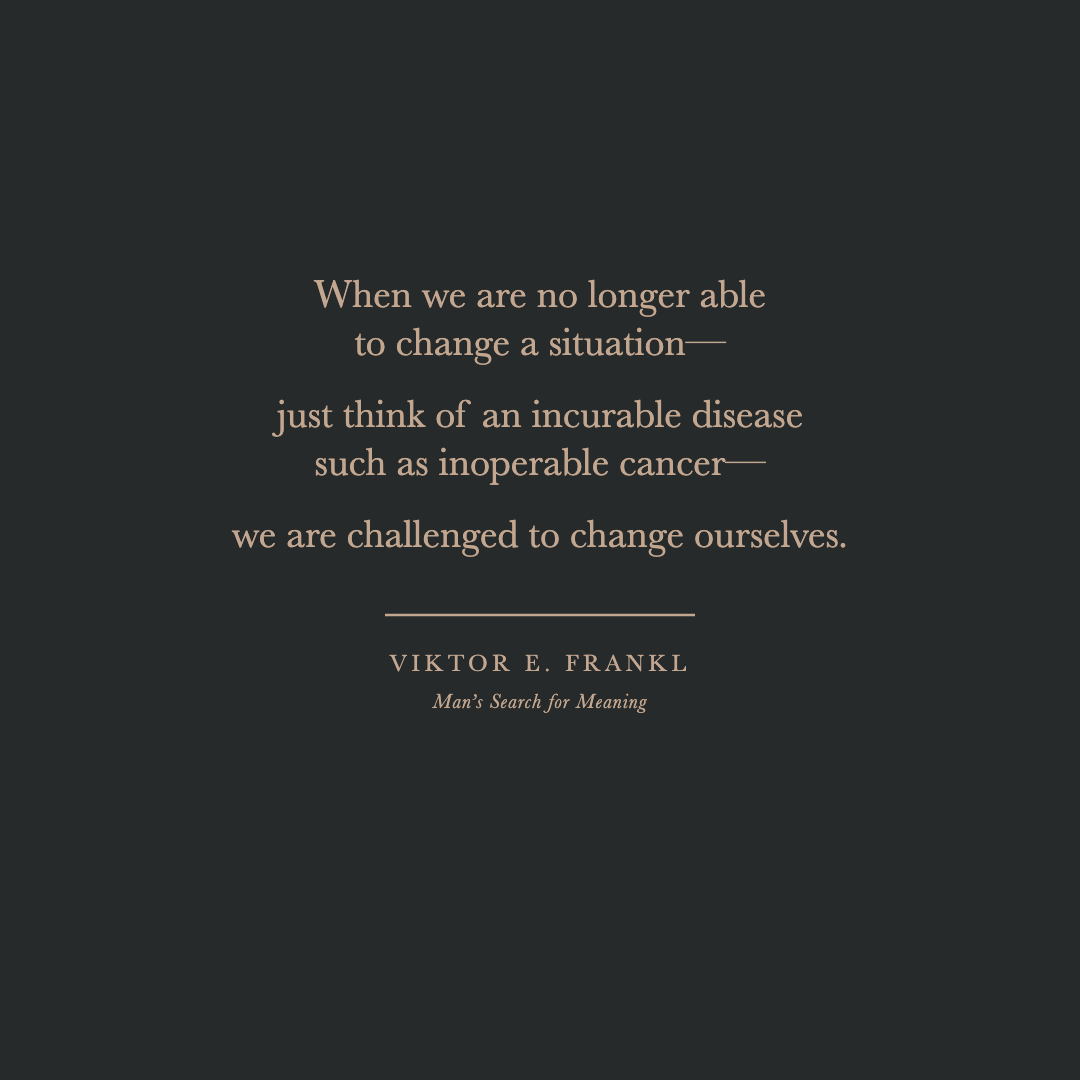
Viktor Frankl (1905-1997) gets a good bit of airtime in this newsletter, and it’s for good reason. He’s the Austrian psychiatrist and neurologist who was born and died in Vienna—but he survived four Nazi concentration camps, including Auschwitz.
Despite losing his wife, his mother, his father, and his brother to the camps, he wrote Man’s Search For Meaning, a potent articulation of the psychotherapy school that he founded, logotherapy. Its central thesis, in a break from Freud, suggests that meaning is the greatest motivational force for humans.
And in case you’re aging and looking for a touch of inspiration to stay active, Frankl earned a pilot’s license at age 67 and continued rock climbing into his 80s.
Weekly Market Update
Large domestic companies were the only market segment we track that was demonstrably up this week, and almost entirely thanks to Friday’s rally:
+ 1.21% .SPX (500 U.S. large companies)
+ 0.09% IWD (U.S. large value companies)
- 0.75% IWM (U.S. small companies)
- 0.97% IWN (U.S. small value companies)
+ 0.05% EFV (International value companies)
+ 0.26% SCZ (International small companies)
- 0.49% VGIT (U.S. intermediate-term Treasury bonds
Don’t Blame Inflation
Contributed by Tony Welch, CFA®, CFP®, Chief Investment Officer, SignatureFD
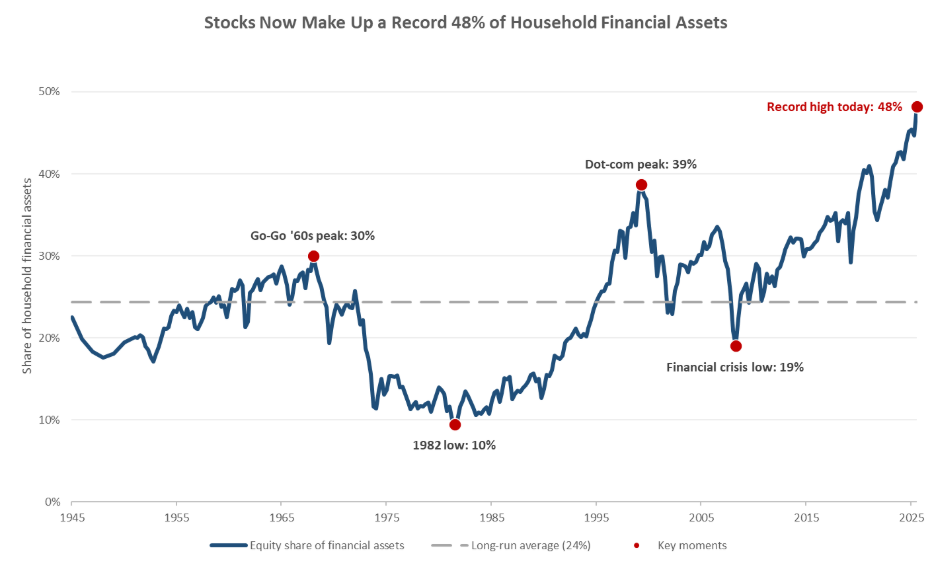
A generation ago, most Americans’ retirement savings weren’t in their own hands. In the decades after World War II, many workers relied on company pensions for retirement, and the investment decisions were made on their behalf. Today, stocks make up 48% of U.S. household financial assets, the highest share on record. Part of that reflects strong markets, but a big part of the story is who owns stocks and how.
The shift started with the creation of the 401(k) in 1978, which gradually moved retirement savings away from traditional pension plans and into accounts that individuals owned and managed themselves. Advancements over the years such as automatic enrollment, low-cost index funds, and commission-free trading have made investing even more accessible. Today, about 58% of American families own stocks either directly or through funds and retirement accounts. The rising line in the chart below isn’t just strong market returns; it’s a story about millions of Americans becoming owners in the economy.
Chart O’ The Week
Last week was a difficult one for stocks. A combination of rising interest rates and higher oil prices continued to weigh on stocks, with selling spread broadly across the market and most stocks now trading below their short-term averages. However, the market is healthier than it initially appears. The S&P 500 remains close to its highs and up double digits for the year. Most stocks are in a long-term uptrend and the economy just posted its strongest business activity reading since 2021. It’s not uncommon to see short-term weakness in the midst of a longer-term uptrend. This is a normal part of markets and our indicators continue to point to a backdrop that is more supportive than headlines may suggest.
The macro and monetary backdrop continues to be the area that is pressuring markets the most. Earlier this month, the Fed raised interest rates for the first time since 2023, and the bond market is pricing in the possibility of one or two more hikes this year and three to four over the next 12 months. However, there is a reasonable case for fewer rate hikes than what the market is currently suggesting. Energy appears to be the main driver this time, rather than excess demand. This is supported by August headline CPI, which came in at 3.4% year over year. Core CPI, which excludes energy and food, was much lower at 2.4%. Rate hikes on their own typically have not been what hurts markets. History suggests that weakness tends to appear when the Fed overdoes it, and credit conditions are usually the first signal to fire. Right now, credit conditions remain healthy. Investment-grade bond spreads across most of the corporate bond market remain tight and have experienced little change this year, suggesting healthy conditions despite the rise in rates.
The market trend has slowed in recent weeks but remains largely intact. Usually, market participation begins to fade well before markets reach their peaks. At the March 2000 top, only about 27% of stocks were still in an uptrend. Today, about 65% of S&P 500 stocks remain in a long-term uptrend. Despite the recent volatility in U.S. equity markets, the S&P 500, at the time of this writing, is up about 12.6% year to date. The strength isn’t just a U.S. story. 20 of the 24 major stock markets globally remain in an uptrend, with about half reaching new highs since August. The four major markets in a downtrend are China, Hong Kong, India and Mexico.
Fundamentals have been the engine of the bull market, and that hasn’t changed. Business activity accelerated in September to its strongest pace since July 2021. Composite PMI rose to 58.4, its fourth straight monthly gain. Manufacturing PMI and Services PMI reached their highest levels since May 2022 and October 2021, respectively. Domestic demand for products and services remains the catalyst, with new orders growing at the fastest rate since spring 2022. Corporate balance sheets remain in excellent health. Companies are currently earning about 17 times what they owe in interest, more than double the historical norm and the strongest in more than 60 years. This provides a cushion for higher borrowing costs, which usually take a year or more to show up on balance sheets. One word of caution is that rising yields make bonds more attractive to investors, which in turn raises the bar for investors to buy stocks and makes them look more expensive. Should we see a deterioration in fundamentals, higher bond yields make “flight to safety” assets more attractive. The market could be susceptible to this given how heavily positioned investors are in equities today. However, we believe recession risk remains very low and market fundamentals remain very healthy.
Weeks like this can be uncomfortable, especially with interest rates climbing and the Fed dominating headlines, but the weight of the evidence remains constructive for markets. The economy continues to grow at its fastest pace in years, corporate balance sheets are well positioned, credit markets look healthy, and most stocks remain in a long-term uptrend. Higher rates remain a key area to watch moving forward, and we expect credit markets will be the early alarm bell if Fed tightening begins to take its toll on the economy. For now, we believe the underlying strength of the economy and markets continues to outweigh the pressure from higher rates.
Have a great rest of your weekend!
Tim