


“Many people who are exceptionally good at building companies, careers, or wealth find it difficult to enjoy simple pleasures,” writes the behavioral scientist and Harvard Professor who specializes in human happiness.
But why? “Not because they lack the capacity for joy, but because their reward system has been trained to overlook it.”
How is that possible?
As winter weather bears down on the better part of the U.S. this weekend, I hope your family stays warm, dry, and safe—and you enjoy a little extra reading time. Thanks for including us in that!
This week, I’ll examine how overachievement has an ironic downside, and how to stay on the upside, while Tony addresses the impact of geopolitical headlines and U.S. dollar weakness on the markets.
Tim
Tim Maurer, CFP®, RLP®
Chief Advisory Officer
In this Net Worthwhile® Weekly you'll find:
Financial LIFE Planning:
Are You A Financial Overachiever?
Quote O' The Week:
Henry David Thoreau
Weekly Market Update:
Global Capital Still Favors the U.S.
Financial LIFE Planning
Are You A Financial Overachiever?
So, why is it that high achievers often find it difficult to enjoy life’s simple pleasures?
Let’s call it the satisfaction trap.
The Satisfaction Trap
“High achievers tend to be very good at satisfaction,” which Dr. Brooks describes as “the joy that comes from achievement after struggle.”
High achievers, it seems, can lose focus on the meaning and purpose that underlie a goal, as they become more driven by the accomplishment of the goal itself.
This exploration really comes to light when we think about it from the financial perspective. For example, there are many who are gifted accumulators of money, but who struggle to spend it in a way that truly enriches their lives.
Presumably, when they started accumulating, there was a purpose behind it. To save up to purchase their first car, a down payment on their first home, to fund a college education for their children, and eventually to replace their income when they’re no longer able to work.
But that number. The net worth number and the account value numbers. At some point, they become the thing, rather than the purpose that inspired the original effort.
And to Brooks’ point, the same thing happens with our careers—when it becomes more about the title than the work that inspired us in the first place. Or that business—when it becomes more about the valuation or the exit than the original mission that impelled the enterprise to its success.

The GPGL Imbalance
You’ve heard me say before that our wealth is more than just our money—it’s also our time, influence, energy, and relationships. And you’ve also heard me say that there are only four ways that we can use our wealth. We use it to Live today, to Grow for tomorrow, to Protect against that which puts our people and property at risk, and to Give to the people and causes that matter to us.
But which “bucket” gets the most attention in wealth management, and which gets the least, IMHO?
I’d argue that Grow gets the gold (the Olympics start in 2 weeks!). The private and public markets have been sliced and diced and leveraged and optioned and shorted and packaged and repackaged, and no doubt will continue to be, as this area seems to be where the financial services industry tends to make the most money.
Protect takes the silver, and again, we likely shouldn’t be surprised, as protection—especially through insurance and insurance-based products—is another big money maker.
Give takes the bronze, but for a reason you likely don’t think. Sure, the non-profit space is a pretty big player, but for most of us, it is our compulsory giving through taxation that represents the majority of our giving. It’s why my friend and colleague, Doug Liptak, insists that many investors over-optimize the minutia of their portfolio in an effort to squeak out more basis points, while a substantial percentage of our wealth is consumed by taxation. Give is also the home to our education and estate planning, two major pillars of any parent’s planning.
Notably off the podium, therefore, is the Live bucket—the bucket that I would argue all the others are in service of!
Please don’t misread me; I’m not suggesting that the financial services industry is conspiratorial for dedicating its efforts in the most profitable pillars of our wealth management. In fact, we all benefit from an ever-evolving slate of products that help us better Grow and Protect our assets.
But these products, by Arthur Brooks’ logic, are also those that are most inclined to generate momentary (and occasionally addictive) satisfaction rather than lasting joy. They’re more transactional, countable, and especially in the Grow domain, they may do as much for our ego as they do our balance sheet.
Therefore, I hope you—and your financial advisor—are spending the invaluable time to focus on the lesser attended buckets, because these are the buckets that literally fund our lives and our legacies.
The Way Out
It’s easy to get into the satisfaction box. Especially when you’re good at meeting or exceeding goals at work, you’ll likely be rewarded for hitting the number, regardless of the purpose that underlies it. It’s easy to accept applause for successful exits and the numerical headline splashes that seem to attribute virtue to mere valuation. And it’s easy to marinate in the false safety of net worth statements that, aside from their intentional activation, are worth little more than the paper on which they are printed.
You see: There’s nothing inherently good about achievement for achievement’s sake or riches for riches’ sake.
We don’t celebrate the top-selling drug dealers or give Pulitzer Prizes to those who write trashy novels, no matter how many copies they sell.
It is the life-giving purpose beneath a goal that gives it value; it is the mission that drives a business that gives it meaning; and it is what we do with our money that gives it worth.
Indeed, we all find ourselves inside the hedonic hamster wheel at various times in our lives and work; and the good news is that there’s a way out. We simply need to refocus our lens, allowing us to pan out in search of perspective.
For example, I believe the best companies ensure that their mission becomes a mantra, oft spoken and always exemplified, especially by its leadership.
The highest achievers regularly revisit the motivation that fuels their success and refine their goals when necessary to ensure they are vehicles, not destinations.
And I believe the truly wealthy can plot a direct line from their assets to their aspirations and can always articulate the purpose beneath their planning.
So what’s your money actually for?
Quote O' The Week
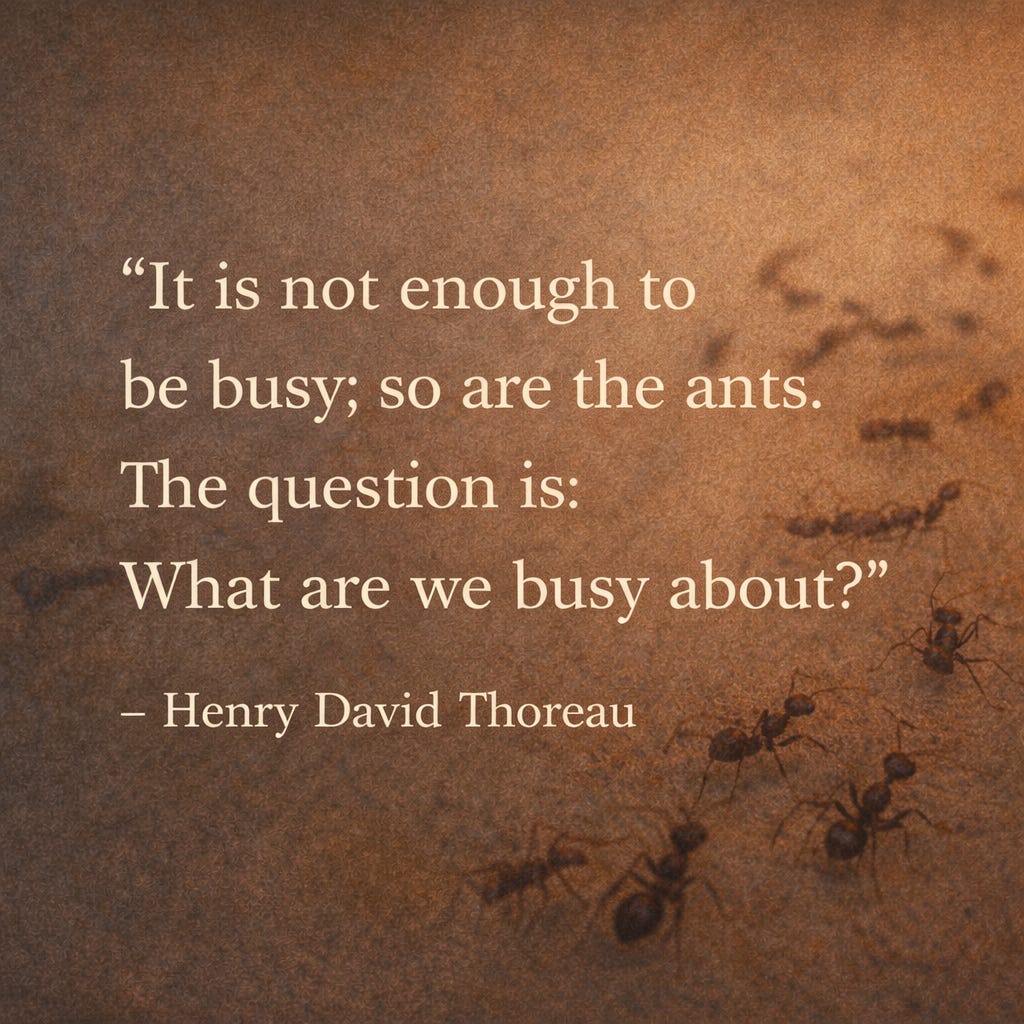
Henry David Thoreau (1817-1862) was an American essayist, poet, and philosopher best known for Walden, his reflection on simple living in natural surroundings, and his essay Civil Disobedience, which influenced figures from Gandhi to Martin Luther King Jr.
A lesser-known fact about Thoreau is that he was an accomplished land surveyor and is credited with inventing a technique for measuring tree heights that became standard practice. His surveying work was highly sought after in Concord, Massachusetts, and he took meticulous field notes that modern ecologists still use to track environmental changes over the past 150+ years. The philosophical wanderer was also a precise scientist and skilled technician.
Weekly Market Update
The S&P was down slightly, but the remaining equity indices were up:
- 0.35% .SPX (500 U.S. large companies)
- 0.23% IWD (U.S. large value companies)
- 0.36% IWM (U.S. small companies)
+ 0.13% IWN (U.S. small value companies)
+ 0.48% EFV (International value companies)
+ 1.50% SCZ (International small companies)
+ 0.00% VGIT (U.S. intermediate-term Treasury bonds
Global Capital Still Favors The U.S.
Contributed by Tony Welch, CFA®, CFP®, CMT, Chief Investment Officer, SignatureFD
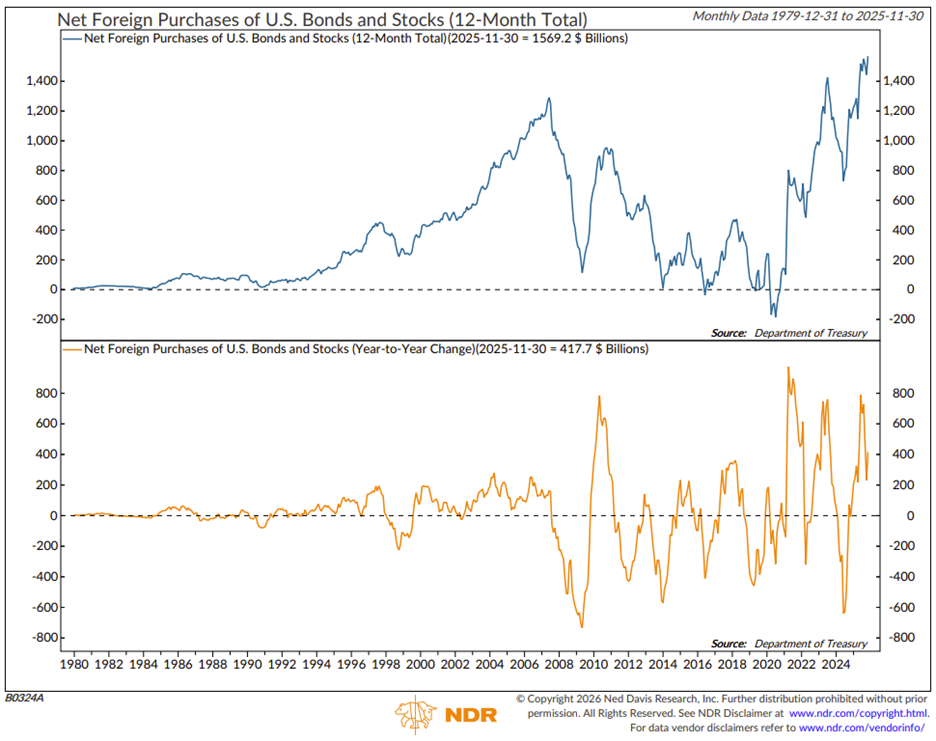
Recent dollar weakness and geopolitical headlines have prompted questions about whether something more structural is at play for the U.S. dollar. One useful way to pressure-test that concern is to look at where global capital is actually flowing. Over the past 12 months, foreign investors purchased roughly $1.6 trillion of U.S. stocks and bonds, the highest level on record.
While currencies can move up and down over shorter periods, sustained capital inflows suggest continued confidence in U.S. financial markets. Relative interest rates, market depth, and ongoing leadership in technology and innovation have kept the U.S. an attractive destination for global investors. Taken together, the data suggests that a sharp or disorderly decline in the U.S. dollar is not likely, even if periodic weakness persists.
Chart O’ The Week
The Message from Our Indicators
The economy is still growing, but the margin for error may be narrowing. Recent data suggest the U.S. economy continues to expand, with consumer spending holding up and inflation no longer accelerating. That’s the good news. The more nuanced part is the labor market. Hiring and wage pressures are cooling, which helps ease inflation, but it also introduces risk if job growth weakens too much. For now, conditions point to moderation rather than contraction. Still, we believe the labor market remains a key area to watch, as it will heavily influence both consumer confidence and the Fed’s next moves.
From a fundamental perspective, companies have broadly shown impressive resilience. Despite higher tariffs and cost pressures, profit margins have remained near record levels, supported by productivity gains and cost controls across many sectors, not just large technology companies. At the same time, today’s stock prices reflect fairly optimistic assumptions about future earnings. That means the market may be less forgiving if growth slows or profits fall short. Strong fundamentals are a positive backdrop, but expectations are high, and that raises the importance for earnings to match expectations.
Market trends are improving beneath the surface. We’re seeing early signs of broader market participation, with leadership expanding beyond a narrow group of large-cap stocks into areas like value, smaller companies, and international markets. This often happens when investors gain confidence in continued growth. Still, broader leadership is not guaranteed to last. For these areas to sustain momentum, earnings growth will need to follow. In that sense, the recent rotation is encouraging, but it remains a developing trend rather than a confirmed shift. All told, we continue to give the bull market the benefit of the doubt but remain aware that midterm election years have been challenging, especially in the middle third of the year.
Middle third? And I just got adjusted to quarterly planning! I hope three-thirds of your weekend are amazing.
Tim
Nearly every week, something in this newsletter sparks a nuanced way to consider my wealth differently.
Great article.