


This week’s post features a riddle that’s more than a thousand years old: How do you proceed from the top of a hundred-foot pole?
It was written for monks. But I’ve come to believe it was also written for financial advisors—and for anyone who has climbed exactly the ladder they intended to climb, arrived exactly where they hoped to arrive, and then quietly wondered why the view feels less satisfying than they’d hoped.
So if that’s you, whether you’re a financial advisor or not, this one’s for you. And it comes with all the trimmings, a compelling Quote O’ the Week from T.S. Eliot and an enlightening Weekly Market Update after a doozy of a week from Tony Welch.
Thanks for joining us!
Tim Maurer, CFP®, RLP®
Partner
In this Net Worthwhile® Weekly you'll find:
Financial LIFE Planning:
Avoiding Burnout As A Financial Advisor
Quote O' The Week:
T. S. Eliot
Weekly Market Update:
Expansion Intact
Financial LIFE Planning
Avoiding Burnout As A Financial Advisor
How A Dream Job Can Feel Like A Trap, And Ways To Get Out
I’ve noticed a phenomenon that, while still anecdotal, I’m going to claim as more than coincidental: Though it looks like nothing short of a dream job, the work of a financial advisor may predictably lead to burnout without proper attention.
There are (at least) a few reasons why this may occur:
How A Dream Job Can Feel Like A Trap
First, there is a meaningful degree of pressure or stress in the job that is undeniable. It’s hard enough for most people to manage the finances of a single household, much less scores of them. Bearing a meaningful share of the strain inherent in managing through one financial crisis, not to mention the several one is likely to endure in a career, is a lot. And that’s just one of multiple systemic factors that can lead to high stress as an advisor. What about the exponential number of individualized household stressors that are brought to the feet of a financial advisor over the course of a career?
Second, for most advisors, managing a practice also requires a meaningful degree of people management, as no great advisor (I’ve observed to date) operates as a singular entity. There are team members, each with their own challenges and opportunities, as well as firm leadership, whose job it is to impose mandates and restrictions that, however helpful or evolutionary, can materially move the proverbial cheese stewarded by an advisor. All of the above results in a collective friction that is no small effort to smooth.
And third, but certainly not finally, you may have heard, “If you’re not growing, you’re dying,” and while I do believe there are several strands of truth to be teased out in this statement, it can also be over-applied as a blunt instrument to suggest that we, as advisors, are only as good as the next thing we do. And this undermines an even deeper truth—that the effort it takes to build and maintain a sustainable financial planning practice is nothing short of enormous. And if you’re an advisor, please read this next sentence twice: While it’s an entirely valid metric to track, your value as a human, and your pursuit of this profession as a calling, has nothing to do with your “organic growth rate.”
Have To Get To
When aggregating just these three factors, you can likely begin to see how the pursuit of financial planning as a profession can absolutely lead to burnout. Yet I submit that it’s not primarily these factors that hasten that outcome. In fact, it may be precisely the above factors that make this career a true dream job for the right person. And here’s what I mean:
We don’t have to co-steward the missions of scores of families and architect planning to support their hopes and dreams while helping protect them from both systemic and individualized risks. We get to.
We don’t have to help grow up the next generation of financial planners through apprenticeship, mentoring, and coaching; nor do we have to work within the constraints of good leaders who support and guide us. We get to.
And we don’t have to be an evangelistic outpost of financial wisdom in our communities, shielding our clients from an onslaught of unhelpful messaging from the outside world and creating the safe space for them to discover, discern, and direct their financial, labor, and relational capital. No, you can be very sure, we get to do that.
Indeed, nobody said being a financial advisor was going to be easy, but for the right person, this genuine helping profession that, unlike most others, tends to be quite financially rewarding itself, can and should be a dream job.
Standing On A 100-Foot Pole
So, if not for the above reasons, then why do educated, credentialed, experienced advisors burn out?
For this, we turn to the unofficial (but undeniable) poet laureate of the business world, David Whyte, borrowing from a Zen riddle first posed by Chinese masters more than a thousand years ago—and preserved in a 13th-century collection called The Gateless Gate. Here’s Whyte’s commentary, from his benchmark book, Crossing the Unknown Sea: Work as a Pilgrimage of Identity:
It seems to me that this question waits in the shadow of every successful life. A koan question for advanced Zen students is “How do you proceed from the top of a hundred-foot pole?” Once you reach a certain stage of mastery, the dangers increase exponentially. In any occupation where we have achieved a degree of competence, we imperceptibly begin to see ourselves as God’s gift to whatever world we have decided to occupy with our working bodies.
Every path, no matter how diligently we follow it, can lead to staleness and ennui. We might reach dizzying heights in our organization, occupy the top floor of any given building, or, as a zoologist, make it to the Galapagos Islands, but if we lose our horizon and the excitement of that horizon, our high office or our storied islands can seem like a gilded cage.
Thankfully, Whyte’s insight gives us a glimpse into ways we can get out of the trap and avoid burnout as an advisor.

How To Get Out Of The Trap
How do we proceed from the top of a hundred-foot pole, then? I submit it’s a career cocktail with three primary ingredients and one clear action we can take after stirring (not shaking) the mixture.
First, let’s follow Dan Sullivan’s example and go BIG: Begin in gratitude. Many of our friends, family, and even our clients, do feel genuinely trapped in their work, and they have a much stronger case to make. If necessary, return to my have to / get to trio above, but simply put, we get to help individuals and families figure out what’s most important in life and point their precious personal resources in that direction.
Second, and in the convicting words of another poet—and the first artist outside classical and jazz ever to win the Pulitzer Prize for Music, rapper Kendrick Lamar: “Sit down. Be humble.” No matter how long you’ve been in this business, how much you’ve learned, how many credentials you have, how many assets you manage, or how much money you make, the subject matter of financial planning is so deep and so wide and so ever-changing that there will always be more that you don’t know than you know. That’s why it’s a team sport and why this next ingredient is, in my humble opinion, the most important trait of any great financial advisor:
Intellectual curiosity. Those who inhabit this trait may never be bored in our business. They’ll find a way out of every ho-hum rut because ours is a field that is always changing and expanding. And that’s just the technical subject matter. Every new client is truly unique—with apologies to Strunk and White because that statement is (truly) redundant. And every long-time client is facing their own protean circumstances.
So, what’s the one action we can take, even if the walls that entrap us are of our own making? Back to David Whyte’s counsel:
Sometimes we have built the walls ourselves, but often it is simply the nature of things that walls that once served and sheltered us at certain periods of our life only imprison us when we have remained within their confines for too long. A work emboldens us for a while, and then, if we do not invigorate and reimagine our participation, it begins to enclose us and slowly starve our spirit. Good work done in the same way for too long, or done in the wrong way for any amount of time, eats away our sense of being right with the world.
Often, in order to stay alive, we have to unmake a living in order to get back to living the life we wanted for ourselves. It is this cycle of making, disintegration, and remaking that is the hallmark of meaningful and creative work.
Invigorate And Reimagine
How can you invigorate and reimagine your participation in your practice? What’s the good work that you’ve done in the same way for too long? And owing to your humanity, what is the work you’ve simply done wrong that you know could be done better?
What is the working and living that you can unmake to get back to living the life you want for yourself?
The great news is that if you had it in you to build and sustain your practice, you have it in you to remake your living. The view from the top of the pole only feels like a trap when you mistake it for the destination. It isn’t. It’s where the next horizon comes into view—and the only way toward it is the step forward.
Quote O' The Week
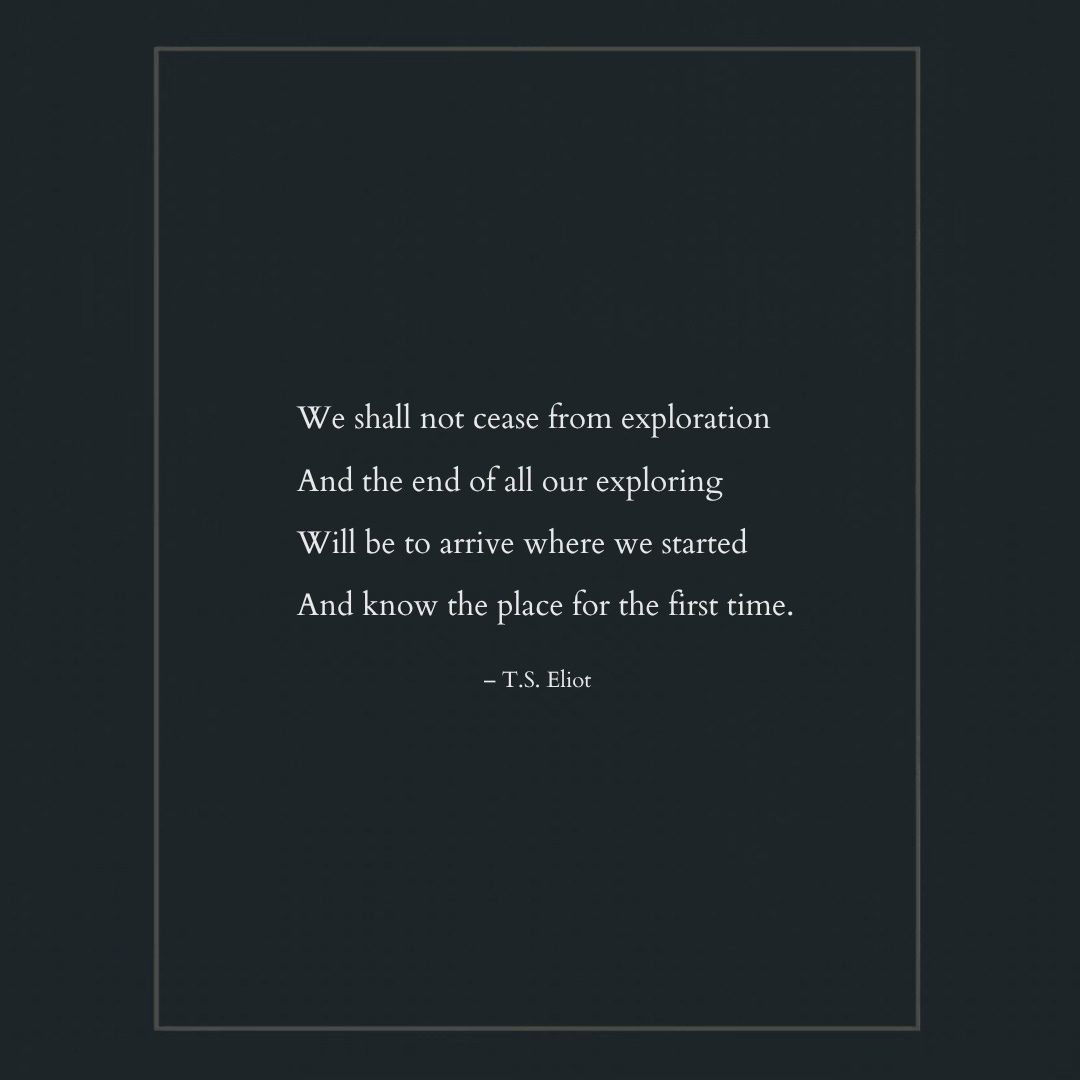
T.S. Eliot (1888–1965) may be the patron saint of anyone doing meaningful work inside a day job: He wrote The Waste Land, arguably the most influential poem of the twentieth century, while working as a banker at Lloyds of London. A Missouri kid who became a British citizen, a skeptic who became a devout Anglican, Eliot won the Nobel Prize in Literature in 1948. This week's quote comes from "Little Gidding," the last of his Four Quartets, written in wartime London while he served as a rooftop fire-watcher during the Blitz, and named for a tiny religious community where he'd gone seeking quiet.
Weekly Market Update
The S&P survived the week despite an historic down day, but small value leads the way this week:
+ 0.65% .SPX (500 U.S. large companies)
+ 2.42% IWD (U.S. large value companies)
+ 4.01% IWM (U.S. small companies)
+ 4.24% IWN (U.S. small value companies)
+ 2.67% EFV (International value companies)
+ 1.83% SCZ (International small companies)
+ 0.44% VGIT (U.S. intermediate-term Treasury bonds
Expansion Intact
Contributed by Tony Welch, CFA®, CFP®, CMT, Chief Investment Officer, SignatureFD
Despite a steady stream of headlines about inflation, interest rates, and geopolitical tensions, the broader economic picture remains surprisingly resilient.
One indicator we watch closely is Ned Davis Research’s Economic Timing Model, which combines dozens of economic data points into a single measure of economic momentum. Today, that model remains firmly in expansion territory and is consistent with moderate economic growth rather than recession. Historically, readings near current levels have been associated with positive equity market returns over the following year.
That doesn’t mean there aren’t risks. Inflation remains elevated, and higher energy prices are creating new challenges for consumers and businesses alike. But the data continue to suggest that the economy is in solid shape.
For investors, we believe the message is straightforward: while volatility is always possible, the weight of the evidence continues to support economic expansion and a constructive backdrop for long-term investors.
Chart O’ The Week
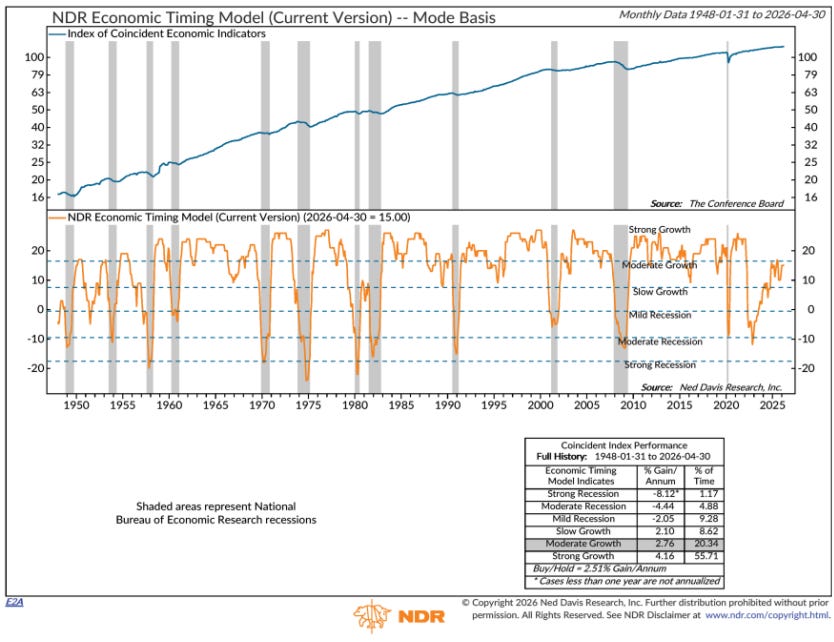
The Message from Our Indicators
The market spent much of the week digesting a now familiar combination of strong economic data and stubborn inflation.
On the growth side, the evidence remains encouraging. Payroll growth surprised to the upside, recession indicators remain subdued, and several of our preferred economic models continue to point toward ongoing expansion rather than contraction. The economy may be operating at different speeds across industries and income groups, but the broader picture remains one of resilience.
Inflation, however, continues to complicate the outlook. Both consumer and producer prices moved higher in recent reports, driven in large part by energy costs. While some underlying inflation measures showed signs of moderation, inflation remains well above the Federal Reserve’s target and we believe is likely to keep policymakers on hold for the foreseeable future.
Finally, investors are turning their attention to one of the year’s most anticipated market events: SpaceX’s public debut. Along with several other large AI-related companies expected to come public, this represents one of the largest waves of new stock supply in years. Historically, IPO booms tend to emerge after strong market advances and periods of investor optimism. While that environment has often been associated with somewhat lower future returns, it has not reliably signaled the end of bull markets.
Our takeaway remains largely unchanged. Economic growth continues to hold up better than many expected, inflation remains the primary risk to monitor, and enthusiasm surrounding new public offerings reflects a market that still has confidence in the future. While we would not be surprised by periods of volatility, the overall weight of the evidence continues to suggest that we give the bull market the benefit of the doubt.
Enjoy the World Cup this weekend!
Tim