


Two people can hold the same net worth, the same portfolio, and the same beautifully formatted plan—and only one of them would tell you they have enough. One may live a rich life, filled with gratitude and purpose, while the other seems to gain the whole world while losing everything that made it worth having.
The line between those two lives is more nuanced than it looks, so in this week’s Financial LIFE Planning section I called on C. S. Lewis. What he wrote in a preface in 1961 is less a warning than a description; unnervingly precise, and closer to home than you’d expect.
I’m going deep this week, and I hope you find it life-giving—as I also hope you find Tony’s Weekly Market Update, Looking Beyond Headline GDP, edifying!
Tim
Tim Maurer, CFP®, RLP®
Partner
In this Net Worthwhile® Weekly you'll find:
Financial LIFE Planning:
C. S. Lewis On Hell—And Your Financial Plan
Quote O' The Week:
Lynne Twist
Weekly Market Update:
Looking Beyond Headline GDP
Financial LIFE Planning
C. S. Lewis On Hell—And Your Financial Plan
What a 1961 definition of Hell has to say about the difference between being rich and being wealthy.
“We must picture Hell as a state where everyone is perpetually concerned about his own dignity and advancement, where everyone has a grievance, and where everyone lives the deadly serious passions of envy, self-importance, and resentment.”
That’s C. S. Lewis, writing in 1961—and it is almost surely more applicable in 2026 than when it was penned.
I regularly range into matters of psychology and philosophy—even spirituality—to explore insights that can aid us in a deeper understanding of our personal finances. But despite holding firm to my own convictions on the spiritual front, I’m not a pastor, priest, or rabbi, so I tend to steer clear of the overtly religious. We don’t need to share the same religious convictions, however, to learn from one of the greatest thinkers and authors of the 20th Century—a famously former atheist turned Christian apologist.
Lewis wrote those words in the preface he added to The Screwtape Letters years after its initial publication, his novel of a senior demon’s letters of advice to his apprentice nephew. And notice what he’s doing: defining Hell not as a physical location, but as a state of being.
And yet the more I reread this passage, the more I feel like he’s tapping into something far earthier and present than a metaphor or a seemingly distant location we’d prefer to never visit—something that can be readily applied in even our financial planning. And it also has me asking the question: Is there a type of financial life planning that is more likely to lead us to Lewis’s version of Hell—and one that is more likely to lead us in precisely the other direction? Let’s break it down and see.
3 Attributes Of Lewis’s Hell
First, let’s note a few things about the state of being that Lewis describes—and how easy it is for any of us to find ourselves there, especially today:
“…everyone is perpetually concerned about his own dignity and advancement…” Everyone is self-focused, presumably rather than others-focused. Self-preservation is a powerful, and in some cases positive, instinct, but we also know that perpetually positioning ourselves as the center of the universe tends to leave us with an ironically dissatisfying ache, doesn’t it? It’s almost as though we were wired for relationships and for applying ourselves to something bigger or more than just…ourselves.
“…where everyone has a grievance…” Despite living at a time when there are more ways to pursue comfort and convenience than at any other time in human history, it seems that our penchant for the expression of complaints and grievances is also at an all-time high. And I’d submit that sitting near the other end of the grievance continuum is another “g” word (that also happens to play a massive role in our financial planning): gratitude.
“…where everyone lives the deadly serious passions of envy, self-importance, and resentment.” It’s almost impossible to never struggle with envy, self-importance, and resentment, but note Lewis’s deliberate choice of words regarding the next-level nature of this particular fixation, where these fleeting temptations turn into living with these as deadly serious passions. I want to be careful not to paint too broadly with this brush, but I can’t help but think that envy, self-importance, and resentment are three of the foundational pillars of at least social media, if not society as a whole, in our current age.
2 Versions Of Financial Planning
So, here’s the challenge as we consider this breakdown in relation to our personal finances: There’s a version of financial planning that amounts to little more than piling up as much money as possible and distributing it as efficiently as practical. Advancement, accumulation, even striving to become worthy of envy, and especially the envy of those with whom we have a grievance. Ouch.
But there’s also a version that has a very different orientation. It begins with discerning and articulating a life of purpose that is about far more than our own personal edification, and then marshaling our scarcer earthly resources—our time, influence, money, energy, and relationships—in pursuit of that purpose.
And yet, whether earthly or from beyond, there are forces that seem inclined to herd us in the direction of Lewis’s Hell. Which means our more aspirational paths and plans are not a destination to be reached once and for all time, but an ideal toward which we will forever be seeking alignment.
And that, I propose, is where financial planning transcends a mere ordering of our stuff and becomes a practice of naming, ordering, and re-ordering our loves—while investing our resources to those worthy ends.
Multidimensional Wealth Management
It’s not a linear line from rags to riches—from lack to plenty—that is wholly exterior, but a multidimensional transformation that has the ability to change us also at an interior level, for better or too often for worse. Consider this 2x2 visual:
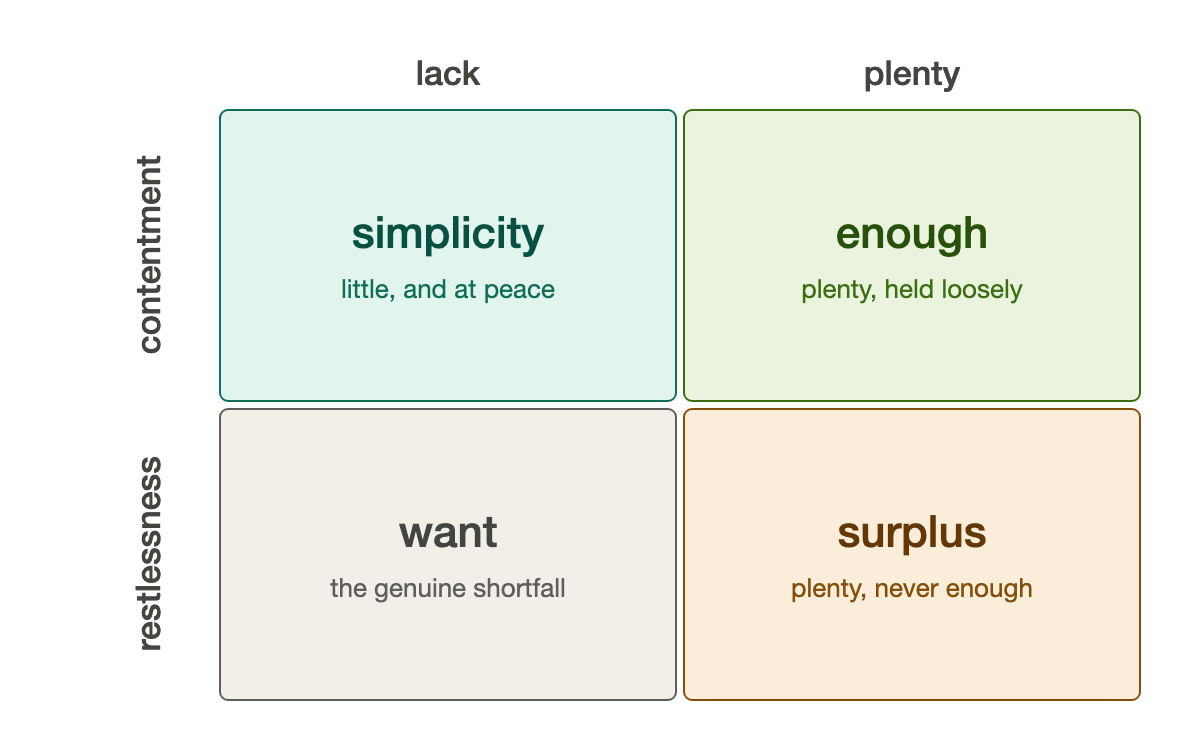
Note that the bottom two boxes in the grid represent the more limited approach to financial planning I referenced—the one that may even contribute to our spending (much) more time than is preferable in Lewis’s Hell. But that’s only addressing the external factors of traversing from a literal lack to plenty. An exterior-only approach can slide you from left to right across the bottom row; it struggles to lift you out of it.
And there’s one more through line in this potent passage that speaks directly to financial planning: None of those inhabiting Lewis’s Hell are suffering from something that is missing. Indeed, they have an image that appears to be worth advancing. They possess a grievance, or several. And they are actively pursuing what they envy while nursing what they resent.
Rich, But Not Wealthy
This may lead us to wonder whether the first step out of Hell and toward something preferable is to release something, to give something away, to decline an invitation or honor. Maybe that something is a social media account, a status symbol, a promotion or opportunity that would improve our financial standing.
Lewis suggested elsewhere that the doors of Hell are locked from the inside. If he’s right, don’t we possess the key? And is it possible that releasing something is what it looks like to turn it?
I’ve met plenty of people who are rich by any measure but who aren’t truly wealthy—because what they really lack is contentment (which, interestingly, often has nothing to do with their finances). True wealth—contentment—doesn’t necessarily require a change in your income or net worth (in the vast majority of cases, anyway). Because when we wrestle with our restlessness, make a habit, if not a ritual, of gratitude, and forgive our grievances, we can find peace even in the midst of lack. And perhaps not surprisingly, those who can find peace with less are often better skilled at enjoying more. Enough.
Quote O' The Week
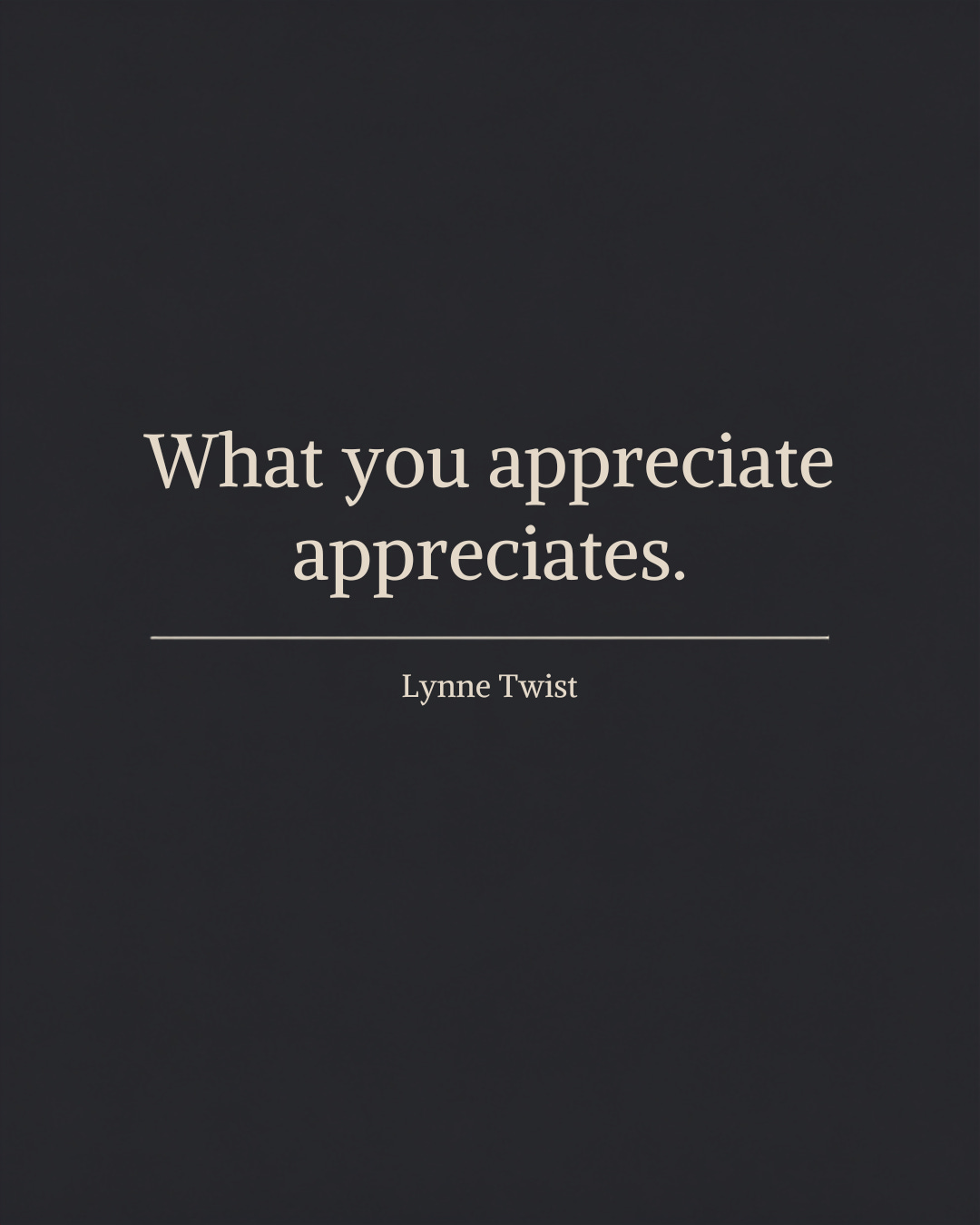
Lynne Twist spent twenty years as chief fundraising officer for The Hunger Project, raising more than $120 million across forty countries. Her work has taken her from Calcutta alongside Mother Teresa to refugee camps in Ethiopia to the private offices where some of the world's wealthiest families decide what to do with their money. In The Soul of Money, she argues that sufficiency isn't an amount you finally reach but an experience you generate.
Weekly Market Update
Almost all in the green this week:
+ 1.05% .SPX (500 U.S. large companies)
+ 1.44% IWD (U.S. large value companies)
+ 0.01% IWM (U.S. small companies)
- 0.08% IWN (U.S. small value companies)
+ 2.32% EFV (International value companies)
+ 1.51% SCZ (International small companies)
+ 0.05% VGIT (U.S. intermediate-term Treasury bonds
Looking Beyond Headline GDP
Contributed by Tony Welch, CFA®, CFP®, CMT, Chief Investment Officer, SignatureFD
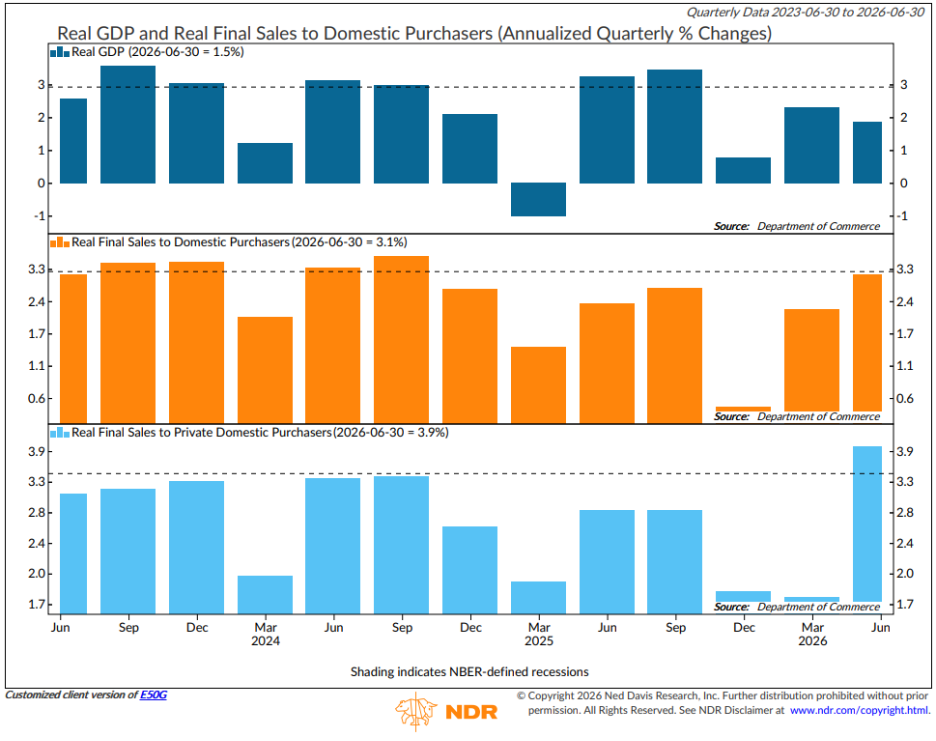
On the surface, second-quarter GDP was a little disappointing, with the economy expanding at a 1.5% annualized pace. But the headline number doesn’t tell the full story. Much of the weakness came from inventories and trade, while underlying domestic demand remained remarkably healthy.
In fact, private final sales to domestic purchasers, a measure that strips out many of GDP’s more volatile components, grew at its fastest pace in more than three years. Consumer spending remained firm, businesses continued to invest, and the labor market has yet to show meaningful signs of deterioration.
The takeaway is an important one. Economic growth may be moderating from the rapid pace we’ve seen since the pandemic, but it is not rolling over. That continues to support corporate earnings and helps explain why recession fears have remained subdued.
The challenge, however, is that strong demand also makes it more difficult for inflation to return to the Federal Reserve’s 2% target. While inflation has improved meaningfully from its peak, resilient demand gives policymakers little reason to rush toward easier monetary policy.
Chart O’ The Week
The Message from Our Indicators
This week’s data largely reinforced our constructive outlook, although the environment remains more challenging than earlier this year. Corporate earnings continue to impress. Almost 60% of S&P 500 companies have now reported second-quarter results, with earnings growth tracking about 25% year over year, a very strong pace. Revenue growth has also remained healthy, suggesting companies are benefiting from solid underlying demand rather than cost-cutting alone.
Economic indicators continue to paint a similar picture. Manufacturing activity has improved, capital spending remains healthy, and consumer confidence has softened only modestly while remaining consistent with continued economic expansion.
The primary headwind remains interest rates. The Federal Reserve left policy unchanged this week, but three officials dissented in favor of raising rates, underscoring the committee’s continued concern about inflation. Markets are increasingly pricing in the possibility of another rate hike later this year if inflation fails to moderate further.
Meanwhile, higher Treasury yields and rising energy prices have become increasingly important variables for investors. Higher rates reduce the relative attractiveness of equities, while elevated oil prices risk slowing progress on inflation over the coming months. Neither development necessarily signals the end of the bull market, but both argue for more measured return expectations after a strong first half of the year.
Bottom line: Our indicators continue to suggest the economy remains on solid footing and earnings growth has been better than expected. At the same time, resilient growth is likely to keep the Federal Reserve cautious, and interest rates elevated. We continue to expect volatility along the way, but the evidence still points to an expansion rather than an impending recession.
Have a great rest of your weekend!
Tim