

The notion that we should focus on what we can control—and not on what we can’t—has almost become passé. And indeed, whether thanks to over-utilization or flippancy, the concept is not new.
But it’s even older than I thought. Ancient, actually.
So when I saw a helpful, simple exercise featured on the #1 health and fitness podcast in the U.S. (Huberman Lab), I knew I wanted to share it with you. Then I went hunting for its origin—and kept going, back through thousands of years of philosophy. And the financial LIFE planning implications are significant.
Rather than cutting right to the chase, I decided to share what I learned through that research, because I believe this concept deserves so much more than placement on a cheesy motivational poster. Which is why this is the first of a two-part series on framing what we control inside what we influence inside what concerns us.
Thanks, as always, for joining me this Sunday morning!
Tim
Tim Maurer, CFP®, RLP®
Partner
In this Net Worthwhile® Weekly you'll find:
Financial LIFE Planning:
Concern, Influence, Control (Part 1): Nothing New Under The Sun
Quote O' The Week:
Flannery O’Connor
Financial LIFE Planning
Concern, Influence, Control (Part 1): Nothing New Under The Sun
From Huberman to Solomon—and the three circles your money fuels
Former Navy SEAL, Andy Stumpf, was recently on Dr. Andrew Huberman’s podcast, and they were commiserating on a practice that both of them do routinely, designed to help them maximize their individual agency in a world of distraction.
Stumpf said that despite its utility, he couldn’t remember where it came from. Interestingly, the person who is likely most known for its popularization, and almost certainly Stumpf’s original inspiration, Stephen Covey, has also struggled a bit with the concept’s true source. He thought it was psychiatrist and Holocaust survivor, Viktor Frankl, but there’s no direct source for Covey’s paraphrase.
And even if it was Frankl, which I kinda hope it was, he likely learned it from Oldfather in the late 1920s, and he definitely got it from Epictetus in 125 AD, who was almost certainly influenced by his mentor, both of whom arrived at something “the Teacher,” AKA King Solomon, had already said a long, long time before.
So what the heck are all these wise and learned sources talking about? Let’s go down the rabbit hole in reverse order, and then emerge from philosophy to a hyper-practical strategy that we can apply in life, and also very directly in our financial planning today.
Stumpf’s Monthly Practice (From Stephen Covey)
It’s hard to argue with Andy Stumpf’s discipline, in part because, for him, it was a matter of life and death, over hundreds of missions through 10 deployments during 17 years as a Navy SEAL. But he acknowledges that any number of cares and concerns will still render him wide-eyed, staring at the ceiling in the middle of the night.
His practice, therefore, is based on a concept popularized by Stephen Covey, describing The Circle of Concern and The Circle of Influence:
The Circle of Concern
“We each have a wide range of concerns—our health, our children, problems at work, the national debt, nuclear war. We could separate those from things in which we have no particular mental or emotional involvement by creating a ‘Circle of Concern.’”
Covey initially shared this observation in the 1980s. Before cellphones, social media, and the dreaded algorithm that amplifies all the rest. Do you think the circle’s gotten bigger? Andy Stumpf addresses that for us in a moment, but let’s allow Covey to define the other circle first:
The Circle of Influence
“As we look at those things within our Circle of Concern, it becomes apparent that there are some things over which we have no real control and others that we can do something about. We could identify those concerns in the latter group by circumscribing them within a smaller Circle of Influence. By determining which of these two circles is the focus of most of our time and energy, we can discover much about the degree of our proactivity. Proactive people focus their efforts in the Circle of Influence. They work on things they can do something about.”
Our Circle of Influence is nested within our Circle of Concern, and Stumpf gives us a powerful visual to imagine the scope of each:
“So if it was the size of this table, that would be your concern. The influence would be the size of a pin drop on the table.”
Is that why it feels like we’re fighting such an uphill battle so many days? Why we’re not accomplishing more of what we know is important?
Huberman and Stumpf both employ the following super simple practice, weekly and monthly, respectively:
“Take a standard piece of paper, draw a line down the middle, concern on one side, influence on the other,” Stumpf said. “And you just take the time to write down the things that are occupying your waking hours.”
Stumpf notes that the stuff that has a tendency to keep him up at night is almost exclusively in the left-hand column.
The Best Quote Nobody Said
“Between stimulus and response there is a space. In that space is our power to choose our response,” is the Viktor Frankl quote that has inspired millions, likely through Covey—except that there’s no evidence Frankl ever said it. Covey says he saw it in a library book in Hawaii while on sabbatical in 1969, but nobody can find the darn thing.
Said or not, it’s a quote that is entirely in line with Frankl’s logotherapy ethos, so let’s just give it to him. And where’d he get it? This might be a long shot, but perhaps William Abbott Oldfather, a character that seems worthy of his colorful name. An apparent descendant of Daniel Boone (on his mother’s side), he was born in Persia in 1880 to Presbyterian missionaries.
From Oldfather To Epictetus To Ecclesiastes
Oldfather was a classics professor at Illinois with degrees from Hanover College, Harvard, and the University of Munich, whose colleagues described him as “adventurous, opinionated, passionate, and driven,” with “penetrating eyes, a swinging stride,” and “a growling laugh.”
Don’t you wish you could have a cup of coffee with this dude? Alas, his writing will have to suffice, and he has something to say about the concern/control conundrum. He refers to the circle of concern 64 years before Covey as “…an external impression…a ‘constant,’ beyond our power to alter. But we remain free in regard to our attitude towards them.”
We remain free in regard to our attitude towards them. [Long exhale.]
And where’d he get this? Epictetus, from 125 AD, as translated by Oldfather in Encheiridion:
“Some things are under our control, while others are not under our control. Under our control are conception, choice, desire, aversion, and in a word, everything that is our own doing; not under our control are our body, our property, reputation, office, and in a word, everything that is not our own doing.”
Funnier yet is that Oldfather calls out Epictetus for his unoriginality of thought, suggesting, “…there can be no doubt but the system of thought in the pupil is little more than an echo, with changes of emphasis due to the personal equation, of that of the master.”
The master he was referring to was Musonius Rufus, under whom Epictetus began studying while he was still enslaved. And perhaps both Rufus and Epictetus would just point back to the writer of Ecclesiastes who, thousands of years before 2026, was already exasperated with the inherent unoriginality of life:
“What has been will be again, what has been done will be done again; there is nothing new under the sun. Is there anything of which one can say, ‘Look! This is something new’? It was here already, long ago; it was here before our time.”
Irony of ironies? The above has long been attributed to King Solomon by generations of Sunday School teachers, including mine, despite the fact that the preponderance of scholars suggest it may have been someone else, centuries later.
Putting It All Together
As we emerge from that deep dive, let’s put it together, shall we, because I think we can create a version of this whole thing that, while not necessarily original, may be the most applicable.
I propose that the best practical mental model may not be two columns on a piece of paper or two competing circles, but three concentric circles. Let’s try this out:
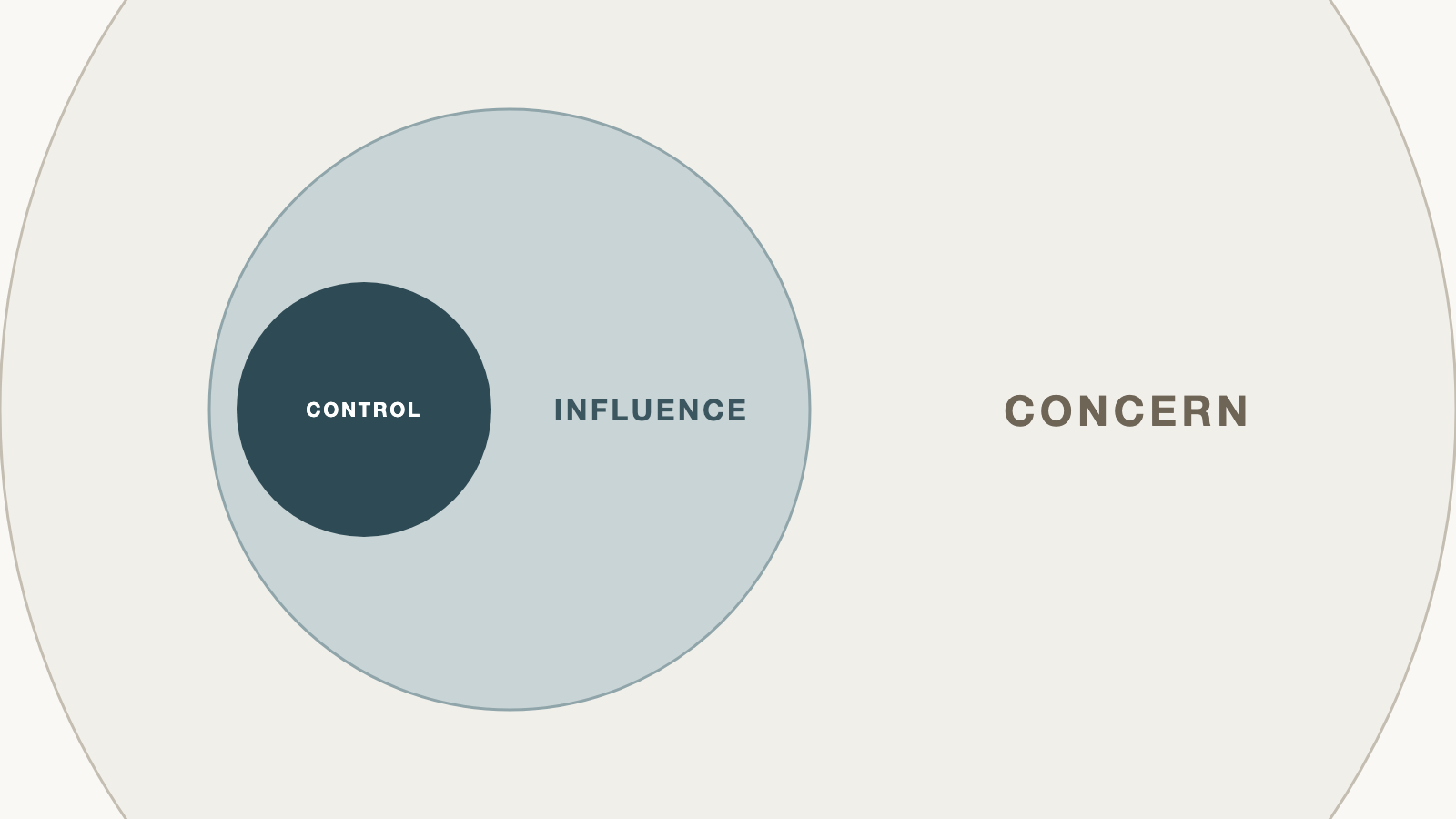
While I’d agree with Stumpf that if this could be rendered with proportionate precision, we’d need to blow out the circle of concern, I think it’s helpful to see that there are still further degrees of influence. Covey references that over which we have direct control (problems involving our own behavior), indirect control (problems involving other people’s behavior), and those over which we have no control at all (which is most of them). Or, we could just add a circle of control inside of influence inside of concerns, and call it a day.
This nicely seems to aggregate the best of observations from all the brilliant folks above. But Covey does take one concept to a new level that is both empowering and concerning: He suggests that there are instances where our presupposition regarding the outsized nature of our concerns relative to our influence can invert:
“Because of position, wealth, role, or relationships, there are some circumstances in which a person’s Circle of Influence is larger than his or her Circle of Concern.”
But he’s not saying this is a good thing. He suggests it’s just a different version of “…a self-inflicted emotional myopia—another reactive selfish life-style focused in the Circle of Concern.” Woah!
The ideal, he suggests, is that we do, indeed, work on expanding our influence positively in the world, and that “…proactive people have a Circle of Concern that is at least as big as their Circle of Influence.”
So, is he suggesting that we actually expand our circle of concern as our influence grows—that we should care more, or about more? Interesting.
And what does he suggest as one of the key amplifiers of influence—for better and for worse? Our wealth.
And that, my friends, is where we’ll pick up next week, in Part 2 of this two-part post. We’ll put this more nuanced angle of the concern / influence / control interplay under the magnifying glass before looking clearly at our wealth and financial planning.
Quote O' The Week
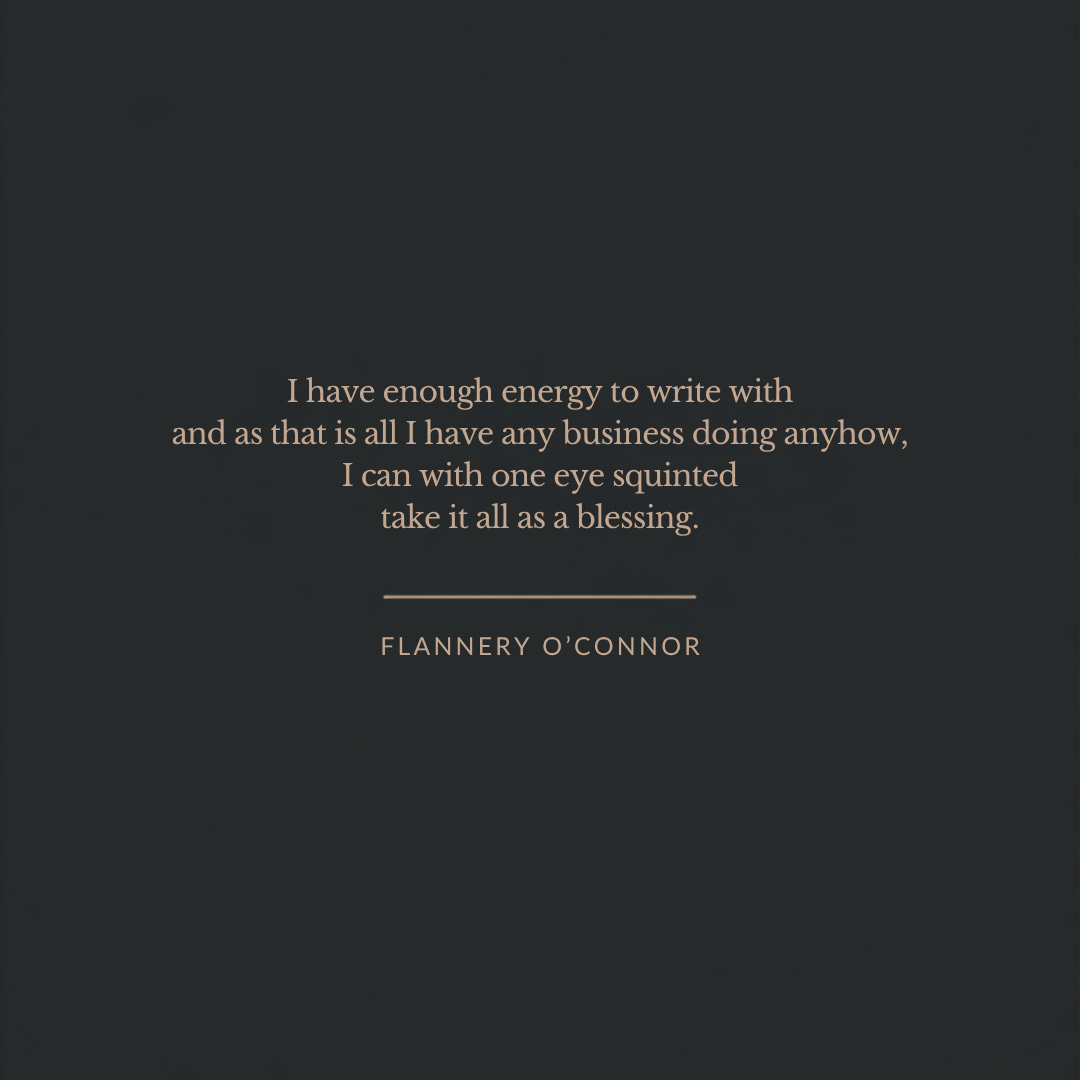
Flannery O'Connor (1925–1964) published two novels and thirty-one short stories before dying at age thirty-nine. Her posthumous Complete Stories won the National Book Award in 1972. She lost her father to lupus when she was fifteen, and was diagnosed with the same disease at twenty-five, three years after leaving the Iowa Writers' Workshop. From 1951 until her death she lived at Andalusia, her family's dairy farm outside Milledgeville, Georgia—largely on crutches, writing a few hours each morning, raising peafowl. The line above comes from her letters, collected in The Habit of Being (1979). She was describing exactly that life, and, without meaning to, all three circles.
I hope this three-circle concept sticks with you (in the best way possible) over the weekend. I’d love to hear how it strikes you, and we’ll pick the conversation back up again next week!
Tim