

Last week, in Part 1 of a 2-part series, I shared a simple exercise to help us delineate our sphere of control from our much broader list of everything in the world that concerns us, and then we went down a few-thousand-year rabbit hole—from Andrew Huberman to Stephen Covey to Viktor Frankl to William Abbott Oldfather to Epictetus to Ecclesiastes (and back)—examining their approaches to this whole control-concern conundrum, before setting up precisely how we can use our wealth to navigate our spheres of concern, influence, and control.
This week, we jump into how we can do that—how we can use our money as an amplifier for the instrument that is our presence in the world, personally and professionally.
Thanks for joining us this long Labor Day weekend, and I hope you don’t set an alarm clock tomorrow!
Tim
Tim Maurer, CFP®, RLP®
Partner
In this Net Worthwhile® Weekly you'll find:
Financial LIFE Planning:
The Influence Amplifier
Quote O' The Week:
Wendell Berry
Weekly Market Update
Higher Bond Yields are Offsetting Price Movement
Financial LIFE Planning
Concern, Influence, Control (Part 2): The Influence Amplifier
How money magnifies our influence—and why that may be a responsibility before it’s a reward
My son, a junior at Clemson University—Go Tigers—is an avid guitar player. He spends hours a day on his instrument, or instruments, really. Indeed, all of his prized possessions in life are guitars. Electric guitars.
Each one is a beautiful creation of its own—two different Les Pauls, a Stratocaster, Telecaster, Jazzmaster, MS450. But what’s interesting about them is that by themselves, they can hardly produce a sound. Barely audible plinking. They each have to be plugged into an amplifier to do anything. And when they are plugged into an amplifier, they come alive. Loudly.
What’s of further interest to me is that good electric guitar players, perhaps unlike most other instrumentalists, become not only masters of their instrument—but also of their amplifiers. He will literally spend months dialing in the perfect sound that he seeks to gain from the respective instrument, each of which has a sound that manifests differently, depending on the amplifier and its unique settings.

In last week’s post—Part 1 (of 2)—we went all the way down the historical, philosophical, and spiritual rabbit hole of the popularized notion that we should focus more on what we can control in life and less on what we can’t. We examined this through a three-fold lens with three concentric circles that invite us to acknowledge that most of us have a range of concerns in life that is much larger than our “circle of influence,” the stuff we can actually do something about. And that within our circle of indirect influence nests one additional sphere—the very limited domain over which we have direct control.
The post concluded with an interesting, if not complexifying, twist from Stephen Covey, where he suggested that our circle of influence in this life is far from static, and that it can be grown through “position, wealth, role, or relationships”—for better and for worse.
So this week, I’d like to suggest that we are each a beautiful creation, a hand-crafted instrument, and that these tools—position, wealth, role, and relationships—are our amplifiers. We’ll focus especially, and very practically, on the wealth piece.
Of course, in our broader definition of wealth—our time, influence, money, energy, and relationships—it pretty much encompasses all of Covey’s named amplifiers, but let’s take a specific look at our money management, as that is the ever-present amplifier that is connected, in one way or the other, to just about every decision we make in life.
The Money Map
Let’s start by ordering a host of financial factors into the three categories we’ve established:
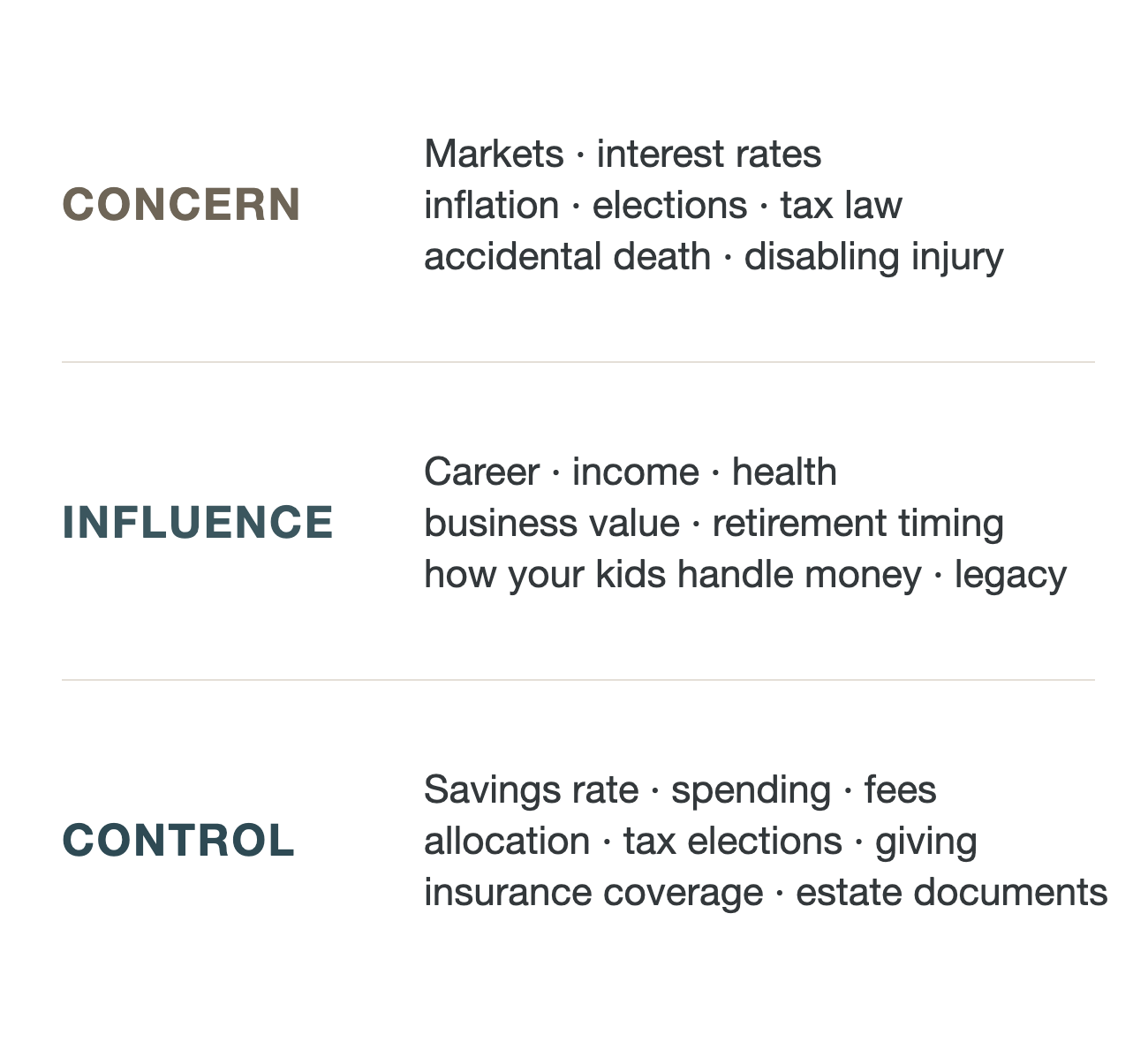
You immediately get the picture, right? But here’s the really wild thing to me:
The financial industry markets almost exclusively on the Concerns—the fears, the manic, the sensationalistic headlines. The uncontrollable. (And yes, they know exactly what they’re doing.)
Jumping to that which we can actually Control, it’s the boring stuff, the mundane. It’s patience, discipline, and box-checking.
Meanwhile, it’s often the middle Influence ring that actually drives us the craziest. These areas that we can move but not command often generate both paralysis and delusion, because we can tell ourselves that we should have done more (or less) to achieve a desired outcome and because we often don’t know when divinity, serendipity, happenstance, or just plain dumb luck has influenced an outcome—often in a material way.
The practical takeaway? I believe the Control group is the vast majority of good financial planning, and it’s also not a stretch to suggest that the most predictable financial success stories will be grounded in this category. In other words, for the vast majority, your savings rate and your portfolio allocation will be the greatest indicator of a successful retirement savings plan—not individual security selection.
In Covey’s own parlance, I suggest that this Control group in financial planning is the “first things first.”
And yet.
If that’s the majority of good financial planning, I remain convinced that the great planning I’ve seen has delved, often deeply, into the Influence domain. Though less tangible, it is often career shaping and planning, income unlocks, dedicated health initiatives, and considering how and when we will shape the next generation that takes planning to the proverbial next level. It’s certainly some of the work I’ve enjoyed the most, both as an advisor and an advisor coach.
Returning to the musical metaphor, on a good day, my son can play an admirable version of the legendary Cliffs of Dover, originally performed by guitar virtuoso Eric Johnson, but he didn’t start there, but with hundreds and hundreds of rudiments, scales, and foundational practice, without which there’d be no hope to wail.
And regarding our posture toward the Concerns, it must be said that the true goal here may not be simply to ignore them. They are, after all, important, and understanding them can helpfully inform how we act. For example, you can’t refinance your mortgage to a lower rate, directly controlling your cost of housing, if you don’t know what rates are. You don’t know to update your estate planning documents if you’re unaware that the tax laws have changed. The objective, I submit, is to be aware of them without ruminating on them.
Can I give you an example that I’ve applied in my own life? I think it’s important to be informed, but I think that a constant feed of news is nothing short of toxic, at least for me. So, instead of listening to or watching or scrolling through the never-ending news cycle every day, I get one physical weekend newspaper edition delivered to my house every Saturday morning. Over the weekend, I’ll scan the headlines and read the articles that I think are important. But on any given Tuesday, I likely won’t be able to tell you what the Dow did or what new terror has been unleashed in the Middle East.
So, what’s of your three circles, and how do you manage them? If you’re not sure, Covey gives us some additional instruction, and again, it has meaningful implications and application directly in our wealth management:
The Haves And The Bes
One way to determine which circle our concern is in is to distinguish between the have’s and the be’s. The Circle of Concern is filled with the have’s.
“I’ll be happy when I have my house paid off.”
“If only I had a boss who wasn’t such a dictator…”
“If only I had a more patient husband…”
“If I had more obedient kids…”
“If I had my degree…”
“If I could just have more time to myself…”
The Circle of Influence is filled with the be’s—I can be more patient, be wise, be loving. It’s the character focus.”
Brilliant. And he takes it one step further, suggesting that “Anytime we think the problem is ‘out there,’ that thought is the problem. We empower what’s out there to control us.”
He calls it the “outside-in” paradigm, where “what’s out there has to change before we can change,” recommending instead that “the proactive approach is to change from the inside-out: to be different, and by being different, to effect positive change in what’s out there.”
Let’s rest in that truth for a beat and consider how that shift in focus could impact our finances, our relationships, our health, our lives.
The Warning
Lastly, I think we need the reminder that Covey gives us of the danger of wealth in expanding our influence that I glossed over last week:
He said, “Because of position, wealth, role, or relationships, there are some circumstances in which a person’s Circle of Influence is larger than his or her Circle of Concern,” suggesting that this situation actually reflects “…a self-inflicted emotional myopia—another reactive selfish life-style focused in the Circle of Concern.”
Simply put, financial success has a way of fooling us into thinking that we’re better. But we’re not, and that’s where one other famous saying popularized by JFK, echoed by Covey, Frankl, Oldfather, Epictetus, and enshrined in the NIV translation of Luke 12:48 in the New Testament of the Bible deserves, I believe, the last word:
“From everyone who has been given much, much will be demanded; and from the one who has been entrusted with much, much more will be asked.”
And not because we have to, but because we get to.
Quote O' The Week
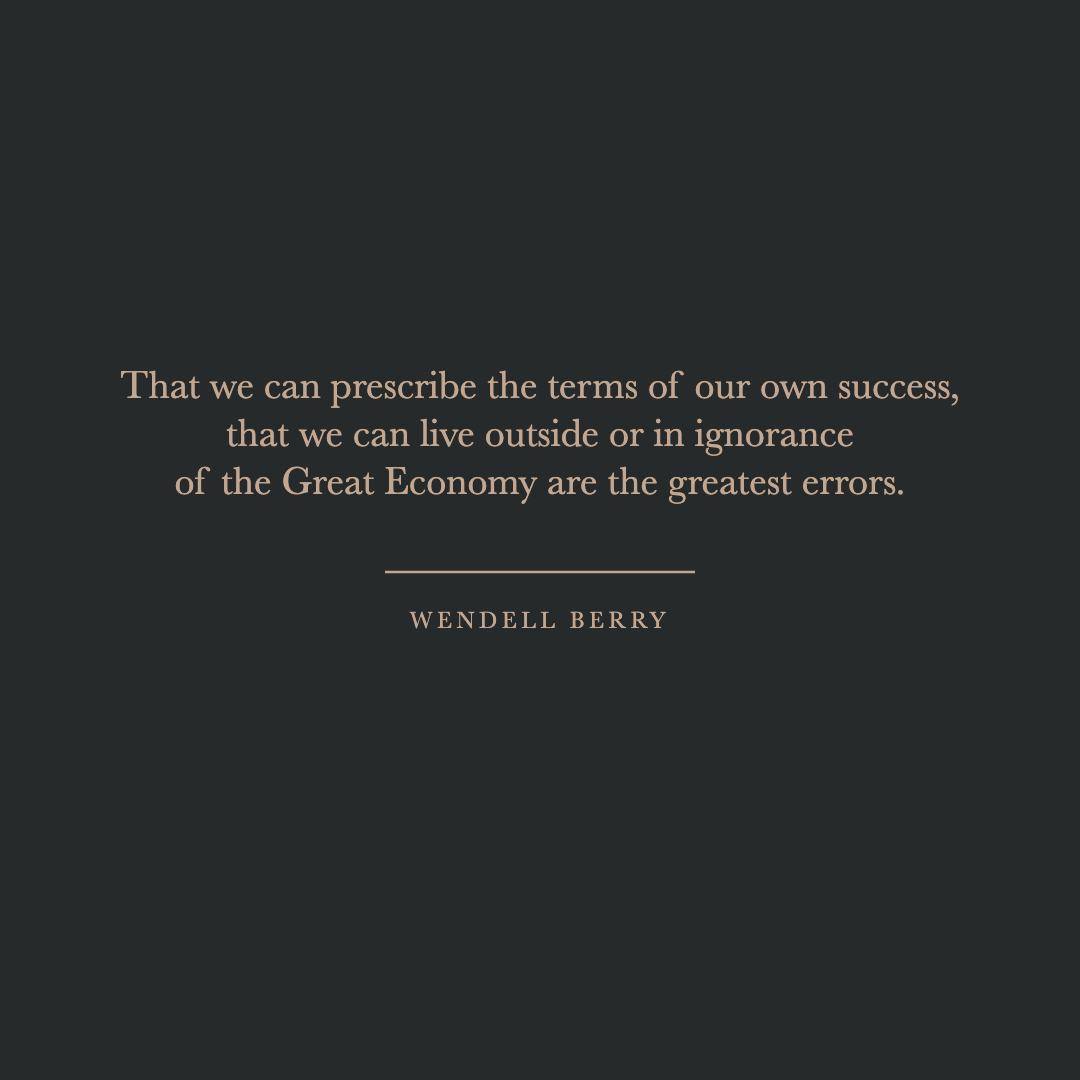
The most well-loved author that you may not have read, Wendell Berry, died August 31st in Port Royal, Kentucky, at the age of 92. Berry has already inspired next week’s post, so you’ll hear more from him then, but in addition to the luminaries cited in our short concern/control series, Berry, too, had something to say about it.
In a 1984 essay called “Two Economies,” Berry referenced two different economies—the “Great Economy,” the whole order of things (and not just financially), nearly all of which we did not create and cannot control. Nested inside of the Great Economy is ours, the “little economy,” the human economy, the industrial economy, and he warns “…that it tends to destroy what it does not comprehend, and that it is dependent upon much that it does not comprehend."
If you’re new to Berry and have seen his name a bunch this week following his passing, might I recommend one of his novels, actually—Jayber Crow, one of the handful of fictional volumes that shows up on my 40 Books That Changed My Life. But here’s a taste of his non-fiction prose that speaks to our post this week.
Weekly Market Update
Moderately mixed markets for this first weekly peek into the month of September:
+ 0.09% .SPX (500 U.S. large companies)
- 0.27% IWD (U.S. large value companies)
+ 0.09% IWM (U.S. small companies)
+ 0.66% IWN (U.S. small value companies)
+ 1.49% EFV (International value companies)
+ 0.69% SCZ (International small companies)
- 0.53% VGIT (U.S. intermediate-term Treasury bonds
Higher Bond Yields are Offsetting Price Movement
Contributed by Nick Amat, CFA®, CFP®, CAIA, Senior Portfolio Designer, SignatureFD
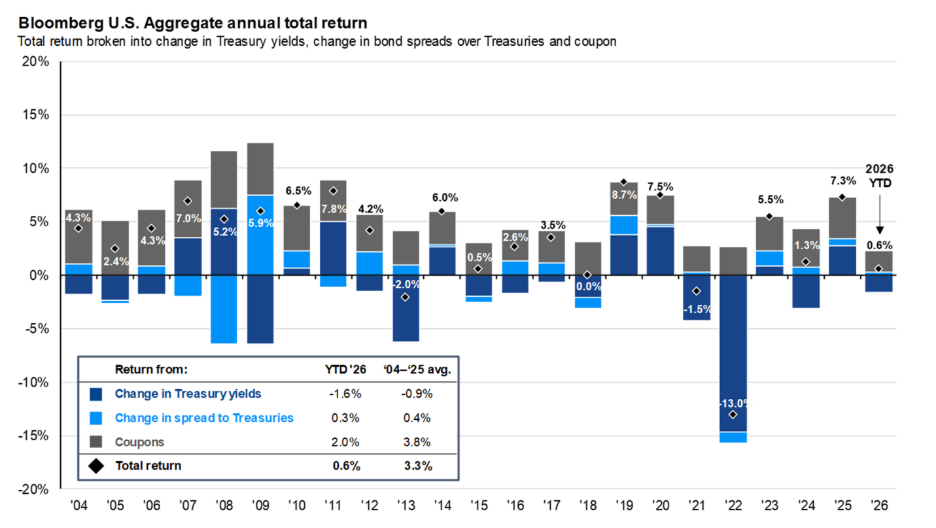
Interest rates have been the “talk of the town” for the past few years and have played a major role in the returns bond investors have seen. The key point here is that interest rates cut both ways for bonds. Interest rates have an inverse relationship with bond prices, so when rates go up, bond prices go down. On the flipside, higher interest rates result in higher income for investors.
Bonds recovered nicely last year as a result of modest interest rate declines, shown below in dark blue, and attractive coupons, shown in grey. Bond spreads, shown in light blue, remained tight and had little influence on returns.
The story this year has shifted. Longer-term rates have been volatile, despite the Fed holding rates steady. That’s because intermediate bonds price on intermediate to long-term interest rates, not the policy rate. Longer-term bond yields have moved higher. That’s the roughly -1.6% drag from Treasury yields (dark blue) within this year’s total return.
However, investors are still receiving higher coupons. Coupons have done the heavy lifting for bonds this year. Even with the U.S. Aggregate index, our core bond benchmark, up modestly this year, higher coupons have allowed bonds to keep their head above water. Bond prices will fluctuate over time as the current rate environment changes, but your coupon is fixed.
Chart o’ the Week
The narrative this week shifted away from the bond market as geopolitical tensions moved back into the driver’s seat. The week began with the U.S. executing missile strikes on Iran. Iran retaliated by attacking U.S. assets in the region. Oil prices spiked. The fear is that the renewed conflict will delay a resolution and continue to push inflation higher and global interest rates along with it. The market continues to balance rising rates, yo-yoing oil prices, all while equities sit near all-time highs.
The macro and monetary indicators were the busiest this week. The main story came mid-week as the probability of a rate hike at the September FOMC meeting jumped significantly to about 65% from around 35% the week before. As a result, the 10-year Treasury touched 4.82% on Wednesday, the highest level since November 2023. On Thursday, Fed Governor Waller made comments about supporting a hold if inflation moderated. This sent the probability of a rate hike down to about 50% in September, and the 10-year dipped to 4.77%. Friday brought strong payroll data, which moved the probability of a rate hike up over 50%, accounting for the third move this week. This emphasizes the fragility of the situation and how quickly it can change from day to day. August CPI will be released prior to the FOMC meeting in September which we expect will play a key role in how the committee moves forward.
Market fundamentals remain the strongest indicator. S&P 500 profits have grown for 12 consecutive quarters now. Q2 earnings this year were up about 40%, and revenue growth was steady at 14%. The remarkable number is that 84% of companies beat earnings expectations in Q2. Looking ahead to Q3, analysts expect another strong quarter, with earnings expected to rise 22.3%. However, valuations are beginning to show signs of strain. Forward P/E now sits at 19.6, slightly higher than the 10-year average of 19.0, indicating valuations are beginning to look a bit rich.
Trend remains strong, with markets sitting near all-time highs. However, market concentration has begun to rear its nasty head again. Schwab reported that Nvidia and Micron alone accounted for roughly one-third of the market’s 2026 profit growth, and the 10 largest contributors explained about two-thirds. The strength we are seeing in the market is real but narrower than what we might see in the headlines. The percentage of S&P 500 stocks trading above their 50-day moving average fell below 50% this week after topping 70% in mid-August. Breadth isn’t completely breaking down, but the areas that have detracted are more interest-rate-sensitive sectors.
The market has navigated several disruptions this year, whether it’s tariffs, war, or inflation. A firm labor market and strong corporate earnings have allowed it to remain resilient. We expect that resilience will be tested again when the FOMC meets at the September meeting.
OK now, this long weekend isn’t going to enjoy itself. So, get after it!
Tim