

Are you wondering why so much of what you online read today leaves you feeling hollow?
You may find this to be especially true of what you read on my two preferred content platforms, Substack and LinkedIn. One of the reasons they are two of my favorites, by the way, is that they tend to feel a touch more personal or purposeful (respectively) than many of the others that often feel like nothing more than manufactured algorithmic clickbait.
Yet, if I spend more than a few minutes on either, I’m increasingly feeling like that which I’m consuming is all three: manufactured, algorithmic, and clickbait.
In this week’s Net Worthwhile weekly, I’m exploring something I love dearly—reading and writing—and how a transactional approach to these practices custom designed to get us to buy products and services has diminished the value of our online conversations.
I’ll suggest a new equation that I hope will breathe more life into how you approach our online communication, whether you’re acting as a creator or consumer.
Thanks for joining me this weekend!
Tim
Tim Maurer, CFP®, RLP®
In this Net Worthwhile® Weekly you'll find:
Financial LIFE Planning:
Content < Connection > Conversion
Quote O' The Week:
Bob Marley
Weekly Market Update:
International > US (this week)
Financial LIFE Planning
Content < Connection > Conversion
A Better Equation For Satisfying Reading, Writing, And Business Development
I think we all know what clickbait is and feels like now—a compelling (if not manipulative) headline that isn’t substantiated within the actual body of the post or article. It’s designed to increase a content creator’s ad revenue, not to inform. Big hat, no cattle, as my Texan friends would say.
By algorithmic, I mean content that is either promoted or suppressed (the latter of which this post is almost sure to inspire!) for the sake of the platform, not the reader. Substack, for example, would definitely be my favorite social platform if every fifth post wasn’t a surely-promoted post extolling the never-ending virtue of the platform itself. And as for suppression, did you know that the LinkedIn algorithm will give your post a demerit if there’s a link outside of LinkedIn in the post?
But the real issue I’m attempting to address here is manufactured content, because while we may be able to use our knowledge of clickbait and algorithms for our benefit or that of our enterprises, we really don’t have any control over it. We do, however, have control over manufactured content.

So, What’s Manufactured Content?
Manufactured content is that which is not designed primarily for the purpose of its inherent existence (good art, if you will) or for the primary benefit of its recipient, but instead for the benefit of the content generator.
It is content that is not composed primarily in service of those who read it, but for those who wrote it. Yes, of course it’s the thinly veiled self-congratulatory “I’m honored to be so awesome” post and the plea-for-sympathy “Can you believe what I’ve overcome?” post. But it’s also the horde of less obvious posts for which the purpose of getting you to do something for—or buy something from—the author preceded the actual message.
AI is currently taking a beating for a lot of this, and not without reason—it truly is threatening to drown out whatever genuine content exists. But the tool of AI is not to be blamed for the intentions of the humans who deployed it. Those same humans were simply writing less (and less articulate) content two years ago.
This Isn’t Anti-Sales
But please note, this is not a plea for content so singularly produced for the benefit of its readership that it would qualify for the most virtuous of non-profit status.
The real question is: What is the primary purpose of this content?
If the primary purpose is to tell an amazing story, make us laugh, inspire us, educate us, or make us healthier, wealthier, or wiser, and the secondary purpose is to let us know that someone is gainfully employed in a pursuit that could lead to a mutual benefit, we’re good!
I don’t have a problem with content marketing. I do, however, have a problem with marketing masquerading as content.
And if the unveiled purpose is to get us to buy something? I don’t have a problem with that either. I love a good sales pitch. But nobody loves getting fooled, and I don’t believe that fooling people is a sustainable business model.
Building The Best Hotel In the World
While so much online content these days leaves us feeling empty, I enjoyed a pleasant surprise this week when I attended my local Rotary meeting, fully expecting some sustenance, fellowship, and a touch of inspiration from a speaker, when I learned that the person giving the 20-minute talk was none other than Horst Schulze.
If that name doesn’t ring a bell, Horst was the founding president and COO of The Ritz-Carlton, whose motivation to leave one of the world’s largest hotel brands for that gig was singular: to create the best hotel brand in the world. But that’s not the point.
Starting in the hospitality business at the age of 14 in Germany, he was trained in delivering what the Ritz has surely become known for: excellence. And that’s also not the point, because what Horst learned when he was still a teenager, long before he even moved to the United States or launched the first Ritz-Carlton in Atlanta’s Buckhead enclave, was that excellence for its own sake wasn’t enough.
It needed to be excellent for a purpose—in this case, the purpose of elevating people and making people feel elevated. Before choosing to embark on this journey, he asked the following questions:
Would it be good for the patrons?
Would it be good for the employees?
Would it be good for the investors?
Would it be good for society?
(A person of faith, he also asked the question, “Would God approve?”)
So it certainly wasn’t being the biggest that inspired him, and you can see that he had a very clear vision of what it even meant to be the best. It wasn’t just to be the best—it was to be the best for something, and in this case, that something was the people it served and employed.
Content < Connection > Conversion
Which brings us circuitously back to the point of this communication. The world doesn’t need any more content. We’re awash in content. Some of it is created by humans, some by robots at the behest of humans, and some that is created by robots at the behest of robots.
While it might consume it, the world doesn’t need just another blog post, podcast, or video.
What the world does need—perhaps more than ever—is more genuine connection. And the really cool thing is that great, genuine content does, indeed, help us connect.
Now, here’s the trick: Some great content connects, but for the primary purpose of conversion.
It might be for the purpose of converting someone to buy your product or service—or to buy your religion, or your political stance or whatever else.
And I believe that cheapens the content and diminishes, if not destroys, the connection.
So Why Not Do Better?
Horst Schulze didn’t set out to build a business. He set out to make people feel like they mattered—and a great business was the result. The content followed the connection, and the conversion followed both.
That’s the equation: Content < Connection > Conversion. Connection isn’t a step in the funnel. It’s the point. When it is, the content gets better—because it’s honest. And the conversion follows—because it’s earned.
It’s worth noting that even the companies building the AI tools flooding our feeds with manufactured content are beginning to figure this out. Netflix recently posted a communications role paying up to $775,000. Anthropic tripled the size of its communications team last year. OpenAI is hiring writers at $400,000. LinkedIn job postings mentioning “storyteller” doubled between 2024 and 2025. The companies that taught machines to write are paying a premium for humans who can connect.
So if you’re reading this and wondering what to write next, or say next, or post next—maybe don’t start with “What will get engagement?” or “What will convert?”
Start with the question Horst asked before he built the best hotel in the world: Would this be good for the people it’s meant to serve?
If the answer is yes, the rest tends to follow.
Quote O' The Week
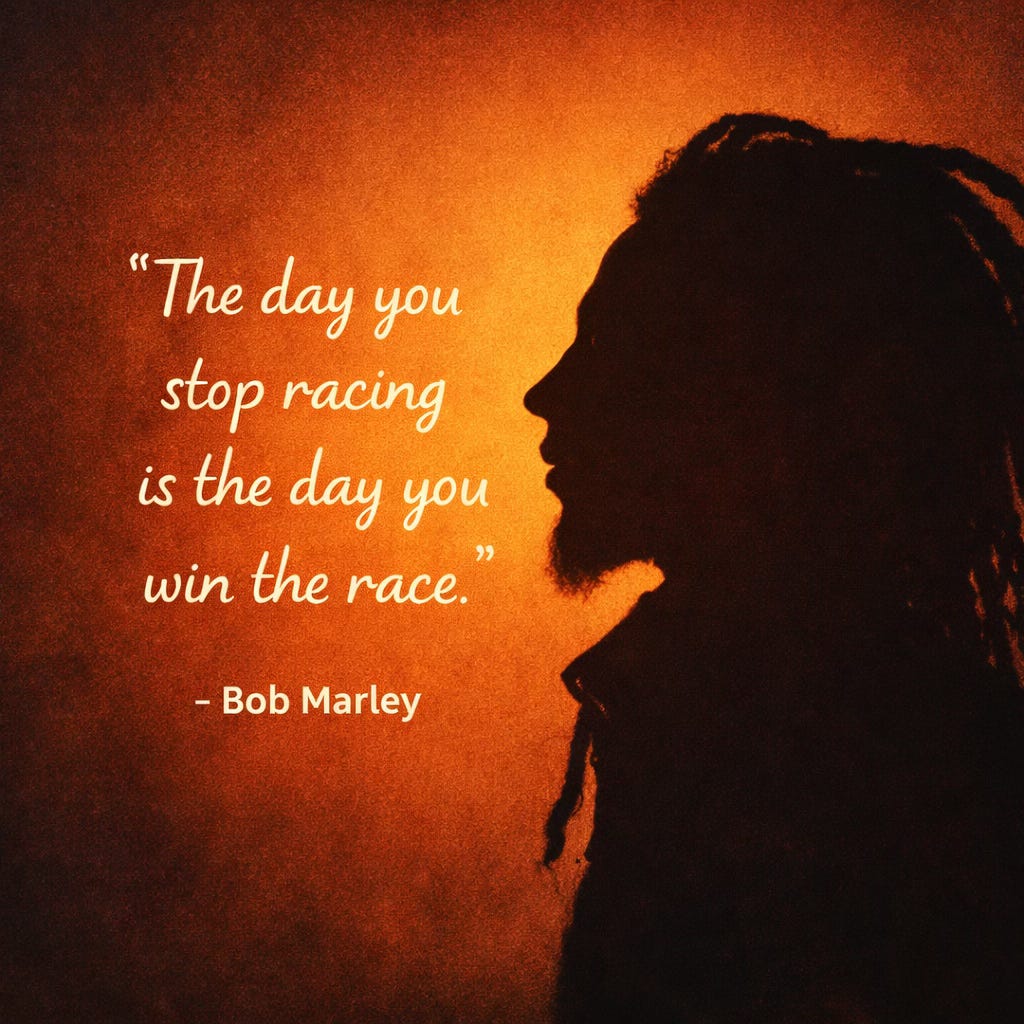
Bob Marley (1945–1981) was a Jamaican singer, songwriter, and musician who became one of the most influential artists of the 20th century, bringing reggae music and Rastafari philosophy to a global audience. His songs of love, resistance, and spiritual freedom have transcended generations — and so, it seems, have words he may or may not have actually spoken. This quote, like several others widely attributed to Marley, has no verified source. But perhaps that's fitting for a man whose message was always bigger than the messenger.
Weekly Market Update
Only international markets were spreading the LOVE this week:
- 1.39% .SPX (500 U.S. large companies)
- 0.38% IWD (U.S. large value companies)
- 0.78% IWM (U.S. small companies)
- 0.17% IWN (U.S. small value companies)
+ 1.01% EFV (International value companies)
+ 1.93% SCZ (International small companies)
+ 0.82% VGIT (U.S. intermediate-term Treasury bonds
Our resident market analyst will be back with us next week, surely providing us with two weeks’ worth of insight!
Tim
This resonates with me as true! Great insight and thank you for sharing, Tim.