


I had a near-death experience, it’s true.
The whole story is a topic for another day, but I can verify what you might expect: It was an experience so powerful that more than 30 years later, there’s not a day of my life that has been lived absent the imprint of what was nearly lost.
And yet, I was struck recently with the notion that the ordinary distractions of life, when compounded by an attempt to navigate them simultaneously, often lead to a diminishment of moments that could otherwise be enjoyed, if not remarkable. The end result can be a squandering of the scarcest of all the resources we’re capable of possessing—our time.
Let’s call it what it is: a near-life experience. Present in body, elsewhere in mind.
In this week’s Financial LIFE Planning section, I’ll give you a simple example, an attempted explanation of the science behind this phenomenon, and a recommendation that will, I hope, infuse more of your precious moments with meaning. Then, Tony Welch updates on the wide dispersion in private equity returns.
Thanks for joining for this week’s Net Worthwhile weekly!
Tim
Tim Maurer, CFP®, RLP®
Chief Advisory Officer
In this Net Worthwhile® Weekly you'll find:
Financial LIFE Planning:
Don’t Settle For A Near-Life Experience
Quote O' The Week:
Anne Lammot
Weekly Market Update:
Dispersion is Wide in Private Markets
Financial LIFE Planning
Don’t Settle For A Near-Life Experience
I have a precious two-year-old daughter whose very existence was the shock of a lifetime, and perhaps especially because I had plans beyond hitting the 18-year reset button in my late forties, I occasionally notice that I’m still trying to live out Plan A despite the fact that I’m neck-deep in Plan B.
The way this has often looked is that while our precocious little package is in my charge, I’ll often be doing something else. That something else almost always involves my phone, whether it is the pursuit of the elusive inbox zero, keeping a project moving forward with my more intellectually stimulating thought partner, Claude, scanning the daily load of clickbait related to the world’s apparently imminent demise (or Lamar Jackson’s forthcoming contract extension), or the more virtuous search for the next (potentially but rarely) life-changing article on Substack.
The Toddler Time Hack
Yet my toddler cannot be fooled, because she has a roughly 100% track record of intuitively knowing that she lacks my undivided attention, and thus dedicates hers to reclaiming mine.
The net result, as you might expect, is dissatisfactory for both of us, regularly resulting in a mutually agitated state, or at best, the mere passage of time.
BUT.
But when I simply give her the gift of my undistracted self, everything changes. She almost seems to revel in the glory of having all of her dad. She narrates the whole experience, processing her every thought aloud, with regular exclamations that carry us from the Play-Doh station to her magnetic blocks to her quick-change routine and regularly to the reenactment of Simba’s euphoric reveal in the opening moments of The Lion King.
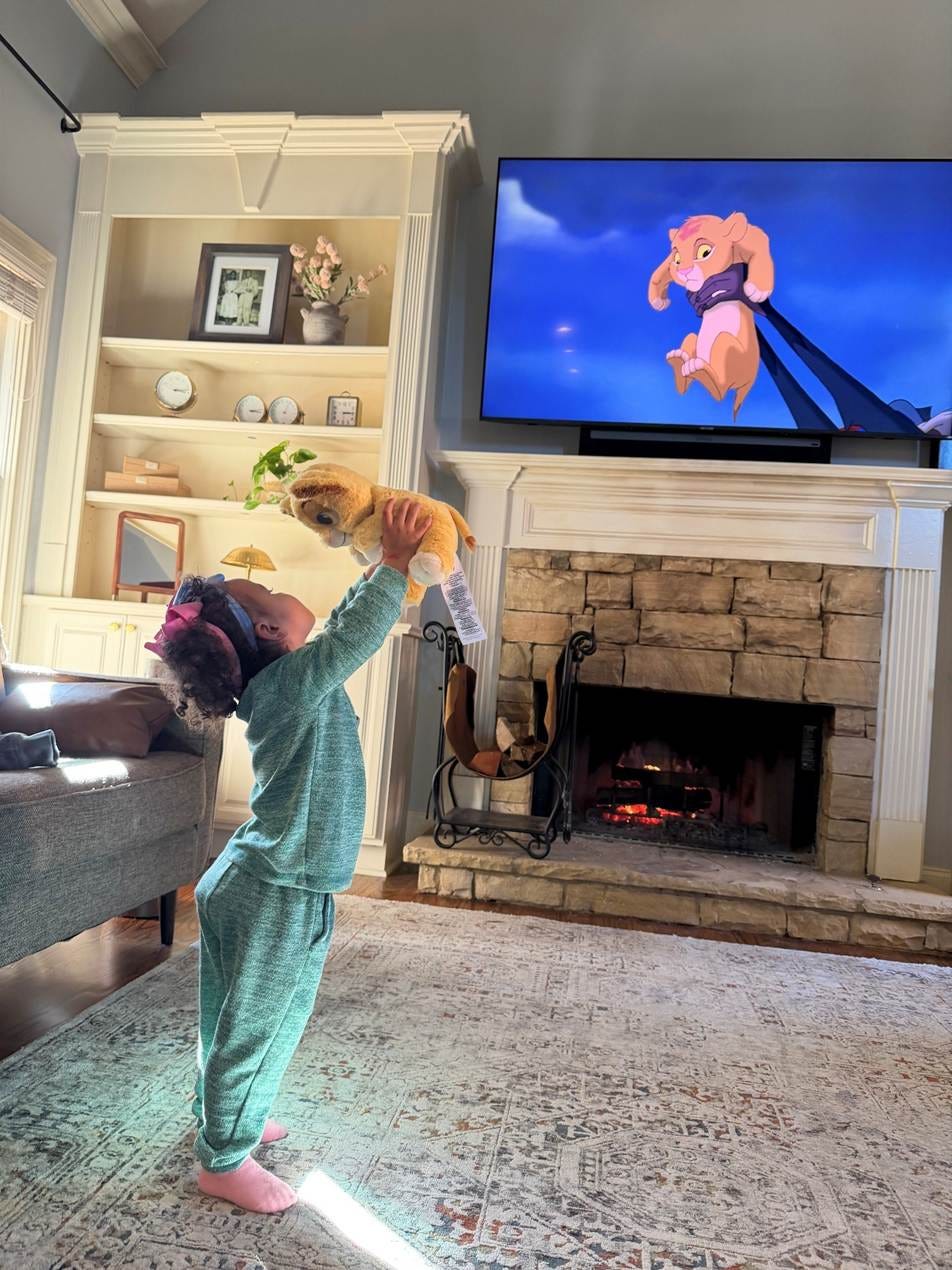
In the end, it’s really quite a simple equation. If I only give a portion of myself to my daughter, we both experience something that could only be described as a near-life experience, and time moves slowly. Yet, if I give my whole self to her in these moments, it seems to unlock a real-life experience for both of us that often turns mundane moments into measurable memories that propel us swiftly through time.
The Bad News About Good News
My daughter, it turns out, isn’t just fighting for my attention. She’s fighting my neurology. And the thing about moments is that we have to work harder to create and maintain them.
I don’t have any trouble remembering my near-death experience, and the science suggests that our negative experiences in life tend to impact us more than our positive experiences.
Rick Hanson is a neuropsychologist and senior fellow at UC Berkeley’s Greater Good Science Center and has written several books, including Hardwiring Happiness: The Practical Science of Reshaping Your Brain—and Your Life. He suggests “the brain is like Velcro for negative experiences and Teflon for positive ones.”
This negativity bias has helped keep us alive longer by remaining ever attentive to life-threatening situations, but it also draws our attention disproportionately to all those negative headlines and, yes, even the potential threat of the bad news email that may never come.
The marriage whisperer, Dr. John Gottman, goes so far as to suggest that we must apply the 5:1 ratio in our partnerships to maintain relational health. While acknowledging that conflict is inevitable, especially in our most intimate of attachments, “for every negative interaction during conflict, a stable and happy marriage has five (or more) positive interactions.”
It seems that we can simply expect our negative experiences to do their work, but we must be intentional about manufacturing positivity in our lives.
Awareness Breaks The Spell
Dr. Hanson gives us just the prescription for doing so: When something good happens, don’t just notice it; dwell in it for 20 or 30 seconds. “Taking in the good” allows us to savor a good experience long enough to help guide it from shorter- to longer-term memory—the same 20 or 30 seconds my daughter has been trying to give me all along.
Because the negativity bias operates most powerfully when we’re unconscious of it, the moment we notice and name the good stuff, we can gain leverage that our ancestors never had.
Attention Training
I recently took one additional step to train my attention to operate in the way I prefer. I actually paid about $50 to purchase a device that disables my phone called The Brick.
Yes, I know there may be cheaper and simpler ways to navigate the challenge that our phones pose in stealing attention from the humans we love—like just putting your phone in do-not-disturb, or better yet, the drawer. But then we also lose some of the functionality that we may well want, like the ability to accept an important phone call or, say, capture a memorable moment by taking a picture.
The Brick, therefore, allows you to create different modes and schedules that either only allow certain apps or restrict others. The schedule inspired by this near-life revelation I’ve shared with you is dubbed “Family Time,” and it disallows all the apps I don’t want to encroach on time with my wife and daughter from 5:30 pm until 8:00 am.
(I have other schedules too, like one that turns EVERYTHING off except for sleep-enabling apps when it’s time to wind down for bed; and one that I’m piloting soon called “flip phone” that will transport my phone back into the 1990s for 24 hours every Sunday.)
If I really want or need to gain access to anything disallowed, I have to walk into my home office, tap my phone against the Brick, and I’ve got the whole phone back. But I think it’s only happened one time since I installed the app. Otherwise, I’m spending my time more intentionally thanks to a device that makes my smartphone dumb.
The Life That’s Already Here
This isn’t an anti-technology post, and The Brick is no one’s savior. It’s just one person’s honest attempt to stop accidentally living a smaller life than the one that’s right in front of him.
Thirty-some years ago, I nearly lost everything. What I gained in exchange was a visceral understanding that ordinary moments aren’t ordinary at all. That understanding shouldn’t require a brush with death, and it doesn’t have to.
We don’t need a near-death experience to stop settling for a near-life one. We just need to notice what—or better yet, who—is actually in the room.
Quote O' The Week
Anne Lamott is a bestselling author and spiritual teacher who writes about faith, motherhood, and imperfection with unflinching honesty and dark humor, helping readers find grace in the messy, ordinary moments of life.
Weekly Market Update
Friday’s tumble sent the broader markets negative for the week while international markets did what they do best—help us diversify:
- 0.58% .SPX (500 U.S. large companies)
- 0.09% IWD (U.S. large value companies)
- 1.03% IWM (U.S. small companies)
- 1.79% IWN (U.S. small value companies)
+ 0.90% EFV (International value companies)
+ 0.68% SCZ (International small companies)
+ 0.65% VGIT (U.S. intermediate-term Treasury bonds
Dispersion is Wide in Private Markets
Contributed by Tony Welch, CFA®, CFP®, CMT, Chief Investment Officer, SignatureFD
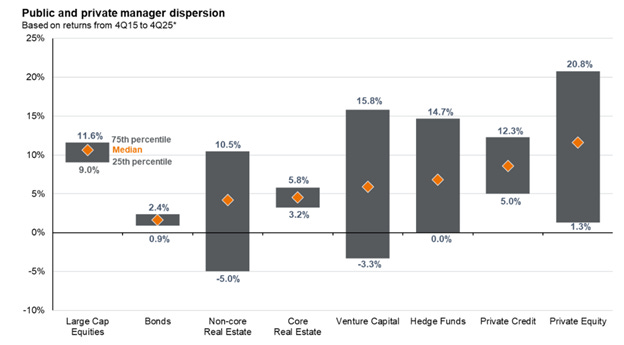
This week’s chart highlights a reality that often gets lost in the “alternatives are better” narrative: dispersion is dramatically wider in private markets than in public ones. While large cap equities and bonds show relatively tight ranges of outcomes, private equity, venture capital, and even private credit exhibit a much broader spread between top and bottom quartile managers. That is the opportunity and the risk. In a narrow dispersion world, beta does most of the work. In a wide dispersion world, manager selection becomes the strategy.
Recent headlines around Blue Owl reinforce this point. Liquidity concerns tied to redemption pressures, asset sales, and changes to fund withdrawal structures have weighed on publicly traded private capital names and raised broader questions about valuation, liquidity, and retail access to these strategies. Importantly, this does not invalidate private markets as an asset class, but it does highlight that not all exposure is created equal.
Our approach is to be highly selective, focusing on partners with disciplined underwriting, aligned incentives, and demonstrated ability across cycles. In areas where outcomes can vary this widely, success to us is less about accessing the asset class and more about accessing the right managers.
Chart O’ The Week
The Message from Our Indicators
The macro backdrop continues to hold up despite uncertainty around tariff policy and the labor market impact from AI. Recent data shows U.S. growth firming, with the Chicago Fed National Activity Index turning positive and pointing to above-trend activity early in the year. Business leaders are responding accordingly, with CEO confidence jumping into net optimism for the first time in a year and signaling a willingness to invest. At the consumer level, expectations have begun to stabilize after a prolonged decline, reducing recession fears and supporting spending. Even the evolving tariff backdrop, while creating uncertainty, appears unlikely to derail global growth.
Fundamentals are still supportive, but the rate of improvement is slowing. The latest earnings season showed that while most companies continue to beat expectations, the beat rate has declined and is now the weakest since 2022, with negative year-over-year momentum. At the same time, the breadth of earnings revisions has deteriorated, and forward earnings growth expectations have begun to flatten. This is not a collapse in profits, but it does suggest that the easy phase of upside surprises is likely behind us.
Technicals and sentiment still paint a bullish, but imperfect picture. Despite some corrective action in the headline indexes, the broad market trend remains higher. But underneath the surface there has been increased rotation and divergence across sectors. Measures of market participation are still healthy, yet leadership has shifted to more defensive areas, pointing to a bit more risk aversion early in this year. At the same time, sentiment has turned notably pessimistic even as breadth remains solid, a rare combination that has historically been associated with positive, though more moderate, forward returns. In other words, we expect the market is not breaking down, but it is working harder to move higher.
Putting it all together, we believe this looks less like a market peak and more like a maturing bull market, for now. Mid-term election years have historically brought more volatility and rotation, and that is likely the environment we are entering. Periods of uneven leadership and choppier returns should be expected. However, with economic activity holding up and corporate profits still growing, the broader trend remains constructive even if the path forward is less smooth.
Constructively,
Tim
For me, the idea of just 'being present' can be a challenge. Distractions are everywhere, not just physical ones like the phone, but emotional ones in our minds.
I catch myself in situations where I'm in a room with friends having a nice time but thinking about something else like what I have to do the next day. It's not intentional, but it almost feels borderline disrespectful, especially for an introvert who already has a limited social bandwidth.
This idea even shows up in very small ways, like when I am home alone watching TV or listening to music. I can find myself thinking maybe there is a better show I should be watching or a song I'd rather be listening to. It's a strange phenomenon.
Your article is a good reminder to exercise my awareness muscles.
I still very vividly remember your FPA talk on your near-death experience and using our own stories to reach our clients - an important message, just like this near-life one. Thank you for sharing, Tim! (and for THE cutest reenactment of The Lion King)