


I had to laugh, because one of the topics I’d cued up to write on—how constraints can actually lead to creativity, rather that stifle it—came into real life this week.
The very time I set aside to write weekly was the same as the availability for our mechanic to complete the mandatory renewal of the brakes on my wife’s car. So, instead of my comfy home office with the personally cultivated writing playlist ringing out, I was tapping out this week’s Financial LIFE Planning post in the mechanic’s waiting room with the TV blaring and an implausibly oblivious hard charger insistent on conducting his conference call on speakerphone.
Life imitating art, I suppose. You’ll be the judge, and I hope you’ll let me know if this Financial LIFE Planning post connects with you.
And Tony Welch answers the question, “Are profit margins the market’s quiet superpower?” in this Weekly Market Update.
Tim
Tim Maurer, CFP®, RLP®
Partner
In this Net Worthwhile® Weekly you'll find:
Financial LIFE Planning:
Don’t Wait To Feel Inspired
Quote O' The Week:
Pyotr Ilyich Tchaikovsky
Weekly Market Update:
Are Profit Margins The Market's Quiet Superpower?
Financial LIFE Planning
Don’t Wait To Feel Inspired
Stravinsky, Creative Constraints, and the Counterintuitive Path to Financial Freedom
Imagine for a moment that you’re the most famous living musician in the world, but the critics haven’t been kind to your work for years, you’ve lost the fortune you once had, and you’re recovering from your own bout with tuberculosis, the same disease that just claimed the lives of your daughter, spouse, and mother, all within the course of seven short months. And you’ve been invited to chair a series of lectures at Harvard.
Igor Stravinsky could claim this narrative, as he sailed solo from war-torn Europe to the United States in September of 1939. As the Charles Eliot Norton Professor of Poetry, he was the first composer ever appointed to this prestigious post for the 1939-40 academic year at Harvard.
But from where could Stravinsky possibly derive the inspiration for his message? Or anything at all?

Fortunately, for him (and for us), it was a philosophy that had driven his work for many years, and it’s a philosophy that we may apply in our own lives—and financial planning—if we’re willing to address the discomfort and embrace the constraints we’ll inevitably face.
But first, let’s take a look at Stravinsky’s philosophy and why it was so counterintuitive, especially for an artist.
Inspiration: Chicken Or Egg?
“Most music-lovers believe that what sets the composer’s creative imagination in motion is a certain emotive disturbance generally designated by the name of inspiration... I simply maintain that inspiration is in no way a prescribed condition of the creative act, but rather a manifestation that is chronologically secondary.”
Stravinsky certainly seems to think that inspiration follows the creative act—it doesn’t precede it. But rather than making a defense or critique of his claim, let’s consider: How could we apply this notion beneficially in our own lives—or even more concretely, in our financial plans?
For one, we have a tendency to apply certain labels to ourselves—some consciously while others reside below the surface, but no less powerfully. We may label ourselves “bad with money” or “a spender.” We may consider ourselves a good investor, thereby blessing even our poor decisions, or a bad investor, living down to our diminutive standard.
But while we as humans are incredibly complex, disciplines like good budgeting or sound investing are not opaque; nor do they require an epiphany to do them effectively. We can simply choose to do these things—or make the call to get the help we need—and thereby build the habits that can lead to a balanced budget and a promising portfolio without an ounce of emotional inspiration.
Consider the words of the all-time sage, C. S. Lewis, that I believe apply as much in math as they do in metaphysics: “Very often the only way to get a quality in reality is to start behaving as if you had it already.”
What if, for example, we’d like to be a friendlier person?
“When you are not feeling particularly friendly but know you ought to be, the best thing you can do, very often, is to put on a friendly manner and behave as if you were a nicer person than you actually are. And in a few minutes, as we have all noticed, you will be really feeling friendlier than you were.”
Helpful (And Hurtful) Constraints
But we are quick to quote a long list of excuses—reasons we can’t do something we know we should and have expressed we want to do—when it comes to taking the often uncomfortable action required to achieve our desired result, aren’t we?
I just don’t have the time. It runs in my family. I’m not (fill-in-the-blank) enough. I’ll do it when…
But for Stravinsky, it was precisely these constraints—this resistance—that he used as the very foundation for his creativity:
“In art as in everything else, one can build only upon a resisting foundation: whatever constantly gives way to pressure, constantly renders movement impossible. My freedom thus consists in my moving about within the narrow frame that I have assigned myself for each one of my undertakings.”
And just as we begin to voice how ridiculous this seems to sound, he interrupts and doubles down:
“I shall go even further: my freedom will be so much the greater and more meaningful the more narrowly I limit my field of action and the more I surround myself with obstacles. Whatever diminishes constraint, diminishes strength. The more constraints one imposes, the more one frees one’s self of the chains that shackle the spirit.”
OK, OK, we get it! And how can we use this logic within our financial planning? How, precisely, can constraints—even self-imposed constraints—lead to greater freedom? Well…
Spending less than we earn delivers us from the bondage of consumer debt.
Setting aside free cash flow for a specific purpose—say, a monthly date night with your boo—helps fund our priorities.
Deferring a modicum of enjoyable spending today enables us to sustain ourselves in the future.
Giving a portion of our income or assets to those who have less tends to make us feel like we have more.
Establishing an “investment policy statement” pre-decides how we’ll respond to certain stimuli absent the emotion that may lead to an unwelcome impulse.
But to be clear, research has found that not all constraints are equal—or inspirational—and some can actually suppress our creativity and the joy to be derived from it. For example, in the work she did on the social psychology of creativity, Teresa Amabile found the following:
People produce less creative work when they know they’re being watched while doing it.
Simply knowing that your work will be judged, even before the judgment has happened, can limit creativity.
And working toward an externally imposed reward, rather than an intrinsic interest, can also reduce creativity.
In short, the natural constraints of life—and the constraints that we choose to impose on ourselves—can be helpful, while constraints that function as social control can be hurtful.
What If We Make A Mistake?
But what about accidents? What if we make a mistake? How can we avoid being derailed in these instances?
“One does not contrive an accident: one observes it to draw inspiration therefrom,” Stravinsky said. “An accident is perhaps the only thing that really inspires us.”
He speaks of these accidents with such reverence that it makes me wonder if he’s not invoking a line that a mentor of mine was fond of saying as a way of inspiring us to find the sacred amidst the mundane: “You go no place by accident.”
And regardless of whether or not your belief system aligns with my mentor, or Stravinsky, is it not true that the unexpected could just be viewed as opportunities for improvisation? Opportunities to get more creative?
But I’m Not An Artist
But much in the same way that we may find it a bit out of touch when someone who is independently wealthy offers a lesson on contentment to those who are struggling just to get by, can we really expect one of the world’s greatest composers to lecture us on creativity? Isn’t it easier for Stravinsky to make this claim?
I’m not so sure. Remember where our story started. Though still celebrated worldwide, he’d lost virtually everything—materially and personally—when he gave these lectures. And far from espousing a condescending form of creativity that was the domain of an elect few, he actually had harsh words for those who might be inclined to romanticize the artist:
“The word artist which, as it is most generally understood today, bestows on its bearer the highest intellectual prestige, the privilege of being accepted as a pure mind—this pretentious term is in my view entirely incompatible with the role of the homo faber.”
“Homo faber”—man the maker, the fashioner, the smith, the craftsperson. Great art, ingenuity, creativity—even wealth—were never the domain of an inspired elite. They belong to the maker: anyone willing to do the work and to fashion a life from the accidents, happy and unhappy, that come our way. The inspiration follows.
Quote O' The Week
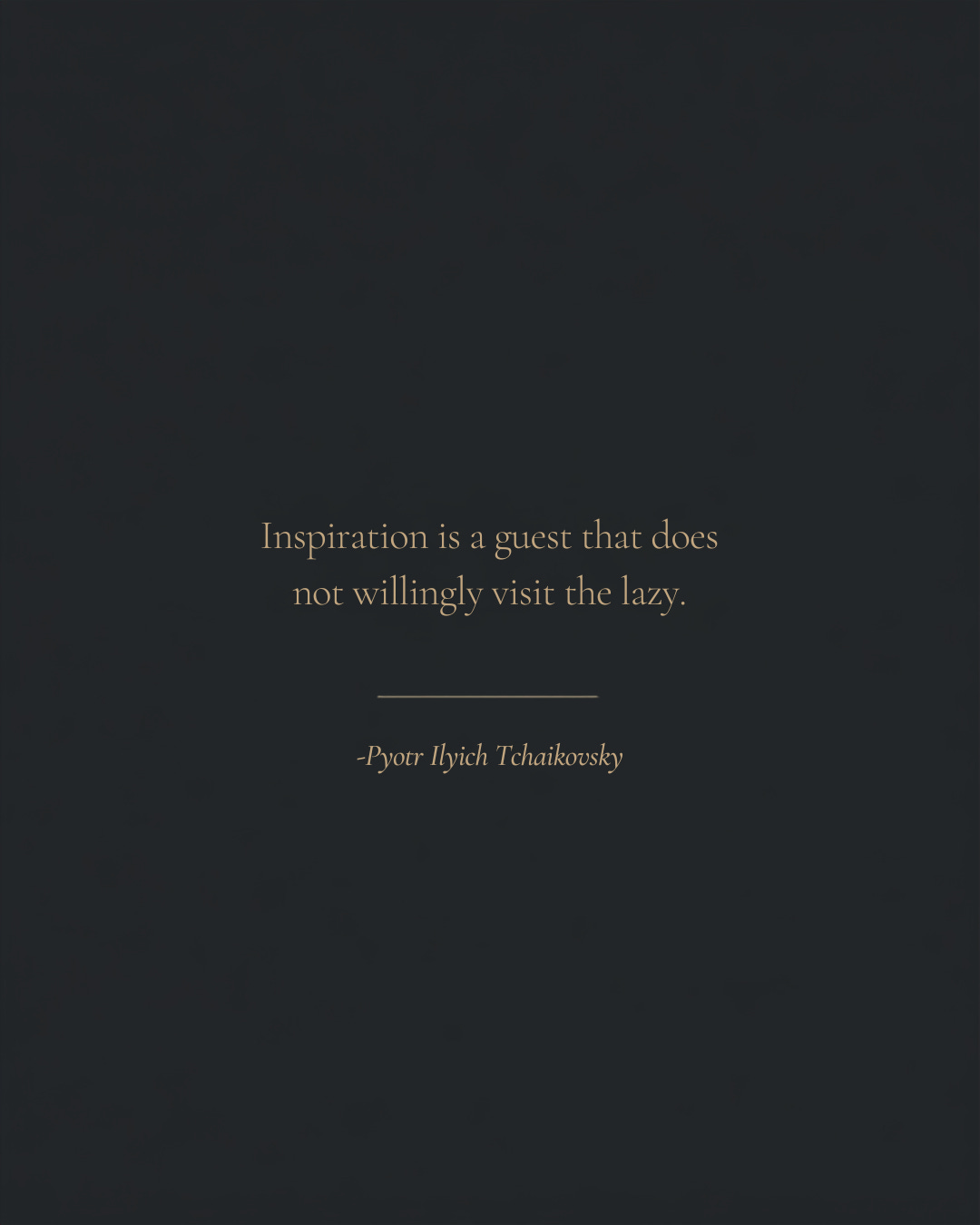
Pyotr Ilyich Tchaikovsky (1840–1893) gave the world Swan Lake, The Nutcracker, and his heartbreaking final symphony, the "Pathétique." He trained for the civil service and clerked in the Ministry of Justice before walking away to bet his life on music. For all the Romantic sweep of that music, he worked like a craftsman—at his desk nearly every day, muse or no muse. He wrote the line below in an 1878 letter to his patron.
Weekly Market Update
Markets were as mixed as they’ve been in a minute, and Tony gives us the scoop in the Weekly Market Update below:
- 1.55% .SPX (500 U.S. large companies)
+ 0.48% IWD (U.S. large value companies)
- 0.66% IWM (U.S. small companies)
+ 1.08% IWN (U.S. small value companies)
+ 0.09% EFV (International value companies)
- 1.08% SCZ (International small companies)
+ 0.20% VGIT (U.S. intermediate-term Treasury bonds
Are Profit Margins The Market's Quiet Superpower?
Contributed by Tony Welch, CFA®, CFP®, CMT, Chief Investment Officer, SignatureFD
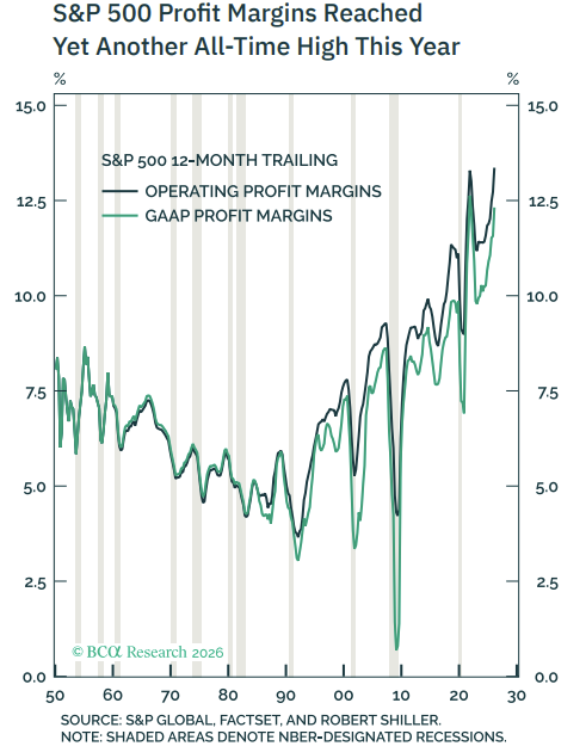
For all the attention on interest rates, tariffs, and geopolitics, one of the biggest drivers of this bull market has been quietly hiding in plain sight: record corporate profit margins. While sales growth has remained healthy, companies have become dramatically more efficient at turning each dollar of revenue into earnings. That helps explain why corporate profits have continued to outpace expectations and why equity markets have been able to support higher valuations.
The obvious question is whether these margins are sustainable. We believe the answer depends less on pricing power and more on productivity. Over the past two years, companies have invested heavily in artificial intelligence, automation, and operational efficiency. The next phase of the AI story isn’t simply building more infrastructure; it is helping businesses produce more with the same workforce. If those productivity gains materialize, today’s elevated margins could prove more durable than many expect. That said, though higher margins can command a higher valuation, they don’t justify paying any price at all for stocks. Even after accounting for today’s profitability, valuation measures still suggest investors are pricing in a healthy amount of optimism, which could explain the stall in the uptrend over the past six weeks.
Chart O’ The Week
The Message from Our Indicators
This week’s data reinforced the picture our indicators have been painting for several months. Inflation surprised to the downside as lower energy prices weighed on both consumer and producer prices, while retail sales continued to show that consumer demand remains resilient. Taken together, we believe the economy continues to look more like a slowing expansion than one approaching recession.
Our investment indicators remain constructive, but we’re also mindful of where we are in the market cycle. Breadth remains healthy despite the market taking a well-deserved pause after its powerful spring rally, suggesting that consolidation, not deterioration, is the more likely interpretation. Meanwhile, earnings season becomes increasingly important from here. Markets have already rewarded companies benefiting from the AI investment cycle. The next challenge will be proving that those investments are translating into broader earnings growth across the economy.
We continue to favor a disciplined, fully invested approach. We believe the backdrop of moderating inflation, resilient economic activity, and improving productivity remains supportive for long-term investors, even if markets experience periods of consolidation along the way.
Disciplined or not, I hope you have a great weekend!
Tim