

Reading fiction is relatively new for me. In the not-too-distant past, I thought there were more than enough real-life stories out there that I didn’t need to delve into the world of make-believe.
Then I met Jayber Crow, the main character in the fictional, if not semi-autobiographical, world composed by the late, great Wendell Berry. That world, “the Port William membership,” is depicted in eight novels and 42 short stories, and Jayber Crow finds his way—and his place—in Port William as the town barber.
Despite the fact that he never existed, I learned more from Jayber Crow—about pivots in life, the utility of journeying, the role of vocation, and the value of true community—than I have from most of the non-fiction I’ve read. And this set me on a path to learning through fiction that has been nothing short of revelatory.
In this week’s Financial LIFE Planning article, I’ll three reasons why I believe fiction is as fertile a field for learning as any non-fiction—and why I believe it can also be a powerful source of inspiration in our financial planning.
Of course, Tony Welch had his work cut out for him this week, after a historic midterm election and some similarly noteworthy market volatility that followed.
Thanks for joining us!
Tim
Tim Maurer, CFP®, RLP®
Partner
In this Net Worthwhile® Weekly you'll find:
Financial LIFE Planning:
Fact Or Fiction?
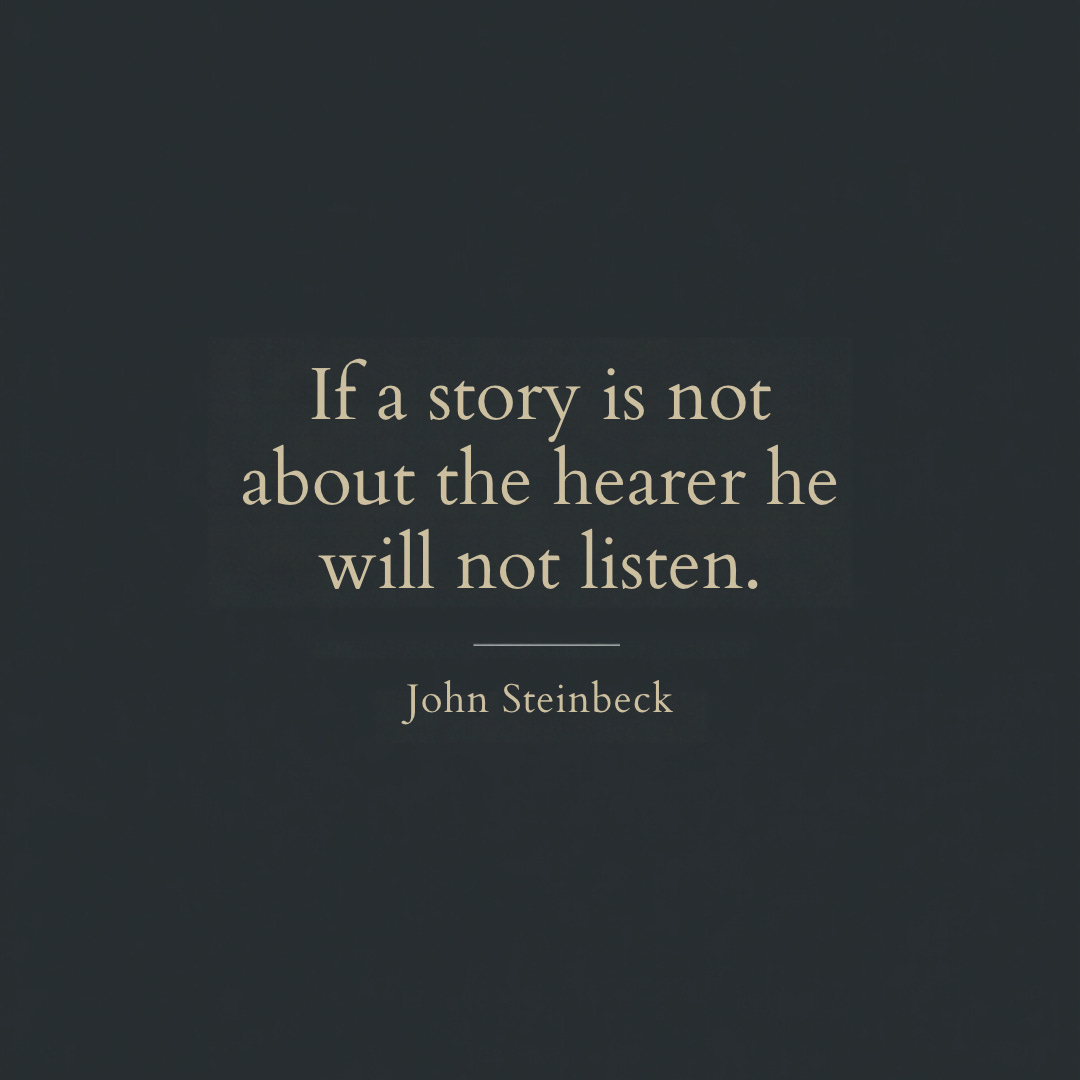
Quote O' The Week:
John Steinbeck
Weekly Market Update
A Rare Midterm Event
Financial LIFE Planning
Fact Or Fiction?
The Objective Case for Fiction As A Tool For Learning And Financial Planning
Here are three reasons why I believe fiction, beyond mere entertainment, is first-class education, too.
1) Facts aren’t always as factual as we’d prefer to believe.
Everything is actually commentary. We need not be reminded of this only days after the conclusion of a major election cycle, as we’re all likely still getting over the nausea from the months-long spin cycle to which we’ve been subjected.
And here’s the good news: The actual truth is often better than portrayed. For example, we may find solace in the fact that most of our American brothers and sisters aren’t actually communists, terrorists, racists, or fascists. Huzzah!
Beyond our borders, the same is also true. In the essential and decidedly non-fiction volume Factfulness, researcher and author Hans Rosling says that the groups he surveys tend to think the world is more frightening, more violent, more hopeless, and, in short, more dramatic than it really is. In the book, he presents the actual data, stripped of hyperbole and spin, on a number of different topics.
Of course, the goal isn’t to inspire rose-colored apathy toward the many problems our world and our country are facing, but to see those problems within the appropriate context, stripped of sensationalism.
In short, there’s more fiction in the presentation of many facts than we’d prefer to believe—and conversely, there’s plenty of truth to be found in the stories of people who never actually walked this earth.

2) Many of the best teachers use fictional stories to make their points.
From the Buddha to Plato (through Socrates) to the Taoist teacher Zhuangzi to Jesus Christ, some of the world’s most lasting teachings were communicated through fiction—parables, as well as poetry and allegory and song. It’s almost as though we, as humans, were made for (and often by) stories and narratives.
In the Gospel of Mark (4:34 NIV), the author notes of Jesus, “He did not say anything to them without using a parable.” And sometimes, it’s only through a story that we’re going to learn what we need to learn. Here’s one of my favorites:
Roughly 500 years before the Buddha hit the scene, King David reigned. We learn that while his men were at war, David sees a beautiful woman bathing on a roof—yup, I’m definitely hearing Jeff Buckley’s rendition of Leonard Cohen’s Hallelujah right now. But the woman, Bathsheba, was the wife of one of David’s soldiers, Uriah the Hittite.
David can’t resist, so he calls for Bathsheba, sleeps with her, and she becomes pregnant. To cover his tracks, David tries to get Uriah to come home to spend some quality time with his wife so the timeline of the child’s birth won’t look suspicious. But Uriah refuses to enjoy the comforts of home while the soldiers in his command are in harm’s way. So David chooses, instead, to send Uriah to the front lines where he is killed. Problem solved.
Then, according to the text, God sends the prophet Nathan to David, and he doesn’t accuse him of anything. He tells him a story of a rich man and a poor man. The rich man had extensive flocks and herds of animals, but the poor man only had one ewe lamb. Nathan describes in detail how the poor man raised the lamb among his own children—allowing it to eat from his plate, drink from his cup, and sleep in his arms. The lamb was a member of the family.
Then a traveler comes to visit the rich man, but instead of choosing an animal from his huge herd, he slays the poor man’s lamb and serves it for dinner.
The king responds indignantly (12:5-6): “David burned with anger against the man and said to Nathan, ‘As surely as the LORD lives, the man who did this must die! He must pay for the lamb four times over, because he did such a thing and had no pity.’”
Now Nathan responds, “You are the man!” And David is undone with grief over his actions.
Often a story will make a point better than…our point. Or as author Tim O’Brien puts it, “Story-truth is truer sometimes than happening-truth.”
3) Many of the best communicators on the planet have chosen fiction as their medium—and if we want to be effective communicators, we must marinate in their musings.
It’s certainly true that there are an increasing number of exceptional writers who bring true stories to greater life through their gift of writing—David McCullough, Erik Larson, Barbara Tuchman, and David Grann, to mention a few. But some of the greatest truths I’ve learned have come not only through the fiction of Wendell Berry, but also through Barbara Kingsolver, Cormac McCarthy, Flannery O’Connor, John Steinbeck, Jeanine Cummins, John Irving, and so many others that to start a list seems woefully insufficient.
In closing, while you might think it a leap to go from fiction to finance, as a financial advisor for more than 25 years, I find enormous value in using fiction, story, and narrative to illuminate and activate what financial planning can offer.
It often starts with identifying our present situation, where facts are often readily available and concrete. But then, as we recount the often-intertwined narratives of partners and the influences of their parents, we find that the facts can be quite fuzzy, despite their indelible influence.
But what about the future for which we are planning? These aims are pure fiction—mere projections of what may or may not be—and often it is in these narratives that we find the greatest inspiration and the courage to take the steps that will become the very real stories of our lives.
Quote O' The Week
John Steinbeck (1902—1968) didn’t just write the book we all had to read in school, Of Mice and Men, although that was a good one, too. He seemed to write as much about place as he did people, and much of his work was framed in the area where he grew up, Salinas and Monterey, California.
And you don’t need a college degree to win a Pulitzer (and a Nobel Prize), apparently. Steinbeck attended Stanford on-and-off from 1919 to 1925 without ever graduating. And the work for which he did win the Pulitzer in 1940, The Grapes of Wrath, was banned and burned in some parts of California.
If you want to explore the novel he thought was his greatest, you can join me in reading East of Eden (currently at my bedside), Steinbeck’s retelling of the Cain and Abel narrative, set in the Salinas Valley.
Weekly Market Update
This week was…wild:
- 2.68% .SPX (500 U.S. large companies)
- 0.46% IWD (U.S. large value companies)
- 2.03% IWM (U.S. small companies)
- 1.81% IWN (U.S. small value companies)
- 0.66% EFV (International value companies)
- 2.08% SCZ (International small companies)
- 0.02% VGIT (U.S. intermediate-term Treasury bonds
A Rare Midterm Event
Contributed by Tony Welch, CFA®, CFP®, Chief Investment Officer, SignatureFD
Last Tuesday, the midterm elections were held. The Democrats flipped both the House and the Senate, creating a much different political environment than the first two years of the Trump Administration. Many governor seats also flipped. Now that the election is behind us, we are starting to think about the potential impacts for investors.
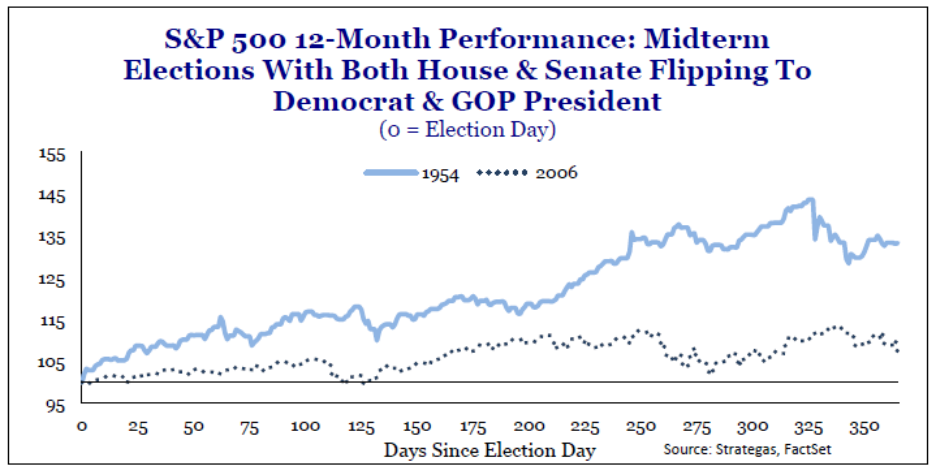
First, we would note that since WWII, the S&P 500 has historically been positive in the 12 months following each midterm election. But this election was a rare event. Only two other times have both chambers of Congress flipped from Republican to Democrat with a sitting Republican president. Those two cases, 1954 and 2006, are shown below. The market was up 12 months following the midterm in each case. Our main takeaway is that a change in leadership is not necessarily a bearish event.
There are nuances in every cycle, though. If the market breaks its positive post-midterm streak, it may have something to do with new headwinds on the AI trade. Voters largely expressed a desire to pause data center development. And today, compute is in short supply. Corporate capital investment has been a major driver of economic growth and positive earnings trends. If that spending slows, it’s not entirely clear that other economic sectors are strong enough to take the baton.
Those risks manifested themselves in elevated volatility following the election. Market participants are trying to discount the many different possibilities for the future. But we would remind folks that whether you are happy or upset with the election results, market forces are nuanced. For example, there could be a slowdown in data center buildout, but at the same time, LLMs are getting more efficient, as are the data centers themselves. It’s possible that slower data center construction could restrict future oversupply of compute.
Through all sorts of different political environments, stocks have tended to perform well following the midterms, and as we’ll discuss below, we still give the bull market the benefit of the doubt.
Chart O’ The Week
Above, we note that it is not clear that other economic sectors could pick up the slack if corporate investment slows. But Friday’s jobs report was at least a green shoot for the consumer. Payrolls were up 165,000, which blew away expectations. The previous two months were revised higher as well. Through much of this economic cycle, wages have failed to keep up with inflation, but wages were solid in this report. It will likely be important for the consumer to gather some strength, especially if investment could potentially slow in the future.
We believe the market rotation that has been a hallmark of 2026 may continue through year-end. The Energy and Tech sectors are the top-performing sectors year-to-date. What has been interesting is that those two sectors are negatively correlated. We saw that in October. Energy gained 14% while the Tech sector was down almost -7%. Because the market has been so rotational this year, market participation has not been as strong as we would like to see. But it has been adequate and not in line with a severe correction.
From a fundamental perspective, this earnings season has again been impressive. 434 S&P 500 companies have reported, and their earnings growth rate has been 30%. True, profit margins have likely expanded in part because of one-off factors unlikely to repeat. But 13% sales growth is also quite strong, especially at this point in the economic cycle. The breakneck pace of earnings growth has thus far allowed for the market to produce a positive return this year, but valuations have actually cheapened. That is not necessarily a bullish or bearish condition, but stocks do have at least something of a higher margin of safety than they did heading into this year.
We expect the election may result in a different operating environment, especially for the AI infrastructure companies. But as it stands now, the economy continues to expand, earnings growth is strong, and market trends are solid; therefore, we would continue to give the bull market the benefit of the doubt.
Now that the election is over, who is going to keep spamming my mobile phone? Oh, the regional roofing companies. Have a great weekend!
Tim