


Earlier this week, a friend sent me a passage from a book he was reading that related to the removal of noise in our lives as a necessary component of giving—and living—our very best. I couldn’t stop thinking about it, so it naturally became the subject of this week’s Financial LIFE Planning article.
Like many of the topics we discuss in the Net Worthwhile weekly, this one is much easier said than done—but the stakes are high, because there’s never been more noise to crowd out the signals that become the catalysts for transformation in our lives, work, and financial planning.
And the story that launches us into the topic couldn’t involve stakes that are any higher.
Tim
Tim Maurer, CFP®, RLP®
Partner
In this Net Worthwhile® Weekly you'll find:
Financial LIFE Planning:
Finding A Signal Amidst The Noise
Quote O' The Week:
Antoine de Saint-Exupéry
Weekly Market Update:
Leading Economic Indicators Showing Positive Momentum (Finally)
Financial LIFE Planning
Finding A Signal Amidst The Noise
The signals that matter most in your life, work, and money are often quiet.
On December 29th of 1972, Eastern Air Lines Flight 401 was nearing its destination—Miami—after its departure from JFK Airport in New York. On approach to Miami, the green nose-gear indicator light didn’t come on to signal that the landing gear was properly deployed. The captain informed the Miami tower that “…it looks like we’re gonna have to circle, we don’t have a light on our nose gear yet,” so they cut off the approach and ended up circling the Everglades in order to identify and fix the problem with the landing gear.
The captain tells the first officer—the guy who is flying the plane at the time—to put the plane on autopilot so that all hands can address the primary issue: the landing gear. The first officer removes the lens for the gear indicator light and it jams going back in. The captain then sends the second officer down to the forward electronics bay to check the gear visually, a task made more difficult in the dark. Ultimately, the captain and first officer end up dedicating several precious minutes to the indicator light. Meanwhile, the plane is losing altitude at a rate that, while meaningful, is nearly imperceptible.
Then, a half-second C-chord chime is heard in the cockpit, alerting everyone to the fact that the altitude has changed by more than 250 feet.

But “no crewmember commented on the C-chord. No pitch change to correct for the loss of altitude was recorded.”
Meanwhile, the second officer, sent to confirm deployment of the landing gear through an optical sight in the electronics bay (where two rods must physically align, lit by the wheelwell service light) isn’t having any luck. “I can’t see it, it’s pitch dark and I throw the little light, I get, ah, nothing.”
The Miami approach control checks in with the plane again, but no fewer than three key crew members and a fourth—an Eastern maintenance specialist riding in the observer seat—are dedicating all of their attention to confirming the landing gear is functional.
The first officer asks, “We’re still at two thousand [feet of altitude], right?” The captain responds, “Hey, what’s happening here?”
Seconds later, the first of six radio-altimeter beeps is heard before the sound of impact—as the plane carrying 163 passengers and 13 crew crashes, ultimately claiming the lives of 101 souls.
Sadly, the culprit was not the landing gear but the cockpit indicator light, where two bulbs had burned out, and the inability of the crew to confirm the deployment of the gear in the dark.
Sadder still is the fact that only 94 seconds before impact, the crew heard the C-chord chime designed to alert everyone to the loss of altitude, but it didn’t register.
In fact, the chime was just one of at least three signals the crew received, but they were consumed by the noise of the hunt for the indicator light.
Nate Silver, whose book The Signal and the Noise was largely responsible for the popularization of this dichotomy, defines the two as follows:
“The signal is the truth. The noise is what distracts us from the truth.”
If you’re reading this, the chances are pretty good that the stakes aren’t quite as high for you as they were for the four men fixated on the landing gear indicators. Actual lives may not be at risk. But I don’t think it’s an overstatement to suggest that our ability to recognize the proper signals amidst the increasing din of noise in our world could have life-changing implications.
Signal Detection Theory
It was all the way back in 1966 that researchers Green and Swets gave us Signal Detection Theory and Psychophysics, and they note that detection of signal and noise has two separable components:
Sensitivity: How well you can discriminate signal from noise
Criterion: Where you set your threshold for calling something a signal
Note that we could have perfect sensitivity and still miss what could be most important because our criterion is set incorrectly. The trick is that it’s very difficult to reset criterion in the moment; it must be set in advance.

Let’s look at three domains where these implications often arise and ways to deal with each of them through the signal/noise lens:
In Investing
This one’s almost too easy to recognize because the noise is so prevalent. It’s the daily ticker, the 24-hour TV and sensationalized headline generator, the forecasts and predictions—and it might even be your financial advisor if they still subscribe to the antiquated hot-tip approach to investment ideas that has evolved into the more palatable, “I have a new idea I’d like to explore with you.”
The findings here are clear, and they don’t even suggest that the noise machine is pumping out lies—but instead that an overabundance of information in investing can be counterproductive:
In the late 1980s, Paul Andreassen’s research found that a group of investors given no news outperformed the group given news by a meaningful margin. Again, this wasn’t because the news was false, but because the news drove trading activity and the activity, as it often does, pushed down returns.
In 1997, Thaler, Tversky, Kahneman, and Schwartz—three of whom helped found the field of behavioral economics—gave all their investing subjects the same information, but they changed the frequency of when that information was provided and found that investors who got the most frequent feedback took the least risk and earned the least money. Loss aversion magnified by the frequency of information.
And in 2008, Barber and Odean noted that the news about attention-grabbing stocks was noisier and drove more buying, but not selling. This leads to what we, as financial advisors, often see—“portfolios” that are really more of a collection of once-compelling ideas, not a thoughtfully constructed grouping of complementary securities.
The biggest challenge we have as investors is that the criterion is often established by the industry—including the financial media—and it is very much on purpose, because their noise is designed to get your attention and to lead you to decisions that may or may not benefit you, but will definitely benefit them.
And interestingly, all too often, the real signals in investing have little, if anything, to do with the specific securities that daily demand our attention. Instead, your savings rate, time horizon, allocation, cost reduction, and commitment to long-term planning more often lead to the most desirable outcomes.
In Work
You know the noise in the work setting, don’t you? The inbox, instant messaging, the meeting, the meeting about the meeting, the industry headlines, and especially today, the AI discourse churn. It might all be true at some level and worthy of our attention at some time, but collectively, it can often fill up our days and crowd out the signal—the two or three outcomes that would make your multitudinous effort in any given year a success.
But this is a battle, especially because in the work setting, we often lack control over the inputs. It is other people who set the criterion, and it is often up to us to navigate the noise with deftness and respect. Think about it: The captain on the plane told the one person whose entire job was flying the plane, the first officer, to go help with the light. Everyone was focused on the problem, not the outcome.
But have no doubt that we are the ones who will be found responsible for the outcomes; therefore, it is up to us to perpetually prioritize the signals amidst an ever-increasing cascade of noise.
In Life
The good news is that we have more control over the noise in our lives. The bad news is that it never stops. Whether through social media or a drive through the neighborhood, the comparison feed is constant.
We, too, get to choose the signals in life. It’s what we read, watch, and scroll. It’s what we eat and drink, how we sleep and exercise. It’s how we communicate with our partners, parents, kids, and friends.
But one of the biggest challenges in navigating the signals and noise in life is that the criterion can be a little murky. There’s no default C-chord chime in the conversation you’re having with your spouse, although we can create one of our own design. And for many, the health piece is too often the radio altimeter signaling an imminent crash.
Seth Godin has a way of getting at this that I keep coming back to.
“A whisper in a quiet room is all you need,” he writes. “There’s so little noise, so few distractions, that the energy of the whisper is enough to make a dent.” And then, a few lines later, the part I’d tape to a monitor:
“Until you remove the noise, you’re going to miss a lot of signal.”
That might be the whole thing. The C-chord worked. It sounded exactly when it was designed to sound. But four capable men just heard a whisper in a nightclub, and it never registered.
You probably won’t find the signal by listening harder, but by making the room quieter—and you have to do it before the bulb burns out, because in the moment, there is no room left to quiet.
So what can you do to create space for more signal and less noise—this week—in your money, your work, and your life?
Quote O' The Week
Antoine de Saint-Exupéry (1900–1944) was a pilot first, and a writer second. He carried mail for Aéropostale across the Sahara and later over the Andes. For a stretch he ran a remote airfield on the edge of the Spanish Sahara, where the job included negotiating with local tribes for the release of downed pilots. Most of us are familiar with him for writing The Little Prince, but this week’s quote comes from his 1939 memoir of those flying years, Wind, Sand and Stars, which won both the Académie française’s Grand Prix du roman and the U.S. National Book Award.
On July 31, 1944, he took off from Corsica on a reconnaissance flight over occupied France and never came back. 54 years later, a fisherman off the coast of Marseille, found his silver identity bracelet.

Weekly Market Update
Of the indices we track, the only one that eked out a small gain was international value. Everything else was in the red:
- 1.43% .SPX (500 U.S. large companies)
- 0.50% IWD (U.S. large value companies)
- 1.68% IWM (U.S. small companies)
- 1.15% IWN (U.S. small value companies)
+ 0.31% EFV (International value companies)
- 0.62% SCZ (International small companies)
- 0.02% VGIT (U.S. intermediate-term Treasury bonds
Leading Economic Indicators Showing Positive Momentum (Finally)
Contributed by Tony Welch, CFA®, CFP®, CMT, Chief Investment Officer, SignatureFD
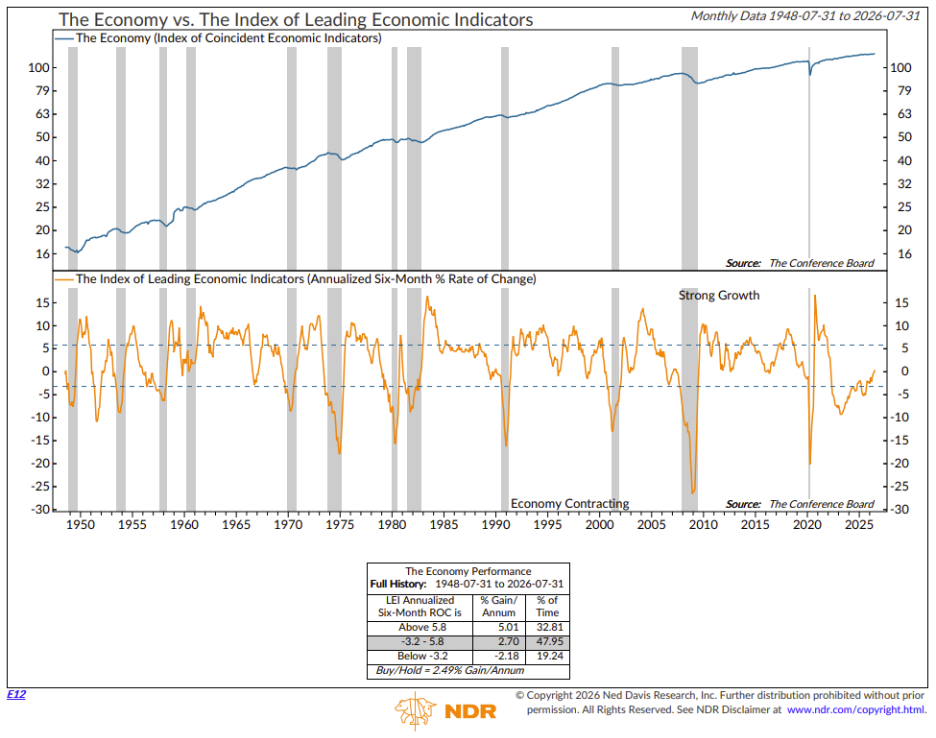
The Conference Board creates their index of Leading Economic Indicators (LEI) by evaluating 10 components. The underlying indicators cover market data like stock prices and interest rate spreads, as well as non-financial data on the job market, consumer confidence, and housing. It has been an odd expansion because for most of it, the LEI was falling, which would normally be associated with an upcoming recession. That recession never materialized, and now the LEIs are finally showing some positive momentum, consistent with 2-3% economic growth.
And the improvement has been broad-based. Nine of 10 indicators in the LEI showed improvement for July. Even outside of the LEIs, we can see some building economic momentum in manufacturing surveys and industrial production. The economic backdrop is not perfect, but the improvement in LEIs is a welcome development.
Chart O’ The Week
The Message from Our Indicators
Last week, rising interest rates captivated not only the market’s attention, but also the Treasury Department, which stepped in to buy longer-dated Treasurys. Ned Davis Research explored past market bubbles, and one commonality is that they had all ended as interest rates worked higher. While we don’t think stocks are in a traditional bubble, we still think rising interest rates are a threat and one of the more important indicators to watch in upcoming weeks and months.
Higher rates bite in a few important ways. First, the economic expansion has been led by investment. A higher cost of capital could threaten the investment cycle. And second, higher rates tend to result in lower market valuations. Your future cash flows just aren’t worth as much when discounted back at a higher rate.
Our base case is that a late-Summer/Fall correction is likely to materialize, which could help cool excessive investor optimism. If that were to occur, we would expect a year-end rally that could bring the market back up to its all-time highs.
One reason we expect a correction to remain contained is that corporate fundamentals continue to provide an important pillar of support. 468 S&P 500 companies have reported, and their blended earnings growth rate is 36%. That is an incredible number at this point in the cycle. Earnings growth this strong tends to occur following a recession. Much of the strength has come from non-operating activities, such as investment appreciation, but operating earnings have also been strong, and topline sales growth has been 14%.
For now, the longer-term evidence remains bullish, but that doesn’t mean the market will not experience corrective action. We would actually expect a correction in the coming weeks, but as long as fundamentals continue to hold up, we believe corrections are likely to remain benign.
Have a great rest of your weekend—and week to come!
Tim