


I wrote this week’s post somewhere in flight between Atlanta and Salt Lake City, listening to a book I couldn’t stop thinking about—Jim Collins’ newest, What To Make Of A Life. And among other things, I was struck that the findings of Collins’ research seemed to poke a few major holes in the foundation of the FIRE approach to money and life.
In this week’s Financial LIFE Planning section, I’ll explore the three foundational elements Collins suggests are required for a deeply fulfilling life, and how we might deploy our finances in support of that worthy pursuit.
Finally, Tony closes things out with his Weekly Market Update, Growth Driven by AI Investment Cycle.
Thanks for joining us!
Tim Maurer, CFP®, RLP®
Partner
In this Net Worthwhile® Weekly you'll find:
Financial LIFE Planning:
Flip The Arrow Of Money
Quote O' The Week:
Barbara McClintock
Weekly Market Update:
Growth Driven by AI Investment Cycle
Financial LIFE Planning
Flip The Arrow Of Money
Jim Collins’ New Book Reveals a Blind Spot in the FIRE Movement
First, let me disclaim, so that my bias is clear: I’ve never been a FIRE fan. It’s certainly not the F and the I that I have a problem with. There are very few downsides, after all, to being financially independent. It’s the R and the E that I take issue with: retire early.
But before you skewer me for sharing an opinion that seems unlikely, if not unbecoming, of a financial advisor, please let me explain. I think the goal of great financial planning isn’t just to have more money but to live a better life, and not just at some future date, many years down the road, that isn’t even promised.
To be fair, many modern FIRE advocates are less interested in ceasing work than in escaping dependence on compulsory work. That distinction matters, and it strengthens rather than weakens the question I want to raise here: even if FIRE is really about freedom, does it still subtly frame work itself as something to outgrow?
I understand the allure of a minimalist approach to life and the freedom of not having anyone to answer to as you seek your path, but working and saving at an extreme pace, all for the purpose of sustaining life without reliance on a paycheck, has never sounded particularly compelling to me.
Where FIRE Fails
But in Jim Collins’ new book, he offers an even more convincing argument that exposes a deeper tension within FIRE. In What To Make Of A Life, Collins extols findings from a vast research study that examined prominent pairings who followed similar courses in life to see where their paths converged, diverged, and which of those turns appeared to maximize, or in some cases minimize, genuine meaning in the lives of the subjects.
For example, among the pairings are scientists Barbara McClintock and Grace Hopper; NFL Hall of Famers Alan Page and Carl Eller; and my personal favorite pairing, rock ’n’ rollers Robert Plant and Jimmy Page, the lead vocalist and guitarist for Led Zeppelin.
Through the analysis, among many other insights, Collins identifies three elements that he suggests lead to a deeply fulfilling life, and I couldn’t help but think each of them stands in contrast to the assumptions often embedded in FIRE.
1) Find Your Encoding
First, Collins suggests that in order to live a deeply fulfilling life, we must find our encoding, our “durable, intrinsic capacities built into your construction, waiting to be discovered.” While these will almost certainly be skills that we build on, the important distinction here is that there should be evidence that these are skills we were built for.
An approach designed primarily to maximize income over a shorter span of time, if only to exit work sooner, may distract us from discovering that encoding altogether.
2) Flip The Arrow Of Money
Collins’ second insight may offer the deepest challenge to FIRE. He observes that his subjects “flip the arrow of money” in pursuit of the most fulfilling lives. Collins frames it as a question:
Is money fuel for your work, or is your work fuel for money?
He suggests we flip the arrow from money as the destination to money as the enabler.
To be clear, many of Collins’ subjects made substantial financial sacrifices, which FIRE well positions us to do. But the difference is in the purpose. With FIRE, the sacrifice can be oriented toward no longer having to work. In What To Make Of A Life, sacrifice is oriented toward being able to do the work one is encoded for.
That feels like a radically different vision.
Viewed through that lens, it can be the difference between freedom from work and freedom for meaningful work.

3) Feed Your Inner Fire
Collins’ final element of a deeply fulfilling life suggests we “feed our inner fire” through sustained effort, not a sprint.
While a handful of Collins’ subjects appeared to peak very early in life, what made most of their lives’ work distinctive was the second and third, and sometimes even fourth, pivots made as the frame of their encoding shifted, narrowed, or expanded.
For example, John Glenn was a pilot, a fighter pilot, a test pilot, an astronaut, a Congressman, and a Senator, all before becoming an astronaut again in his 70s.
That doesn’t look like escaping work. It’s personal evolution with and through it.
Perhaps the real essence of Collins’ findings is that meaningful work, paid or not, appears to be a core component of human flourishing. If that’s true, then the question is not how quickly we can escape work, but how intentionally we can orient it.
Quote O' The Week
Barbara McClintock (1902-1992) spent decades studying corn. Not glamorous work, and for much of her career, largely ignored. When she presented her discovery of "jumping genes" in the 1950s, the scientific community didn't just overlook it; many considered it too radical to take seriously. She quietly kept going anyway. In 1983 — roughly thirty years later — she was awarded the Nobel Prize in Physiology or Medicine, becoming the only woman to receive an unshared Nobel in that category. She was 81. She continued working at Cold Spring Harbor Laboratory until shortly before her death at 90.

Weekly Market Update
Equities were up across the board this week, with only bonds in the red:
+ 0.91% .SPX (500 U.S. large companies)
+ 1.41% IWD (U.S. large value companies)
+ 0.95% IWM (U.S. small companies)
+ 0.61% IWN (U.S. small value companies)
+ 0.87% EFV (International value companies)
+ 1.09% SCZ (International small companies)
- 0.70% VGIT (U.S. intermediate-term Treasury bonds
Growth Driven by AI Investment Cycle
Contributed by Tony Welch, CFA®, CFP®, CMT, Chief Investment Officer, SignatureFD
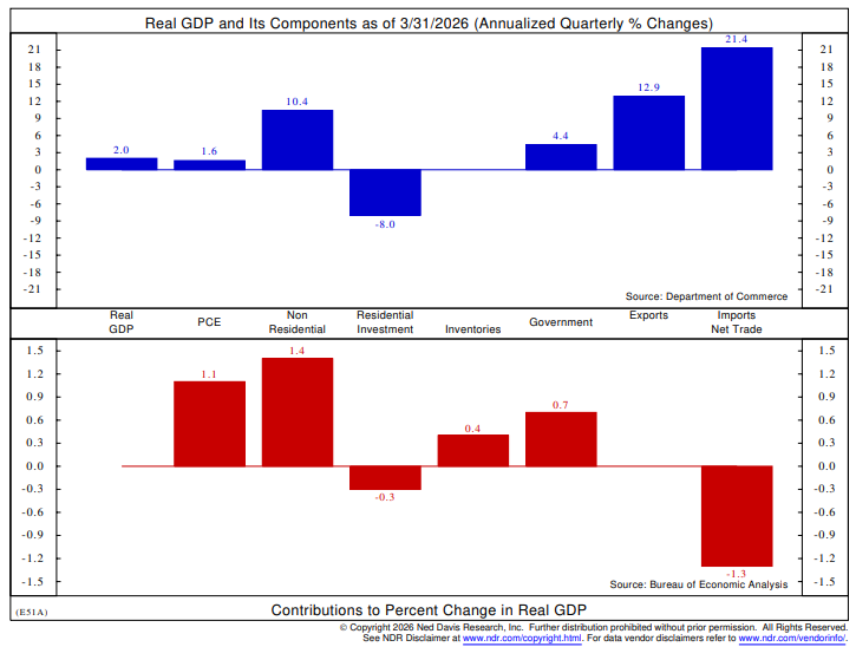
The U.S. economy continues to show resilience, with first-quarter GDP coming in at a solid pace. But when you look under the hood, the composition of that growth tells a more nuanced story. As shown in the chart, business investment, particularly capital expenditures, was the primary driver of growth, while consumer spending moderated, and other areas like housing, remained a drag.
What stands out is just how concentrated that strength has become. Nonresidential investment surged at a double-digit pace, fueled largely by spending on equipment and technology tied to the ongoing buildout of artificial intelligence infrastructure. In fact, high-tech investment alone accounted for a significant portion of overall GDP growth in the quarter.
At the same time, the consumer, the traditional backbone of the U.S. economy, is still growing, but at a slower and more measured pace. That doesn’t signal weakness on its own, but it does reinforce the idea that today’s expansion is being powered by a narrower set of drivers than in past cycles.
Our takeaway isn’t that growth is deteriorating, it’s that it’s evolving. The economy remains on solid footing, but is increasingly influenced by where investment dollars are flowing, rather than broad-based demand across all sectors.
Chart O’ The Week
The Message from Our Indicators
The economic backdrop remains steady, even if the crosscurrents have picked up. Growth rebounded in the first quarter, supported by a surge in business investment, while labor market data continues to point to resilience. At the same time, inflation pressures have firmed, which is likely to keep the Federal Reserve on hold for the time being. Our takeaway from the data is straightforward: the economy is holding up better than many expected, but not in a way that gives the Fed a clear path to easing policy. That combination, resilient growth with still-elevated inflation, helps explain why interest rates are likely to remain in a holding pattern.
Corporate fundamentals continue to provide support for markets, though the strength is not evenly distributed. Earnings expectations remain solid, with forecasts calling for healthy growth over the coming quarters. Much of the momentum is being driven by companies tied to the AI buildout, where capital spending remains elevated and, importantly, is still largely being funded through internal cash flows rather than external borrowing. That’s an important distinction, as it suggests the current investment cycle is built on a relatively strong foundation. Still, the concentration of growth in a narrow set of companies and themes is worth monitoring, particularly as valuations in those areas have already adjusted higher.
From a market perspective, trends remain constructive, but the underlying participation is more mixed. Equity markets have pushed to new highs, supported by cyclical leadership and improving earnings expectations, yet breadth indicators suggest the rally has not been fully broad-based. Leadership has rotated frequently, and sentiment measures have moved back toward more optimistic levels, which can limit near-term upside if not supported by broader participation. In other words, the trend is positive, but it is not without its fragilities.
Putting it all together, our positioning remains balanced. We continue to see a supportive backdrop for equities overall, but with enough concentration and uncertainty to warrant diversification. Our recent moves, adding exposure to areas like small caps and international markets, reflect that view, positioning portfolios to benefit if leadership broadens beyond the narrow set of companies that have driven much of the market’s recent strength.
Hoping your week to come is a great one!
Tim
Focusing on process wins over focusing on outcome every time
Another great write up.