

69% of couples’ problems are never resolved, according to Dr. John Gottman, the marriage expert known for his ability to predict whether couples stay or split.
Dr. Lauren Papp and her colleagues invited their couple subjects to keep diaries of fights at home—with 748 real arguments logged—and while money wasn’t the most frequently disputed topic, the topic of finances was the fight most likely to stay unresolved.
Dew, Britt, and Huston expanded their query to 4,574 couples, and they found that disagreements over money were the strongest predictors of divorce. Yet it wasn’t the frequency of these arguments that was the chief indicator—it was the intensity of the arguments.
I know I don’t have to tell anyone else who’s married what we already know to be true: It’s not whether we disagree that makes the difference, but how we disagree. And relationship expert Terry Real gives us a simple method for managing discord in such a way that it can build us up as couples rather than tear us apart.
In this week’s Financial LIFE Planning section, we’ll examine Real’s method and how we can apply it to financial disagreements with our loved ones.
Thanks for joining us!
Tim
Tim Maurer, CFP®, RLP®
Partner
In this Net Worthwhile® Weekly you'll find:
Financial LIFE Planning:
How Couples Can Use Money Disagreements To Grow Closer
Quote O' The Week:
Mignon McLaughlin
Weekly Market Update
Wall Street's Impact on Main Street
Financial LIFE Planning
How Couples Can Use Money Disagreements To Grow Closer
A Four-Step Script For Moving From Harmony, Through Disharmony, To Repair
From You And Me To Us
I confess that I read Terry Real’s book, Us: Getting Past You And Me To Build A More Loving Relationship, in part because it was recommended by a reliable source, but especially because the foreword was written—and in the case of the audiobook, read by—Bruce Springsteen. The Boss’s gravelly baritone sold me, but the book’s premise and Real’s prescriptions have made it one of the more valuable reads on relationships, and my wife and I have enjoyed it and sought to apply its wisdom.
Among other things, Real walks us through a three-fold rhythm, originally developed by developmental psychologist Ed Tronick that helps us transform the points of unavoidable friction in our relationships into individual and collective growth.
“All relationships are an endless dance of harmony, disharmony, and repair,” says Real. Real defines harmony as “love without knowledge”; disharmony as “knowledge without love”; and repair as “knowing love.”

The Franciscan and best-selling author, Richard Rohr, uses different terminology that rhymes beautifully with Real, while adding a touch of spiritual depth. Rohr addresses the three stages as order, disorder, and reorder. He says, “…we grow spiritually by passing beyond some perfect Order, through an often painful and seemingly unnecessary Disorder to an enlightened Reorder.”
To those of us who have partnered, I think we intuitively recognize the duo of harmony and disharmony. We can feel it when we’re in one or the other. But it ends up being a haphazard game of ping-pong between the two, rather than a deliberate spiral that creates a virtuous cycle. It’s almost as though we strive to avoid addressing the disses—disharmony and disorder—but Rohr encourages us that our willingness to go there is actually “…necessary if any real growth is to occur.”
So how do we add the third and most important arc in this cycle—repair? Real gives us a script.
Real’s Repair Script
Here’s how Terry Real recommends navigating disharmony in order to transform it into repair:
Here’s what I recollect happened.
Here’s what I made up about it.
Here’s what I felt.
Here’s what would help me feel better.
There’s an important distinction to make here—that what we express as feelings aren’t always, well, feelings. For example, if we say that we “felt abandoned,” that’s really a thought regarding someone else’s actions expressed as a feeling, while if we express that we felt lonely, sad, or hurt, those would all be derrivatives of the core feeling of pain. According to Pia Mellody, whose work informs Real’s, there are only eight core feelings (and their derrivatives) versus the many thoughts or judgements we often express as feelings. You can see the full list in the table that follows:
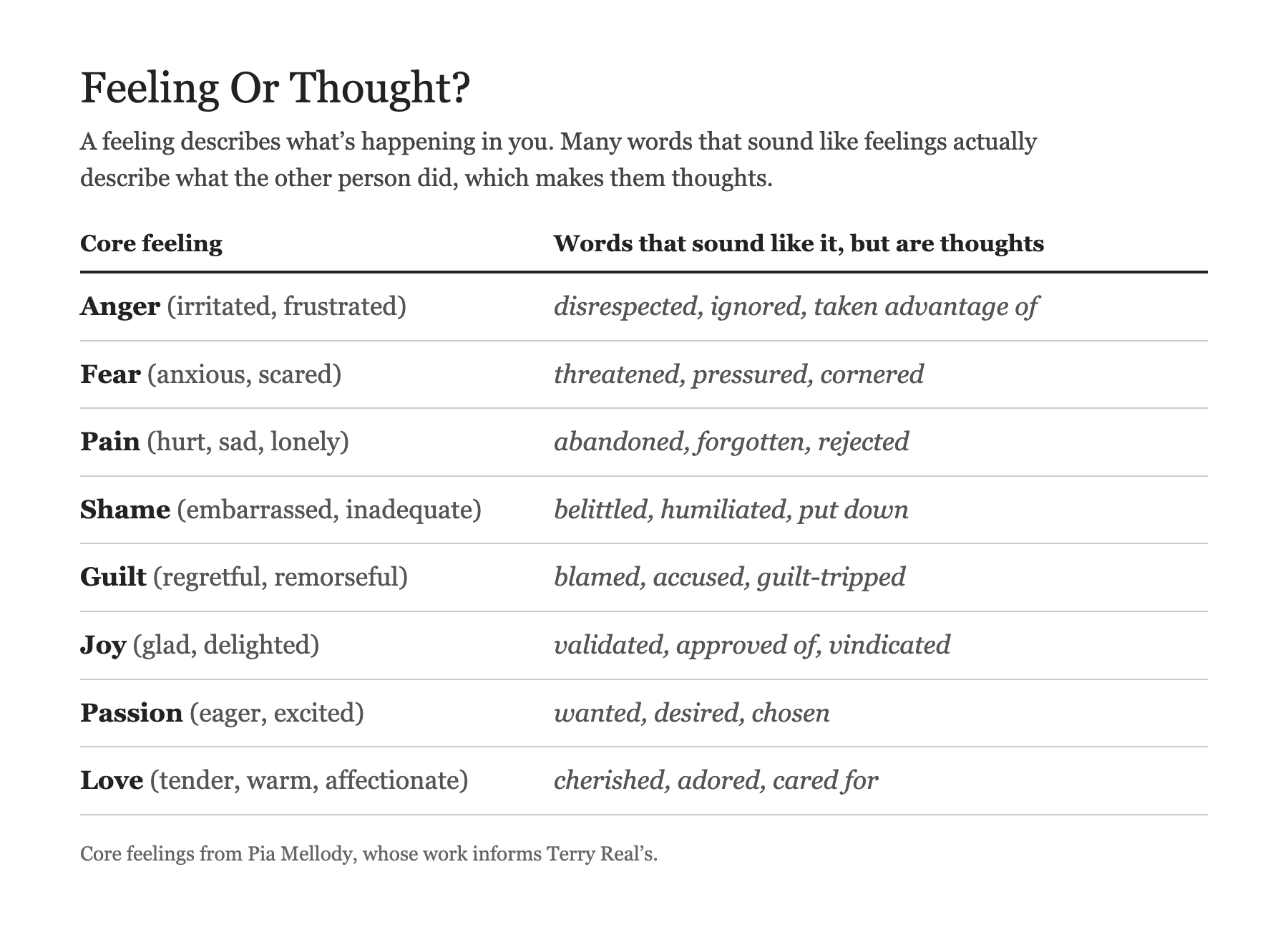
Now, let’s imagine how to navigate this script, using a simple financial example as our context. We’ll invent a scenario that, while hypothetical (and a touch stereotypical), can be translated across a number of similar scenarios.
Case Study: Jim and Pam
Jim and Pam (yes, from The Office), a couple years after the camera crews stopped documenting their lives, live in the same house—and it’s starting to feel a little cramped now that Pam has had their second child. Pam noticed a charge on their joint credit card for a resort in Murrells Inlet, South Carolina. To Pam, it feels like a singular expense that likely will expand into several more charges, once tee times and dinners are added to the bill. And this comes after a recent conversation where they dedicated themselves to saving more money monthly in order to advance from their starter home to something with more space for their growing family.
Fresh off their marriage retreat where they learned Real’s relational repair script, Pam decides to test it out. Here’s how the conversation goes:
“Here’s what I recollect happened, Jim.” This step is designed to be a dispassionate recollection of the facts. “I was reviewing the budget and a charge came through for a resort in South Carolina for $475.”
“Here’s what I made up about it.” Note here the framing that is the polar opposite of how most of our arguments start with a partner. One of us typically skips the facts and goes straight down the accusatory path. But Real’s recommendation is that the potentially aggrieved party owns and shares the narrative that they’ve built around the facts. “Remembering that this is the area you went to last year for your annual golf trip with the guys, I assumed that you’d made plans for this year’s trip without even checking with me first.”
“Here’s what I felt: hurt. The finances are really just a part of it. I have to imagine that this is just the first of several expenses that will range into more than $1,000 when the trip is done—and we agreed that we’d discuss any expense over $500 before it is made. This feels like an especially important discipline now that we’re saving up for the new house, but if I’m really honest, it was the fact that you’d consider booking a trip with the guys just assuming that I’d be happy to bear the full burden of the kids that weekend made me feel…lonely.” The key to this important step, according to Real, is not to share our thoughts—but truly our feelings—and not to dress up a thought in feeling language. For example, “I felt like you didn’t care,” is really an accusatory thought, whereas “I felt shame” is a clear expression of a feeling. And consider avoiding “I felt angry,” because anger is typically a secondary emotion.
“Here’s what would help me feel better,” Pam concludes. “Two things: First, I feel like while we’re saving for the new house, we should lower our threshold for mutual approval to $250. Second, and more importantly, I’d ask that any instances where one of us is traveling and relying on the other to manage the kids and household is discussed before a purchase is made.” By ending this discourse with a next step, it provides an easy off-ramp from the argument before it becomes a fight.
How do you think Pam did? Not too bad, right? But one of the reasons that this process is so important is that oftentimes the assumptions we’ve made are wrong. In this case, Jim did a great job listening—and he was listening at the marriage retreat, too—so he let Pam finish all four points before letting her know that the purchase was actually for the two of them to get away for a long weekend, and he’d already retained childcare. He still apologized for making the extra expense at a time when they are saving for a goal, but Pam agreed that they were overdue for some quality time after the new baby was born, and that the trip would likely act as inspiration to tighten their belts financially upon their return and help them meet their goals.
But there’s at least one problem with this hypothetical example.
It’s Not That Easy
It’s true that it’s never as easy as a hypothetical script in real life. It’s truer still that any of these relational tools will rarely be optimally employed the first—or even tenth—time we try them. And that’s because we often need to reroute neural pathways made stubborn by years of the more typical ping-pong approach between harmony and disharmony.
But it’s also possible that the above example feels harder than it reads because we rarely apply such a thoughtful approach to the management of our most intimate relationships. And I’d be willing to bet that if we did, the outcomes of these conversations would invariably improve.
Relationship expert and founder of The Happy Couples Project, Cameron Madill, reminded me that “…disharmony isn’t a sign of failure; it’s an inevitable part of building a life together and an opportunity to grow stronger.”
I’ll also leave you with two habits that my wife and I have built that might be beneficial for you: We try to have a weekly meeting and a monthly couples counseling session. The design of our weekly meeting is to review our calendars—which are always crazy—and address any issues like the one illustrated above. We each keep an individual list of such issues, and what is really remarkable is how many of those issues didn’t even appear worthy of discussing after we’ve calmed down emotionally.
By waiting to discuss issues that have caused an emotional spike in the moment, we probably avoid at least half of what might otherwise turn into an argument, or worse yet, a fight. And for any of those issues that may appear more intractable, we have our monthly couples counseling session to invite a skilled arbiter to help us navigate the conversation in a healthy way.
We implement this strategy far from perfectly, but there’s no question that having codified approaches to conflict management—and money management—saves us from many arguments. But even better, it’s helping us build a set of skills, the mere navigation of which helps us grow together as a couple.
Quote O' The Week
Mignon McLaughlin (1913-1983) was an American journalist, editor and aphorist born in Charm City (which is to say, Baltimore). She wrote or edited for Redbook, Cosmopolitan, Vogue, Glamour, and The Atlantic, among others. The quote below comes from her book, The Second Neurotic’s Notebook, published in 1966. An interesting note is that Mignon and her husband, Robert McLaughlin, an editor at Time, co-wrote a play, Gayden, that enjoyed a short run on Broadway in 1949.

Weekly Market Update
Markets were truly mixed this week, with small and value notching the biggest up-move while the S&P 500 and international companies led the way down:
- 0.47% .SPX (500 U.S. large companies)
+ 0.65% IWD (U.S. large value companies)
+ 1.96% IWM (U.S. small companies)
+ 2.04% IWN (U.S. small value companies)
- 0.64% EFV (International value companies)
- 1.26% SCZ (International small companies)
+ 0.47% VGIT (U.S. intermediate-term Treasury bonds
Wall Street's Impact on Main Street
Contributed by Tony Welch, CFA®, CFP®, Chief Investment Officer, SignatureFD
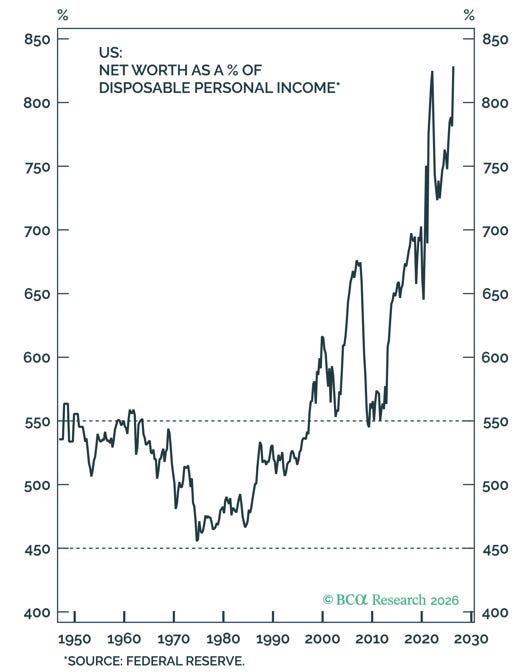
We often write about the economy’s impact on the stock market. But is it possible that the stock market has gotten so large and impactful that we should instead be more concerned with the market’s impact on the economy?
This week’s chart comes from our partners at BCA Research. It shows net worth relative to disposable personal income. Note how this number has exploded higher following the Global Financial Crisis. This is one of the best explanations of how consumers have maintained their spending levels despite weak income growth. Strong market returns have amplified the wealth effect.
This isn’t necessarily concerning. Rising asset values are generally a positive development for American households. And the strong wealth effect has likely served as a cushion for the economy despite higher interest rates and stubborn inflation. But it does create a risk. If the market were to experience a prolonged correction, consumers may begin to pull back. That could create a negative feedback loop. As we’ll discuss below, we still give this bull market the benefit of the doubt but remain cognizant of risks like this.
We should remember that there are ALWAYS risks in the markets. That's a major reason investors earn a premium to Treasurys in their returns - for taking on the known knowns, the known unknowns, and the unknown unknowns.
Chart O’ The Week
The calendar is a bullish tailwind for stocks into the last few months of the year. Historically, performance has been strong in November and December in midterm election years. Of course, there are offsets to that optimism. Notably, market breadth has been poor of late. Rates have come down from their peak but remain elevated. And inflation is not yet close to the Fed’s target.
Fundamentals remain one of the market’s strongest pillars. Earnings are projected to have grown nearly 30% in Q3. Interestingly, given the strong earnings growth, the market has gotten cheaper this year, despite a positive return. This year’s strong earnings may leave a more tricky 2027, though. Some of the earnings strength can be attributed to one-off factors, unlikely to repeat next year. Included in that list are markups on investments in SpaceX, OpenAI, and Anthropic. Additionally, tariff refunds came back quickly. Profit margins have expanded this year, but it’s questionable how much margin expansion is likely in 2027. But for now, the fundamentals are creating a bullish backdrop.
We would like to see further stability, or even easing, in longer-term interest rates. Rising rates may not derail the entire market, but the average stock has had a more challenging time. In fact, almost one-third of the S&P 500 constituents are currently down at least 20%. Softer inflation and lower rates could go a long way toward taking pressure off of the average stock. For now, this appears to be a bull market with frequent rotations. The rotational aspect helps keep the major indexes out of a bear market, but it is also difficult to make much headway without better participation. We remain constructive but would downgrade that view if fundamentals deteriorate.
Hoping your weekend, at least, is an upgrade!
Tim