

Did you know that the English language doesn’t have a single word for feeling happy for someone else? Sanskrit does though—it’s “mudita.” And I’m not sure I would’ve expected to learn that from a football coach, much less Kirby Smart, the University of Georgia’s legendarily intense leader known as much for sideline eruptions and expectations of near perfection.
And yet, that’s the modern-day source for an approach to interpersonal interaction that extends back at least 2,500 years that seems foreign in 2026. In this edition’s Financial LIFE Planning article, I’ll share a personal story that brought this concept to life for me (just this week) and the freeing application of mudita in our financial planning.
And Tony Welch is back in the saddle this week to discuss the Fed’s interest rate hike—and what we can expect from it.
Thanks for joining us for another week!
Tim
Tim Maurer, CFP®, RLP®
Partner
In this Net Worthwhile® Weekly you'll find:
Financial LIFE Planning:
How To Be Happy For Someone Else
Quote O' The Week:
Annie Dillard
Weekly Market Update
Fed Raises Rates—What To Expect?
Financial LIFE Planning
How To Be Happy For Someone Else
Georgia football’s unlikely rallying cry, an ancient word for unselfish joy, and the science of celebrating someone else’s success
My 22-year-old son, a senior at the University of Georgia, made my heart skip this past week.
As I was finishing up a meeting, he called me twice within a five-minute period, which isn’t generally college-kid code for good news—more likely its opposite. But he was on a short break from work, and he had news, indeed.
He’s finishing his exercise science degree as a Dawg, but his goal is to join the evolutionary wave within the practice of medicine that has a less reactive—and more proactive—approach, as a holistically-minded physical therapist, with a particular focus on lifelong strength and mobility. So, he’s been applying to a slate of universally competitive DPT (Doctorate of Physical Therapy) programs in the Southeast, completing extensive applications and conducting all-day in-person interviews for one of relative few spots these programs are filling for their next incoming classes in the fall of 2027.
He certainly had a favorite, and had given that school his singular “priority” tag, meaning that if they select him, he’s already committed. And less than a week after his in-person interview, he got the call from the head of the department, welcoming him to the program.
I’m not sure I’ve ever heard him sound happier, as this usually reserved kid let himself feel all the waves of satisfaction that follow those handful of moments in life where an outsized amount of effort and planning is rewarded with the hoped-for achievement.
The feelings I felt in that moment reminded me of something comedian Steve Harvey said in a deeply personal interview that has since gone viral: “Your father is the only man who wanted you to be better than him.”
Whether he knew it or not, Harvey was echoing rabbi Rav Yosei bar Honi, from about 1,500 years ago, when he wrote, “A person is jealous of everyone except for his son and his student.”
While I’ll likely spend the rest of my life and career—especially a career in finance—fighting the urge to compare and compete, from the first time my kid beat me in a foot race, to the many times he’s outshined me on the athletic field, to his exceptionalism in the classroom, losing to him has always felt like a deeply gratifying win.
Indeed, we’ve all heard that “Comparison is the thief of joy,” but what about taking it a step further—finding joy in celebrating the accomplishments of others? It’s a notion so far from our individualistic American ideal that we don’t even have an English word for it.

Unselfish Joy
For that, coincidentally, we must return to Athens—Athens, Georgia, where the Georgia Bulldogs call home—and the most unexpected application of Sanskrit philosophy I’ve ever seen, as applied by the notoriously intense Georgia football coach, Kirby Smart.
Smart was introduced to the concept by sports psychologist Drew Brannon when Brannon’s consulting firm, Amplos, was brought in to help rehabilitate the program after the disappointing 8-2 2020 season. (Disappointment is obviously gauged differently at Georgia.) Introduced at a team leaders’ retreat, the word “mudita” became a rallying cry for the program that ESPN calls “one of the most important steps in Georgia’s transformation”—and this funny word is even emblazoned on the team’s 2024 SEC championship rings.
The direct Sanskrit translation is “to rejoice, be glad,” but the common English translation is “unselfish joy.”
The German-born Buddhist monk who founded the Buddhist Publication Society, Nyanaponika Thera, acknowledges that this is next-level stuff—that it’s easier to feel compassion or friendliness “than to cherish a spontaneous feeling of shared joy.”
Yes, cut yourself some slack, because it appears that unselfish joy is not our default. In Takahashi’s “When Your Gain Is My Pain and Your Pain Is My Gain” paper in Science, they found that another person’s advantage registered in a region of the brain involved in processing pain, especially when it was something the viewer cared about. And that when the advantaged person later suffered a setback, the brain’s reward center lit up. Oh boy.
I guess this is why I wouldn’t lose an ounce of sleep if the Pittsburgh Steelers lost every football game they ever played for the remainder of their existence. But what about how we respond to someone closer to us?
Years earlier, Tesser’s Self-Evaluation Maintenance model found that we generally have one of two responses when someone close to us succeeds:
Reflection: If they succeed in a field that is not central to who we are, we’re capable of basking in their success.
Comparison: But if they succeed in our field, being close makes it worse.
But while it’s always great to know what parts of our biology and psychology our better angels might be working against, the great news is that we’re not beholden to our basest of instincts. And the upside is pretty great.
For example, in her “Will you be there for me when things go right?” study, Shelly Gable found that how partners respond to good news is more predictive of love and commitment than how they respond to bad news. A later paper by Michael Andreychik summed up the valuable conclusion in its headline: “I like that you feel my pain, but I love that you feel my joy.”
How To Train Your Brain When Hearing Good News
The bad news is that because this often runs against our instinctive nature bent towards self-preservation, it takes work. The good news, however, is that the work works.
As in many areas of behavioral science, we can actually train our brains to respond in the way we prefer—and the collective research and guidance can even be summed up in five useful suggestions to train our brains that work especially when someone is sharing good news with us:
Stay on their news. Even our better intentions often incline us to match our conversational partner’s story with a similar experience of our own, but this is actually hijacking the conversation.
Don’t be a downer. You might think you’re being helpful to point out a potential pitfall when someone shares good news with you—but you’re not. There will be a time for contingency planning, but it’s not now.
Be curious. Ask questions that will help them relive their experience. “When did you find out?” “What did you do first?”
Let it show. Let your positive response show in your face and in your voice.
Tie the outcome back to their effort. “Man, you really worked hard for this. You earned it!”
Yes, it’s good news that we can retrain our brains, but it’s even better news that when we master this method, it’s a) infectious, creating a virtuous cycle, and b) the benefits to this virtuous cycle can compound. As C.F. Knight said, “Unselfish joy multiplies in ratio to the extension of its application.”
Personal And Financial Applications
Aside from the ball field, there’s likely no area where the downsides of comparison are more apparent than in navigating our personal finances. For financial advisors, I’m inclined to point out that we (hopefully) get a lot of practice in being on the receiving end of good news from our clients. And yet, even in that moment, we likely feel a professional responsibility to quickly identify any imperfections to be optimized. So, for starters, I think we can (and should) do our best to apply some version of the five-fold brain training mentioned above. But I’d also encourage you to think about the fact that we have an opportunity to invite moments of positivity, too. I know some advisors who’ve actually systematized this into their regular meeting flows by starting off meetings with a simple, earnest invitation to express good news. It’s simultaneously a gift to your client and a positive frame for the rest of the meeting.
But for all of us, we can do better than to simply re-share the “comparison is the thief of joy” trope in solidarity with the collective knot in our stomachs felt when we see a friend, colleague, or family member succeed—personally, professionally, or financially. We can train our brains to truly celebrate their success, thereby loosening the knot, with greater peace and gratitude as our reward.
It might come (more) naturally to celebrate the success of our children, but mudita is a practice, both ancient and modern, that is universally applicable and serves to deepen our relationships while releasing our grip on the scores and spreadsheets we too often use to measure our worth, financial and otherwise.
Quote O' The Week
Another American writing legend passed away recently. Annie Dillard died on September 15, 2026, at the age of 81. She won the Pulitzer Prize in 1975 for the book, Pilgrim at Tinker Creek, a Thoreau-esque survey of living a year in Virginia’s Blue Ridge with close attention to the natural world.
She taught writing for more than 20 years at Wesleyan University and received the National Humanities Medal in 2014.

Weekly Market Update
Only one color describes all the indices we track over the past week. (Red.):
- 0.08% .SPX (500 U.S. large companies)
- 1.52% IWD (U.S. large value companies)
- 1.66% IWM (U.S. small companies)
- 1.87% IWN (U.S. small value companies)
- 1.80% EFV (International value companies)
- 1.10% SCZ (International small companies)
- 0.28% VGIT (U.S. intermediate-term Treasury bonds
Fed Raises Rates—What To Expect?
Contributed by Tony Welch, CFA®, CFP®, Chief Investment Officer, SignatureFD
The 10-year Treasury yield topped 4.9% on Thursday, reaching the highest level since November 2023. It’s probably easy to assume that the bond market has an inflation problem. Economic data this week didn’t help the narrative, as oil topped $100 a barrel and wholesale inflation was up 5.4% year over year. However, other data says otherwise.
Nominal Treasury yields are the sum of two things: the real yield, the compensation an investor demands above the inflation rate, and the breakeven rate, which is what the market believes inflation will be over the life of the bond. By looking at them separately, we can learn what’s driving the move in Treasury rates.
10-year breakevens sit at 2.40% as of Thursday and, for the most part, have been range-bound over the past two decades between 1.5% and 2.5%. The real yield sits just shy of 2.50% as of Thursday, the highest level in the last 15 years. Investors aren’t asking to be compensated for inflation. They are asking to be paid more to lend for ten years.
It’s been driven by a large supply of Treasuries and record corporate issuance, rather than rising prices. A real yield of 2.5% changes the math on all other investments because it raises the bogey for all other risk assets.
Chart O’ The Week
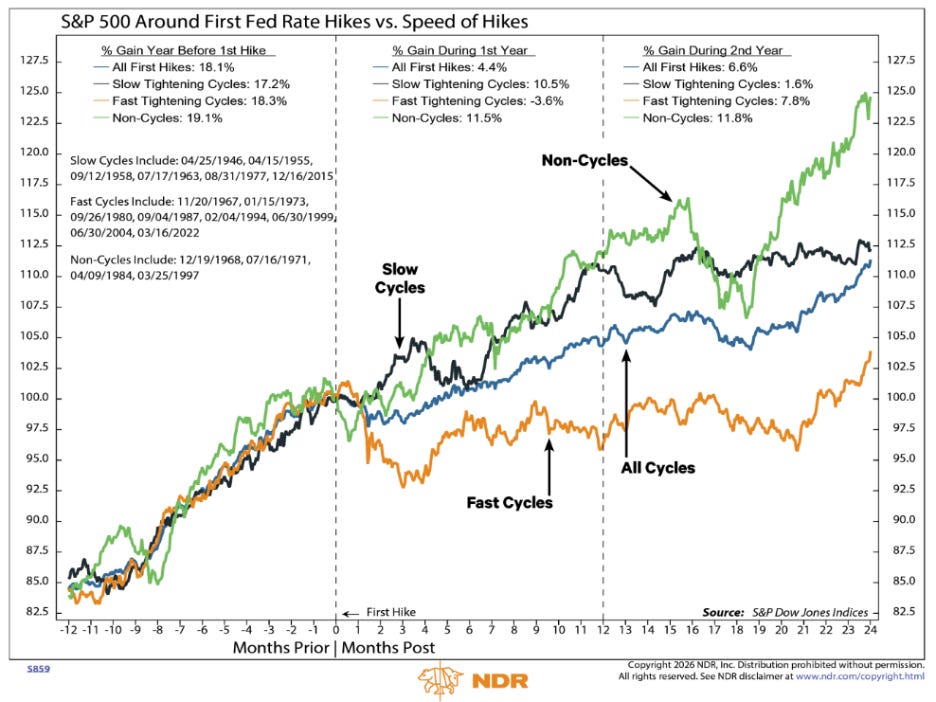
The Fed’s widely anticipated hike came about due to stubborn inflation and solid economic growth. Chair Warsh expressed that underlying inflation trends had not yet meaningfully improved and that financial conditions were not restrictive. We caught a glimpse of the economic momentum in last week’s retail sales report, which showed a 1.2% jump in August. The strong retail report has funneled through to the Atlanta Fed’s GDPNow calculation, which jumped to 5.1% for Q3 growth. While we expect economic growth is not likely to come in as strong as that estimate, it is clear that there has been some recent economic momentum.
Supporting the spending trend has been a strong wealth effect. Stocks are up and bonds are kicking off more yield. Wages haven’t kept up with inflation, so we believe it is likely that the wealth effect is doing a lot of the heavy lifting in supporting the consumption cycle. That does create a risk to consumer spending if stocks were to experience a sustained correction. But for now, the asset markets have been supportive for economic growth.
We continue to expect elevated volatility in the weeks ahead, but suspect it will be contained to a correction and not give way to a bear market. Historically, stocks have corrected in the late Summer/Fall period of mid-term election years. The good news is that the S&P 500 has never been down in the 12 months following mid-term elections. In fact, it has been the strongest 12-month stretch within a four-year presidential cycle.
For now, we continue to give the bull market the benefit of the doubt, supported by an ongoing economic expansion and strong corporate earnings growth. If inflation remains stubborn and the Fed has to hike rates at a quicker pace, that could see us change our assessment. But for now, we believe the weight of the evidence remains broadly positive.
Broadly positive—just like your weekend, I hope!
Tim