

Over the past two weeks, the interwebs was flooded with a host of tributes for Wendell Berry, the author and farmer who apparently inspired a lot more people than I even imagined. He passed away at 92 on August 31, 2026 in his beloved home of Port Royal, Kentucky.
At first, the outpouring was a pleasant surprise, but as I saw the tributes mount, and the myriad of aspirational notes that he had materially changed so many lives, I went from feeling inspired to lend my voice to the chorus to feeling a little dejected. You see, despite having long listed Berry as one of the most influential authors to me, personally, I realized that his words had impacted my thoughts far more than my actions.
Therefore, this week’s Financial LIFE Planning post is really less of a tribute and more of a confession. But, whether you’re a Berry fan or fraud or you’ve just read his name for the first time, I hope you’ll find something of value in these reflections—or more likely, through his own words.
Tim
Tim Maurer, CFP®, RLP®
Partner
In this Net Worthwhile® Weekly you'll find:
Financial LIFE Planning:
I Wish I Was More Like Wendell Berry—But I’m Not
Quote O' The Week:
Barbara Kingsolver
Weekly Market Update
Don’t Blame Inflation
Financial LIFE Planning
I Wish I Was More Like Wendell Berry—But I’m Not
The Late Author, Poet, And Farmer Was Ahead Of His Time By Staying Well Behind It
I wish I was more like Wendell Berry, but I’m not.
Despite having come to feel a new satisfaction from the ordering of words thanks to reading his work, and despite being drawn into fiction for the first time in decades when I discovered his, and despite being moved toward most of his philosophies expressed in prose, and despite desiring to be seen as someone who’d be inclined to be drawn to his philosophies, I really don’t live the way that Wendell Berry did.
For example…
He was a truly prolific author, writing more than 50 books, whose talents transcended a single genre, including more than 25 books of poetry, 16 essay collections, 8 novels, and 42 short stories set in the fictional town of Port William. Berry was a Stegner Fellow at Stanford (in the same group as Ken Kesey), a Guggenheim Fellowship recipient (1961-62), a winner of the National Humanities Medal (2011), deliverer of the Jefferson Lecture (2012), and a National Book Critics Circle lifetime achievement award winner (2016).
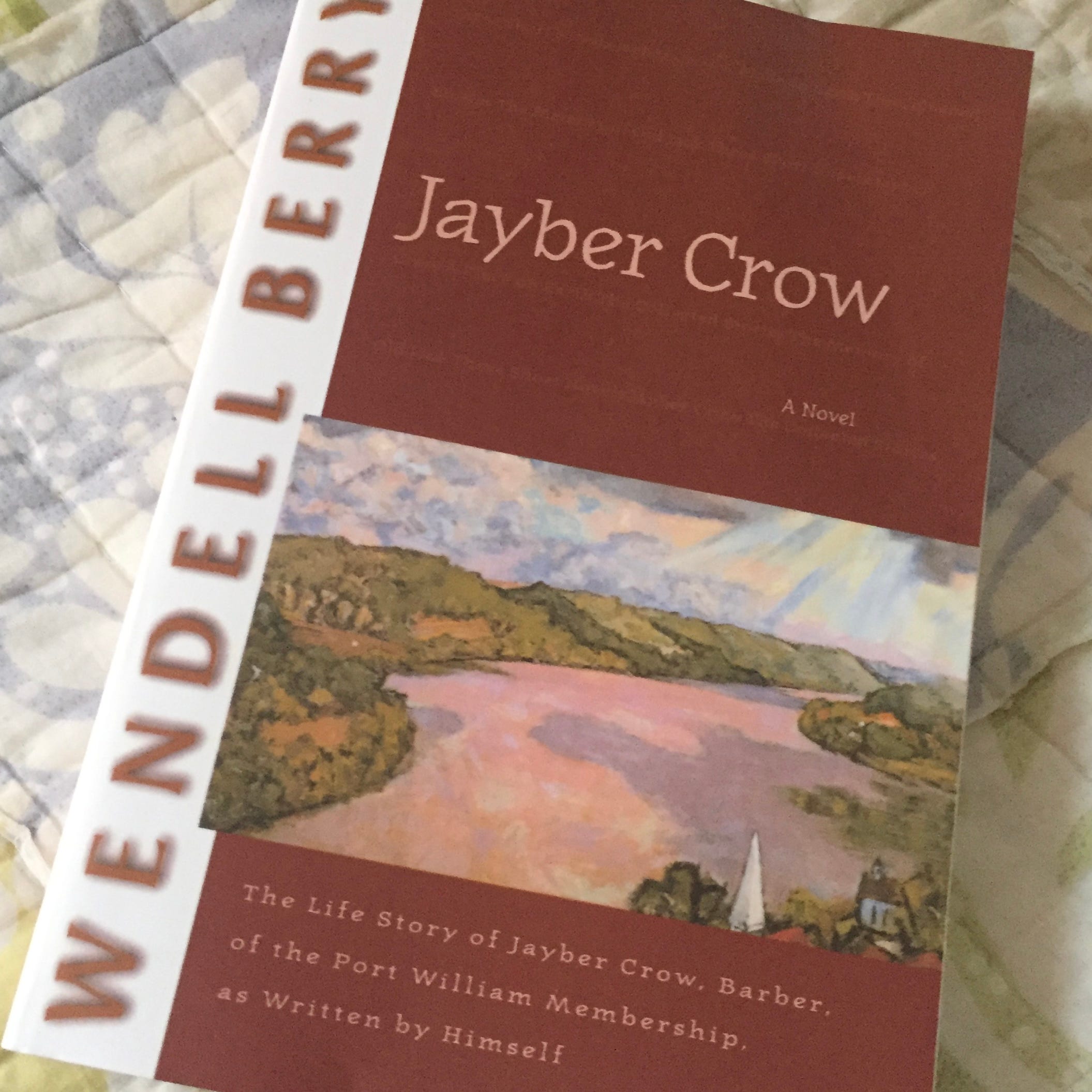
Here are a couple of sentences from Berry’s Port William novel, my personal favorite, Jayber Crow, as Jayber considers the cause and effect of change in life:
Some of the changes in my life were imposed, and some were chosen—if by “chosen” I may mean that I chose what I seemed already to have been chosen by, desire having obscured the alternatives. And each change has been a birth, each having taken me to a new life from which I could not go back.
I—well, if I ever wrote a single sentence that bested his worst, I’d consider it a lifetime achievement.
He went back home. After time at Stanford and in Florence, Berry taught at NYU from 1962 to 1964, and then, despite the literary world’s insistence that it would ruin his career, he gave up the elite academic route to go back to rural Kentucky. He’d already married his college sweetheart, Tanya Amyx, in 1957, and they bought land near where Berry grew up, where they lived and worked the farm for more than 60 years. (Incidentally, his relationship with Tanya is likely worthy of a post, if not a book, all its own, as she survives him as his companion and partner of more than 69 years, in life and work. She edited and transcribed all of his writing, and YES! Magazine called her “the most important fiction editor almost no one has heard of.”)
Berry explores the theme in his poem, “Traveling at Home”:
Even in a country you know by heart
it’s hard to go the same way twice.
The life of the going changes.
The chances change and make a new way.
Any tree or stone or bird
can be the bud of a new direction. The
natural correction is to make intent
of accident. To get back before dark
is the art of going.
I grew up personally and professionally in my beloved Baltimore—but I also spent a dozen years in Charleston, SC and now a few in Atlanta, so I haven’t gone home. Yet.
He was a farmer who was connected to the land and for whom the idea of local interdependence—where neighbors and town form a local economy Berry called the “membership”—was predominant. And he was an old-school farmer, an anti-industrialist, with more than 100 hillside acres of tobacco, cattle, and sheep, for which he used draft horses instead of tractors, crop rotation, manure for fertilizer, and solar panels for energy.
While Berry had much to say about the dangers of industrialized farming, I’m choosing a quote here from one of his short stories contained in The Wild Birds, as spoken by fictional farmer Burley Coulter. Here, we get more of the why behind Berry’s membership ethos:
“The way we are, we are members of each other. All of us. Everything. The difference ain’t in who is a member and who is not, but in who knows it and who don’t.”
I’m all about having a majority of my diet populated by organic whole foods, but I don’t even cut my own grass.
He was pro-tangible and anti-digital, and not in the Substack way where we decry technology with technology. Berry wrote everything in pencil. Tanya typed everything on the Royal typewriter that they’d owned since 1956, while editing. He had no computer. His 1987 essay, “Why I Am Not Going to Buy a Computer,” reprinted in Harper’s, drew one of the biggest backlashes they’d seen. And he didn’t own a television.
And it’s to that essay that we turn for reasoning articulated directly by Berry with simple logic that is hard to argue:
My final and perhaps my best reason for not owning a computer is that I do not wish to fool myself. I disbelieve, and therefore strongly resent, the assertion that I or anybody else could write better or more easily with a computer than with a pencil. I do not see why I should not be as scientific about this as the next fellow: when somebody has used a computer to write work that is demonstrably better than Dante’s, and when this better is demonstrably attributable to the use of a computer, then I will speak of computers with a more respectful tone of voice, though I still will not buy one.
I might say I wished I could live in a screen less world with, but I’ve not deemed it possible. Sure, I’ve got a Brick to make my smartphone dumber at the times of my choosing; my wife and I are flirting with the possibility of no-phone Sundays; I only read tangible books (unless I’m listening); and I’m a sucker for handwritten notes. But at last count, I pay for five different streaming entertainment platforms and I’m pretty sure I could watch my three favorite movies (each three hours long) back-to-back-to-back with just a couple of bathroom and popcorn breaks.
Now, the point of this isn’t to beat myself up or implicitly suggest you should, but to bring to light the thing about Berry that may actually be the most inspiring.
Beliefs —> Words —> Actions
The AP calls Berry one of the most prominent authors never to win a Pulitzer or National Book Award, and perhaps that’s fitting, because it seems his body of work extends far beyond his works. Berry’s known for his writing, but I believe he’s admired by many and respected by most, whether they agree with him or not, for the stunning consistency between his beliefs and his words, and even more so between his words and his actions.
So, perhaps the question isn’t “How do I replicate Wendell Berry’s life?” But instead, “How do I apply the truth I find in Berry’s work that inspires me to live my own best life?” He offers a response himself in “Quantity vs. Form,” an essay that appeared in The Way of Ignorance: And Other Essays:
What is or what should be the goal of our life and work? This is a fearful question and it ought to be fearfully answered. Probably it should not be answered for anybody in particular by anybody else in particular. But the ancient norm or ideal seems to have been a life in which you perceived your calling, faithfully followed it, and did your work with satisfaction; married, made a home, and raised a family; associated generously with neighbors; ate and drank with pleasure the produce of your local landscape; grew old seeing yourself replaced by your children or younger neighbors, but continuing in old age to be useful; and finally died a good or a holy death surrounded by loved ones.
I think it’s important to note the disclaimer offered before Berry’s observation of a fulfilling life, that it probably shouldn’t “…be answered for anybody in particular by anybody else in particular.” But just about everything else that follows resounds with me.
And if nothing else, this, I believe, is actually one of the primary differences between good financial planning and great financial LIFE planning—that we must first articulate what the ideal is before we can productively move towards it.
So, I’m curious, where does Berry’s ideal help you articulate your own purpose, and where does it deviate? Or maybe you just start from scratch to articulate your ideal—your statement of purpose or, as we say here, Net Worthwhile?
Then, you can develop a plan for how to get there through action—through whatever calling you’ve pursued (and where), with whatever tools (virtual or real) will help get you there, and with whom you’d like to enjoy this existence.
In a lot of ways, I might not be like Wendell Berry in precisely how I live life, but I can allow his words to permeate my perception enough to inform how I might do so better.
And then I can actually do it.
Quote O' The Week
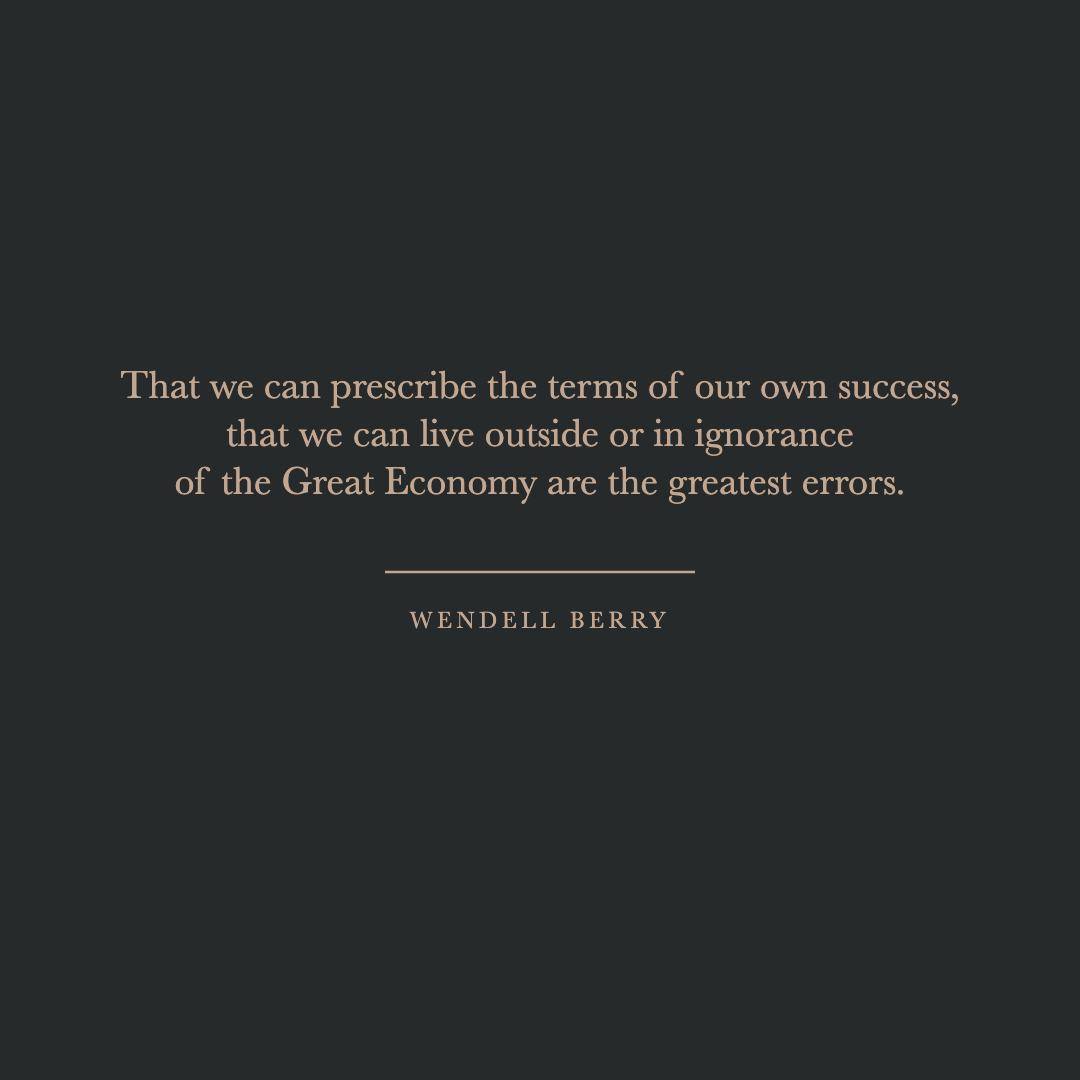
Unlike her mentor, Wendell Berry, Barbara Kingsolver has won a Pulitzer, for her novel Demon Copperhead, which I could not more highly recommend, incidentally. At Berry’s passing, she called him “the mentor who surely meant more to me than any other.” And she’s walked the talk, too, as a farmer herself in rural Virginia whose family went an entire year only eating locally.
But beyond her Berry connection, Kingsolver certainly stands alone. Originally trained as a biologist, she got her National Humanities Medal in 2000 (a decade before Berry got his), and she’s the very first to win the Women’s Prize for Fiction twice. Our quote for this week comes from her 1990 novel, Animal Dreams, and a letter written by the character Hallie to her sister, Codi.
Weekly Market Update
Small caps led the way down for all of the indices we track this week:
- 0.08% .SPX (500 U.S. large companies)
- 0.80% IWD (U.S. large value companies)
- 2.41% IWM (U.S. small companies)
- 2.19% IWN (U.S. small value companies)
- 0.79% EFV (International value companies)
- 1.69% SCZ (International small companies)
- 1.02% VGIT (U.S. intermediate-term Treasury bonds
Don’t Blame Inflation
Contributed by Nick Amat, CFA®, CFP®, CAIA, Senior Portfolio Designer, SignatureFD
The 10-year Treasury yield topped 4.9% on Thursday, reaching the highest level since November 2023. It’s probably easy to assume that the bond market has an inflation problem. Economic data this week didn’t help the narrative, as oil topped $100 a barrel and wholesale inflation was up 5.4% year over year. However, other data says otherwise.
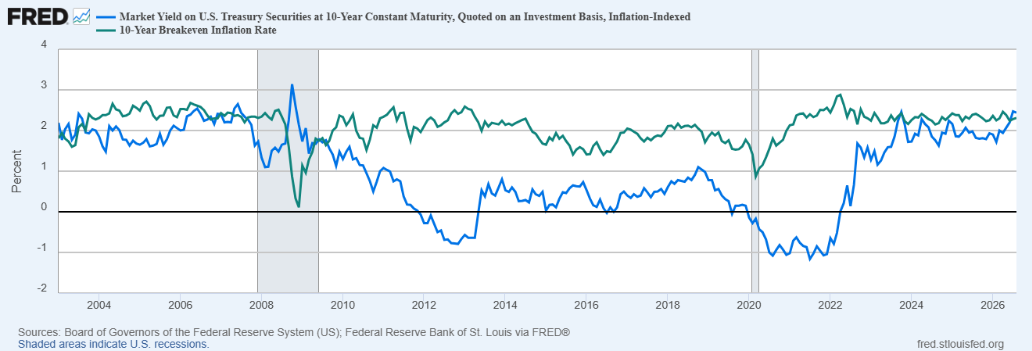
Nominal Treasury yields are the sum of two things: the real yield, the compensation an investor demands above the inflation rate, and the breakeven rate, which is what the market believes inflation will be over the life of the bond. By looking at them separately, we can learn what’s driving the move in Treasury rates.
10-year breakevens sit at 2.40% as of Thursday and, for the most part, have been range-bound over the past two decades between 1.5% and 2.5%. The real yield sits just shy of 2.50% as of Thursday, the highest level in the last 15 years. Investors aren’t asking to be compensated for inflation. They are asking to be paid more to lend for ten years.
It’s been driven by a large supply of Treasuries and record corporate issuance, rather than rising prices. A real yield of 2.5% changes the math on all other investments because it raises the bogey for all other risk assets.
Chart O’ The Week
Despite the short trading week, the data kept us busy. Last week, geopolitics dominated headlines. This week it was all about interest rates. The short end of the curve responded to both wholesale and consumer inflation data, pushing the probability of a 0.25% rate hike up sharply by Friday morning. Long-term yields moved higher on supply pressure. Equities responded by selling off for four straight sessions heading into Friday.
The macro and monetary indicators did most of the work this week, and the direction was consistent. Tuesday opened with a roughly 60% probability of a quarter-point rate hike. By Thursday’s close, it had climbed above 70%. Wholesale inflation came in hotter than expected, with headline PPI up 5.4% year-over-year against 5.3% expected. Oil continued to rally, topping $100 a barrel and strengthening the inflation narrative. Supply pressures in the bond market pushed long-term yields higher, taking the 10-year Treasury above 4.9% on Thursday. Friday brought August CPI, the last data point the FOMC will see before its rate decision on September 16. Headline inflation rose 0.4% from the prior month and 3.4% year-over-year, both in line with consensus. Core inflation is where things got interesting. It rose 0.3% against the expectation of 0.2%, even as the annual core rate eased to 2.4%. Following the print, the 10-year held above 4.9% and the probability of a rate hike climbed to 85%.
Despite continued pressure in the bond market, market fundamentals remain strong. As we stated last week, S&P 500 profits have now grown for 12 consecutive quarters. Analysts expect that trend to continue, with Q3 S&P 500 earnings projected to grow 28.5% year-on-year. The more telling statistic is the direction of earnings revisions. Analysts expected 26.6% growth at the end of June, a 1.9 percentage point revision higher. Estimates are typically trimmed as quarters progress. This time around, they have been raised. Should that come to fruition, it would mark the third straight quarter of earnings growth over 25%. Corporate guidance has mirrored analyst sentiment, with 63% of S&P 500 companies issuing positive EPS guidance. This is well above the 41% five-year average. Valuations continue to look slightly elevated compared to historical levels. This week’s pullback helped that slightly, but with a risk-free rate where it is, richer valuations have less wiggle room should they disappoint.
Market trend has begun to decline as volatility has caused major indices to swing. The S&P 500 is roughly 3% below its August record highs and has fallen for four consecutive sessions, its longest losing streak since early March. Weakness has continued to be concentrated in the more rate-sensitive corners of the market. The Russell 2000, a US small-cap index, was the worst-performing major index three days running as of the close of business Thursday. We saw breadth deteriorate as well, with the percentage of S&P 500 stocks trading above their 50-day moving average falling to around 40% from above 70% in mid-August. While this appears relatively negative, we believe it’s important to provide some context. Wednesday was only the third session in 2026 in which more than 60% of the stocks in the S&P 500 declined, the fewest such days since 2010. This is deterioration from an unusually strong starting point rather than a complete breakdown. However, it’s worth watching as we head into Wednesday’s Fed decision.
The market this year has been fueled by strong fundamentals, and that story hasn’t changed. The pressure we’ve experienced this week has come from the cost of money, not the underlying economy. Now that the latest pre-meeting data is in, the market is turning its attention to the Fed rate decision on Wednesday.
With the passing of the 25th anniversary of 9/11 this week, I’m reminded of the relative unimportance of…so much, really, that tends to draw our attention. Of course, all of us of a certain age remember precisely where we were when the towers were hit, followed by the Pentagon and a Pennsylvania field, but my thoughts are especially with those of you who suffered irretrievable loss, in addition to the fear and confusion we all shared.
Wishing all of you and yours a weekend of focus on the stuff that’s most important to you.
Tim