

Vinyl records certainly didn’t forestall the streaming music movement, but streaming also didn’t kill vinyl. In fact, vinyl sales grew for the 19th straight year in 2025, and passed $1 billion for the first time since 1983. And as a musician and avid consumer of both streaming and vinyl music, I’m thankful that both exist.
Not that it’s a perfect parallel, but could it be possible that analog and AI both deserve a place, too—that it need not be all-in on either?

In this week’s Financial LIFE Planning section, I’m featuring a podcast conversation that I had with George Kinder, the founder of the EVOKE method of life planning and a true luminary in the craft of financial advice.
George makes the case that AI’s thinking capabilities are advancing at light speed thanks to the evolutionary technology—but that the human ability to sense and feel is a veritable superpower, according to a Caltech study.
It’s an interesting perspective that we discussed at length in this week’s featured section. And after our Quote O’ The Week from F. Scott Fitzgerald, Tony Welch updates us on the bad breadth of the market.
Thanks for joining us, and please note that there won’t be a NWWW next week, as the editor is taking some extra time away from the office. :-)
Tim
Tim Maurer, CFP®, RLP®
Partner
In this Net Worthwhile® Weekly you'll find:
Financial LIFE Planning:
Is AI vs. Analog Really The Debate? [VIDEO]
Quote O' The Week:
F. Scott Fitzgerald
Weekly Market Update
The Stock Market’s Bad Breadth
Financial LIFE Planning
Is AI vs. Analog Really The Debate? [VIDEO]
A Discussion With Life Planning Pioneer, George Kinder
There’s a very real temptation right now to think about AI and the human spirit as in competition, but the founder of the Kinder Institute of Life Planning, George Kinder, is not thinking dualistically about this.
While he views AI with a healthy caution, he believes that through the effective utilization of AI, it will enable financial advisors to navigate the computational aspects of money management better than ever—while also creating additional space and time to do the even more impactful work with clients that will always require the capacity for true empathy. True humanity.
This was an especially fun conversation, because George and I will both be presenting keynotes at the National Association of Personal Financial Advisors (NAPFA) conference in Atlanta October 14-17.
Compelling Quotes:
“I read articles about AI every day because I’m so thrilled with what’s going on. At the same time, terrified.”
“The structures are wonderful, they’re fabulous, but they only go so far. The actual delivery is human to human.”
“We’ve had twenty-five hundred years of great thinking. I think the next twenty-five hundred years are gonna be great listening.”
“We don’t think freedom. We experience freedom.”
What We Cover:
George’s newest venture: a UK Innovator Founder visa to bring life planning and fiduciary principles into whole companies
Why George is both thrilled and terrified by AI, and why he says to “dive in and use it” anyway
The underrated thing AI does best: discerning the truth from a mountain of data
What it can’t do: notice the tear, the glance away, the couple turning from each other
The “methodologies of the human side”: why listening is a skill to be practiced, not just a trait you have
Two practical steps before your next client meeting: five minutes of mindfulness, and dropping every goal but one
Lighting the torch: why a client’s dream of freedom should feel equal parts exciting and anxiety-provoking
AI note-takers: what they capture, what they miss, and why George still keeps a pen on the table
Links:
CalTech Study, Thinking Slowly: The Paradoxical Slowness Of Human Behavior
Bain: Great Companies Obsess Over Productivity, Not Efficiency
Quote O' The Week
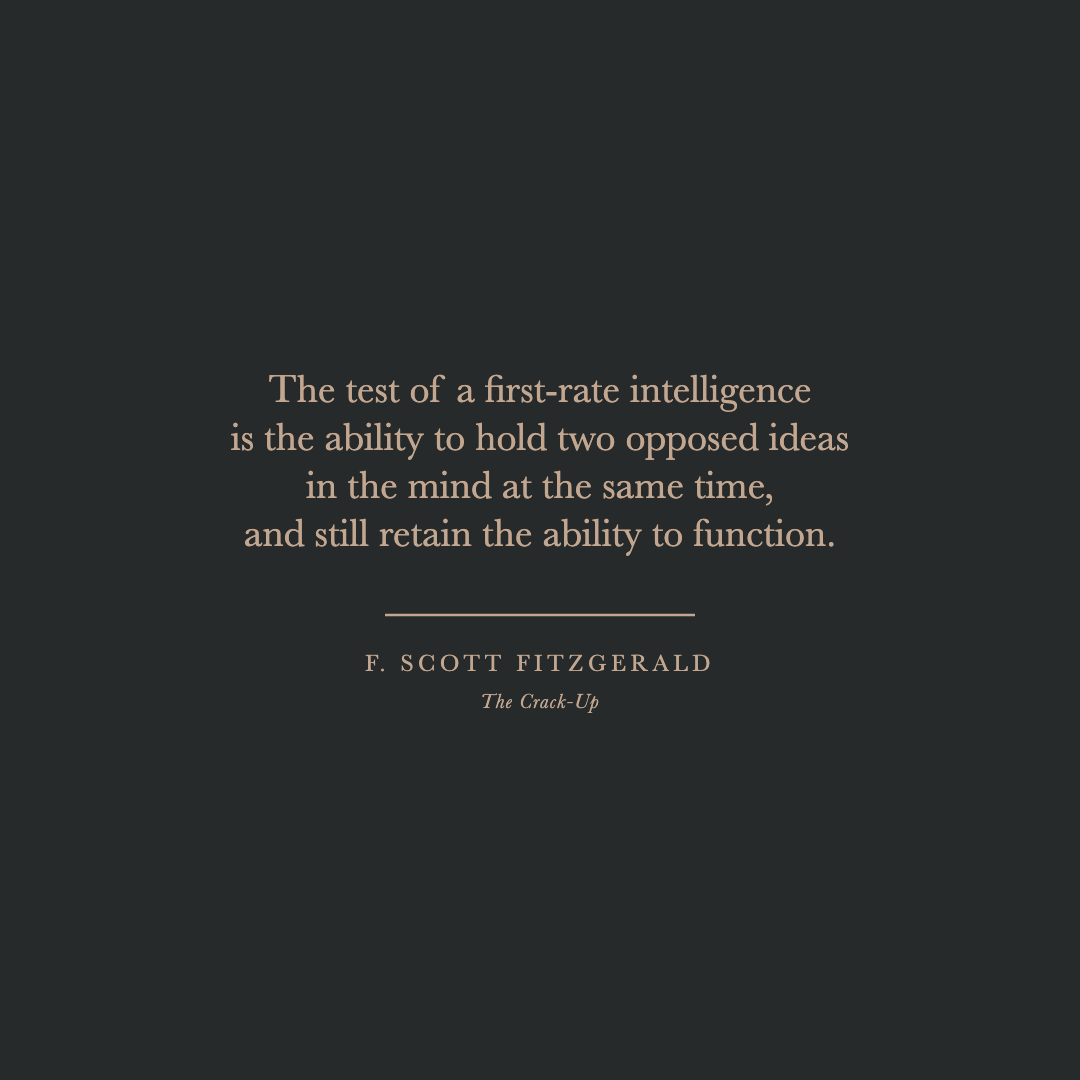
F. Scott Fitzgerald (1896-1940) was an American author we’ve likely all read, by virtue of The Great Gatsby (written in 1925), although this week’s quote actually comes from a three-part essay in Esquire called “The Crack Up,” that was published in 1936. Fitzgerald was one of the highest-paid writers in the U.S., earning $4,000 per short story (roughly $55,000-$60,000 in today’s dollars) by The Saturday Evening Post. But despite keeping a meticulous handwritten ledger of every dollar he earned, he was perpetually broke. And sadly, when he died, his most famous novel, Gatsby, was still considered a flop. It wasn’t until 1945, when 155,000 free copies were given to WWII servicemen that the book’s revival began.
Weekly Market Update
Unless you were US and large, you were likely down this week:
+ 1.15% .SPX (500 U.S. large companies)
+ 1.67% IWD (U.S. large value companies)
- 0.16% IWM (U.S. small companies)
- 0.92% IWN (U.S. small value companies)
- 0.38% EFV (International value companies)
- 0.46% SCZ (International small companies)
- 0.46% VGIT (U.S. intermediate-term Treasury bonds
The Stock Market’s Bad Breadth
Contributed by Tony Welch, CFA®, CFP®, Chief Investment Officer, SignatureFD
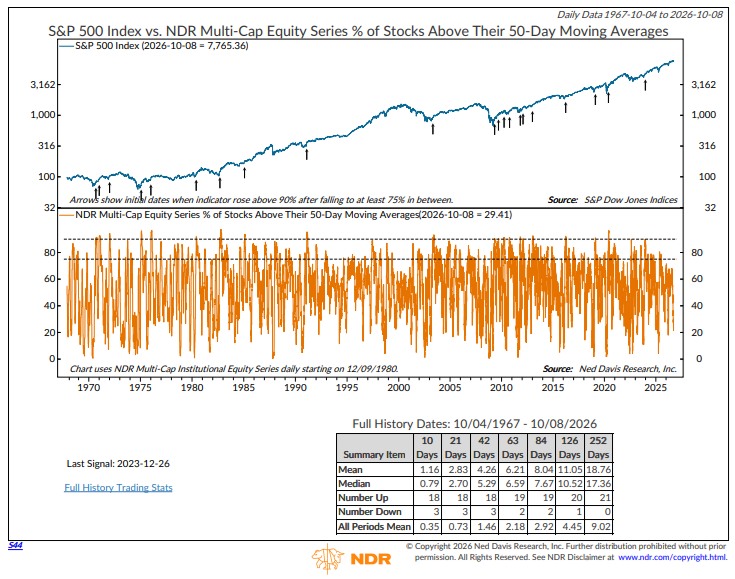
The market has bad breadth. I think that’s been pretty well publicized by now. The chart below shows that despite the S&P 500 being near its best levels ever, less than one-third of all stocks are trading above their respective 50-day average price. In other words, few stocks are actually in an uptrend even though the index itself continues trending higher. This phenomenon can occur when the biggest stocks are rallying without accompaniment from smaller stocks.
Interest rates have been a big part of the story. Higher rates tend to weigh on dividend-paying stocks as well as companies that must access the debt markets for financing. Additionally, higher rates work to tamp down demand, with a lag, so it’s possible that many of these companies have an economic headwind to deal with in the future, particularly if consumption trends slow.
But the good news is that bad breadth can often give way to a more positive backdrop if the other stocks do, in fact, begin to trend higher. As the chart below shows, historically, when 90% of stocks trade above their 50-day average, the market has gone on to rally over the next 12 months 21 out of 21 times, with an average gain of 19%. For now, bad breadth is a risk to the bull market that began in 2022. But we would be encouraged to see breadth improvement, which would likely occur alongside stability in interest rates.
Chart O’ The Week
Economic growth, both in the U.S. and internationally, has held up admirably this year. U.S. growth has been buoyed by the AI investment theme, but consumers have also continued to spend. Disposable income has not kept up with inflation, but there is a wealth effect implicit in record highs for stocks, higher yields on cash, and strong real estate pricing. Additionally, consumers have continued to reduce their savings rate. It isn’t a perfect economic backdrop. We’d like to see incomes grow faster than inflation so consumers can keep spending as well as saving, but the resilience thus far has been notable.
We mentioned interest rates above, and that is certainly one variable that could play the role of a headwind for the bull market. And in many ways it has. As we write above, most stocks are not currently trending higher. But the heavyweights are carrying the index, and therefore, the uptrend for the S&P 500 has remained intact, especially true when compared to bonds.
We are starting to enter a seasonally positive period for stocks.In fact, since World War II, the market has yet to decline in the 12 months following a U.S. mid-term election. We sometimes discuss stock market sentiment, but we also track bond market sentiment. Investors are extremely sour on bonds today, and that has often preceded bond bull markets (lower rates). If bond yields stabilize or even fall, then that could support the average stock and the continuation of the bull market. Q3 earnings are forecast to grow about 30% from Q3 last year. So the fundamentals still remain intact and supportive. For now, despite some concerns over market participation and interest rates, we would continue to give the bull market the benefit of the doubt.
Have a great rest of your weekend, and I’ll see you in TWO weeks!
Tim