


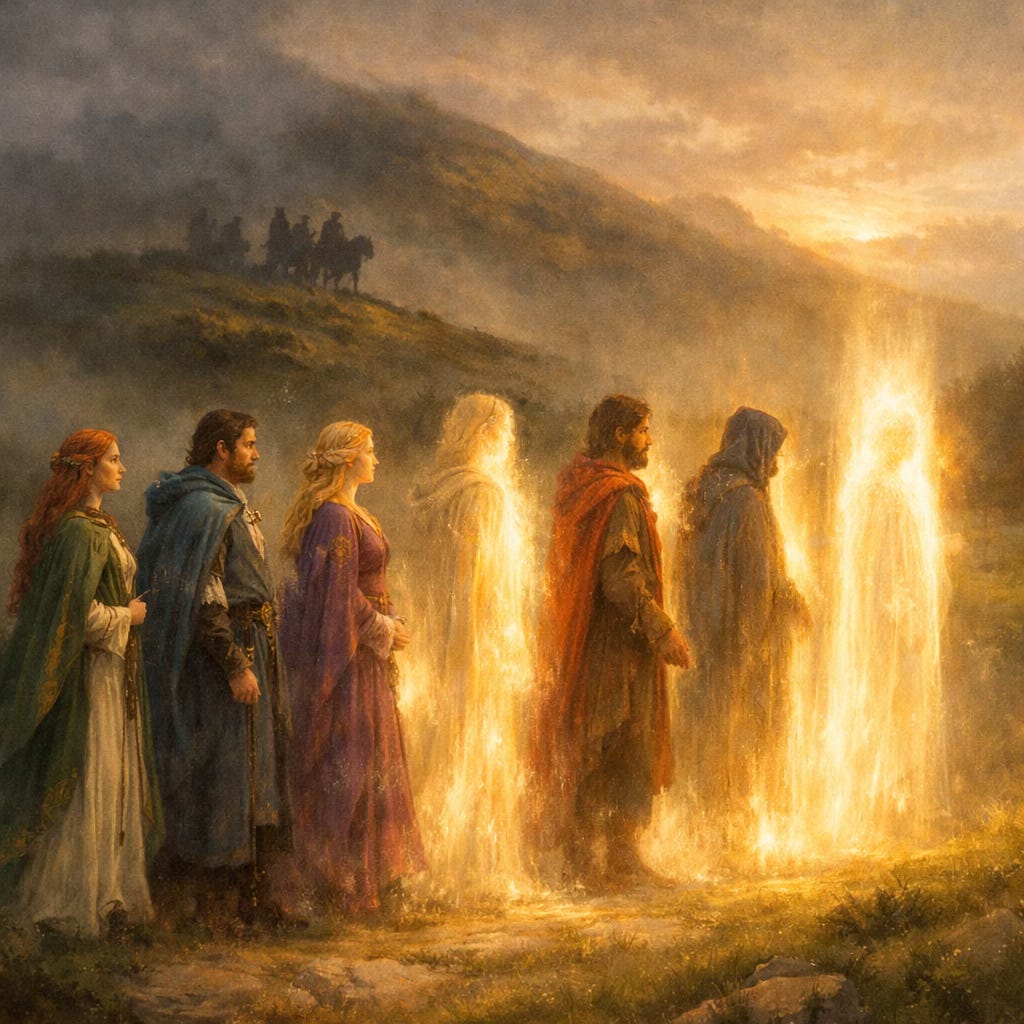
Have you heard of the Tuatha De Danann? As the legend goes, they were an ancient pre-Celtic tribe in what is now Ireland, known for their striking beauty and artisan sensibilities. When the Milesians, the final wave of invaders who ultimately conquered the Emerald Isle, arrived to overtake the Tuatha De Danann, they were assembled in their regalia at the bottom of the hill. Yet, as the invaders rushed the colorful collective, it is said that they simply turned sideways into the light and disappeared.
They didn’t fight. They didn’t flee. They just…vanished.
When I heard this story in David Whyte’s What To Remember When Waking, it occurred to me that in 2026, we seem to have devolved to a single approach to cultural conflict resolution—it’s all a fight, right?
Then I wondered further if we unintentionally inhabit this posture on the home front, with our partners, parents, and progeny. And especially around money.
So, this week, we’re exploring how we can turn prospective conflicts into connections, especially around the challenging topic of money. Then, our resident investment commentator, Tony Welch, takes on the topic of The Strait of Hormuz and Oil Markets.
Thanks for joining for this week’s Net Worthwhile weekly!
Tim
Tim Maurer, CFP®, RLP®
Chief Advisory Officer
In this Net Worthwhile® Weekly you'll find:
Financial LIFE Planning:
Fight—Or Turn Sideways Into The Light?
Quote O' The Week:
David Whyte
Weekly Market Update:
The Strait of Hormuz and Oil Markets
Financial LIFE Planning
Fight—Or Turn Sideways Into the Light?
Money is too often the great divider—whether on an international, institutional, or interpersonal level. And yet, regardless of the inertia that seems to invite us toward insolence, there’s always another option, or better yet, options. Let’s look at a few of them:
Option 1: We Can Fight
Direct confrontation is always an option. It’s sometimes necessary, but often costly. However seemingly righteous, the full-frontal assault tends to leave wreckage in its wake, and that wake too often scores ruts in our relationships that can become difficult to steer out of.
Are you stuck in a relational rut due to the difference in the way that you and your spouse (or kids or colleagues) look at money?
And if you do find yourself in one of those relational ruts, financially rooted or otherwise, have you considered getting some help through therapy? This is a great way to bring some objectivity into the ring and create an off-ramp from those ruts.
Option 2: We Can Flee
While my own Irish heritage disinclines me to such a tendency, I’ve heard that some people naturally shut down in the midst of disagreements. (Imagine that!) And while this technique (because all of these are, whether we acknowledge it consciously or not) may help us avert a blow-up in the moment, they often lead to an underlying current of dissonance that, while not at a frequency that is audible, can become deafening over time and lead to serious divisions.
Do you or your person shut down in the face of disagreement? If you’re stuffing your alternative views down deep, this might be you—and if you seem to win every argument, it might be your counterpart.
Option 3: Turn Sideways Into the Light
As it often does, the third way looks a bit murkier, and this notion of turning sideways into the light is even more challenging, because we’re tempted to view it as the same as Option 2. But it’s not, and here’s the difference.
Fleeing is reactive, fear-driven, and leaves you smaller. But turning sideways can be deliberate, dignified, and generative. Can I give you an example that my wife and I imperfectly employ?
We have a standing weekly “Monday Meeting,” where we eat lunch together. We start with a centering prayer, sync our calendars for the next few weeks, and then address any outstanding issues that may be inclined to incite disagreement, but with a touch of distance and emotional detachment.
Here’s how this helps us turn sideways: Let’s say it’s Thursday night. We’re eating dinner, and I mention that I’m traveling for work the following Wednesday. My wife glances at her phone and sees that I never put it on our joint calendar, and that she has an event while I’m away that will now require scrambling for childcare.
She could attempt to address it right that moment, over the din of our two-year-old’s insistence that she remain the center of attention, followed by a defensive response from me about how busy I am and that it was surely Siri’s fault my trip didn’t make it into the family calendar. Then, we can escalate it, get frustrated that our daughter is frustrated, and then we have the privilege of amplifying every fine point of potential disagreement until the baby goes down, at which time we can both stand on self-righteousness and gird ourselves for an evening of iciness (at best) or a full-blown argument.
(I’m sure this has never happened—but let’s just say it did.)
OR my wife can add “Please be sure to let me know when you’re going out of town” to her (hopefully short) list of topics to discuss in our Monday Meeting, at which point our emotional responses are more muted and reason truly tends to reign.
Is there an issue you’re currently facing with someone important in your life where you could turn sideways into the light?
The Danger Of Duality
Author and contemplative Richard Rohr has done much to illuminate the dangers of duality in our world. He points out that our hearts and minds have a tendency to lump everything into only two options that often represent extremes. Yet while there are normally even more options than we could possibly imagine, he calls us to (at least) “the third way.”
“The third way,” Rohr suggests, “is not balancing or even eliminating the opposites, but holding the opposites. To live inside this space of creative tension is the very character of faith, hope, and love.”
It is fitting, then, that the people who perhaps best embodied this third way were known above all else for their creativity. Perhaps it is that same quality—for which the Tuatha De Danann have become legendarily known—that could free us from the confines of an unbalanced approach to money (and just about everything else) in our lives, our marriages, our extended families and friendships, as well as our work.
The legend further suggests that the Tuatha De Danann return from time to time to rescue the world with beauty once again.
What if our most powerful move in a financial (or other) conflict wasn’t to win, but to rescue the moment with a third way—a turning sideways into the light?
Quote O' The Week
David Whyte is a British-Irish poet and philosopher who has spent a lifetime listening at the edge where ancient myth, the natural world, and the modern human heart converge.

Weekly Market Update
Markets were up this week, mostly a result of Friday’s apparent cheering over the Supreme Court’s 6-3 rejection of Trump’s tariff strategy:
+ 1.02% .SPX (500 U.S. large companies)
+ 0.64% IWD (U.S. large value companies)
+ 0.64% IWM (U.S. small companies)
+ 0.48% IWN (U.S. small value companies)
+ 0.62% EFV (International value companies)
+ 0.55% SCZ (International small companies)
- 0.12% VGIT (U.S. intermediate-term Treasury bonds
The Strait of Hormuz and Oil Markets
Contributed by Tony Welch, CFA®, CFP®, CMT, Chief Investment Officer, SignatureFD
Crude oil has moved higher to start the year, rising roughly 16% as geopolitical tensions tied to Iran have increased. Prediction markets are assigning a higher probability to a potential U.S. military strike, even as diplomatic discussions have shown some signs of progress. At the same time, the U.S. has expanded its military presence in the region in a meaningful way. Markets appear to be weighing these conflicting signals and are beginning to price in a degree of risk, evident in the oil rally.
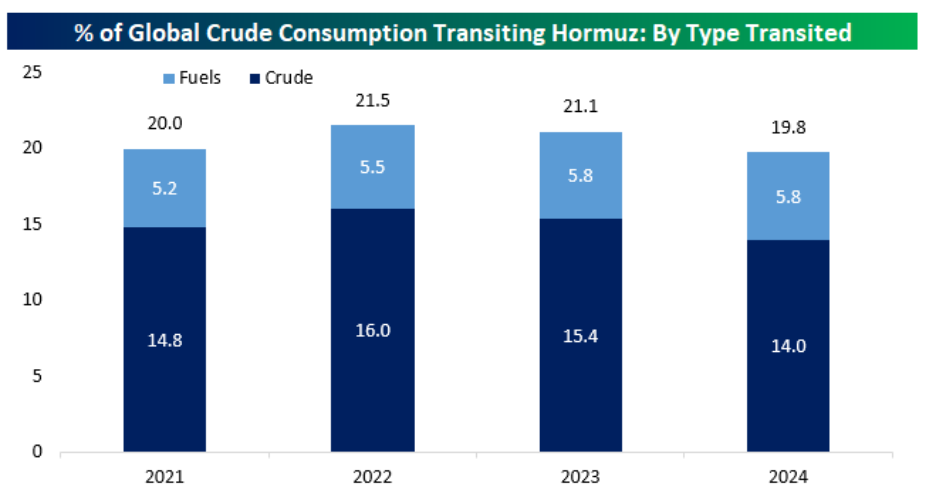
The focus remains on the Strait of Hormuz, a critical chokepoint through which roughly 20% of global petroleum supply flows. As the chart below highlights, this exposure has remained relatively steady over time. In most scenarios, including continued negotiations or a limited military action, the impact on oil prices would likely be temporary. The more disruptive outcome would involve a broader escalation that threatens energy flows through Hormuz, potentially tightening global supply more materially.
For now, markets are reflecting awareness rather than alarm. Near-term oil prices have risen relative to longer-dated contracts, suggesting some short-term concern, but not a sustained supply shock. Just as important, there has been no meaningful change in tanker traffic through the region. That is often a more reliable signal than sentiment. We are monitoring this closely, but at this stage, the environment points to elevated risk rather than active disruption.
Chart O’ The Week
The Message from Our Indicators
Last week, we got important updates on economic growth and inflation. The latest GDP report showed a step down in headline growth, but the composition remains more constructive than the top-line suggests. Private demand, particularly consumer spending and select areas of investment, continues to carry the expansion, while more volatile components have distorted the aggregate number. This aligns with what we are seeing across our indicators: momentum is slowing from above-trend levels, but there is little evidence yet of a broad-based contraction.
The most recent PCE data show inflation remaining sticky around the 3% level, keeping the Fed in a holding pattern. Services inflation remains the key friction point, and while it is improving directionally, it has not slowed enough to justify a near-term policy shift. The implication is a longer window of “higher for longer” policy than markets had priced late last year, even as the overall trajectory remains disinflationary.
From a market perspective, the more interesting development has been beneath the surface. Market breadth has been solid, and there has been a notable shift in leadership. Global equities, particularly international and value-oriented segments, have begun to outperform U.S. large caps on the margin. At the same time, sentiment indicators have moved in a pessimistic direction owing to the weaker performance of megacap Growth stocks. This is typically a constructive setup from a technical perspective. In other words, markets appear to be transitioning from a narrow, momentum-driven advance toward a broader participation phase.
On trade policy, the recent Supreme Court decision striking down the use of IEEPA as a legal basis for broad tariffs is an important development, but we believe it should be interpreted narrowly. The ruling limits one specific mechanism, not the broader ability to implement tariffs. Other pathways remain available, including established authorities tied to national security or unfair trade practices, each with its own procedural requirements. From a market standpoint, this reduces the immediacy of sweeping tariff actions through that channel, but it does not remove trade policy as a variable going forward.
Putting it together, our indicators continue to point toward a late-cycle expansion characterized by moderating growth, gradually easing inflation, and improving market breadth. Risks remain, particularly around policy and geopolitics, but we continue to give the bull market the benefit of the doubt.
The Olympics may be almost over, but hey, football season is only, uh, six months away, right?
Tim