


Last week, John Keats introduced us to Negative Capability, the idea that we can dwell in uncertainty without anxiously reaching for resolution. It was, I argued, one of the most useful things a financial advisor or client could practice.
This week, W. B. Yeats shows us what that actually looks like.
Keats and Yeats. The names almost rhyme, and so, it turns out, do their preoccupations. Both poets were obsessed with the gap between what we can plan for and what we actually receive—between the life we construct and the moments that arrive uninvited. Keats said we don’t have to resolve the tension. Yeats sat alone in a London coffee shop and discovered, for twenty unplanned minutes, what it feels like when we don’t.
This week’s Financial LIFE Planning post is about Planning For The Unplannable—which, I believe, is planning for how we spend most of our lives. And in our Weekly Market Update this week, Tony offers a touch of warning, as he thinks Inflation May Soon Become a Headwind.
Thanks for joining us!
Tim Maurer, CFP®, RLP®
Partner
In this Net Worthwhile® Weekly you'll find:
Financial LIFE Planning:
Planning For The Unplannable
Quote O' The Week:
Mary Oliver
Weekly Market Update:
Inflation May Soon Become a Headwind
Financial LIFE Planning
Planning For The Unplannable
The Real Goal Isn’t Just To Fund A Life, But To Leave Room To Live It.
Financial planning is built around a handful of momentous events, but most of life is lived in between them.
Think about it. Benchmark moments—birthing, schooling, graduating, commencing, working, marrying, moving, arriving, promoting, divorcing, demoting, retiring, disabling, dying—are so big that they require, and therefore anchor, our planning. But we spend many more of our moments in the mundane than the momentous. So what does our planning have to do with those moments?
As is often the case, we must turn to art to inform our math. In this case, our instructor is a middle-aged Irish poet who finds himself in between momentous moments while nonetheless arriving at a realization, if not a revelation:
My fiftieth year had come and gone,
I sat, a solitary man,
In a crowded London shop,
An open book and empty cup
On the marble table-top.
While on the shop and street I gazed
My body of a sudden blazed;
And twenty minutes more or less
It seemed, so great my happiness,
That I was blessed and could bless.
This, the fourth of an eight-stanza poem by W. B. Yeats, called Vacillation, finds our protagonist at a midpoint between pendulum swings from earthy desperation to philosophical heights, finding a moment (or 20 minutes, to be exact) that could, I believe, pass for a quiet picture of financial independence.

“That I was blessed and could bless” sounds to me like the very definition of true wealth—Enough—and yet we’ve made it so much more complicated, haven’t we.
What We’ve Made Planning About
Planning has such a heavy focus on accumulation and optimization, and for reasons that are understandable, I suppose. For example, the average cost of a wedding in 2026 is $34,600. Of raising 2.5 kids, from newborn to 18? About (and I’d say at least) a million bucks. And that’s before college, which will likely run about another $150,000 all in. Per kid.
And while you’re doing all that, please don’t forget your retirement savings. The cocktail napkin approach suggests you could expect to need 25x your annual income in savings. So, if you wanted around $100,000 of income in retirement, the simple calculation suggests you’d need a cool $2.5 million in that 401(k) and other sundry retirement accounts to fund your desired lifestyle.
So yes, we have to plan (well) in advance to accommodate these large numbers—but at what point does our planning to live become a life necessitated to satisfy the plan?
Well before the invention of the defined contribution retirement plan (401(k)), Yeats seems to have acknowledged as much elsewhere in Vacillation.
From the first stanza, he wrestles with the polar ends of the pendulum:
Between extremities
Man runs his course…
In the third, he acknowledges the pressure to fund our life, and our ego:
Get all the gold and silver that you can,
Satisfy ambition, animate
The trivial days and ram them with the sun…
So what’s the point?
Margin For Mundane Moments
Margin.
Of course, margin isn’t only financial. Some of the most constrained people I know have plenty of money.
Yes, we need to plan for the big stuff, and the milestones matter. But let’s not forget that with the millions required to fund the resume, the house(s), the cars, the 529 plans, the 401(k) accounts, the Roth conversions, and all the insurance required to maintain all of that, even in the case of our death or disability, none of those are actually the thing.
The thing might just be that 20-minute stop in the coffee shop that cost all of about $6.00 (in today’s dollars—or pounds). The in-between moments with our loved ones that cost nothing.
The irony is that Yeats couldn’t fully escape the weight either. The stanza immediately following his coffee shop revelation is perhaps the most honest in the poem:
Although the summer Sunlight gild
Cloudy leafage of the sky,
Or wintry moonlight sink the field
In storm-scattered intricacy,
I cannot look thereon,
Responsibility so weighs me down.
Twenty minutes of grace. Then back to the weight of a life. He didn’t solve it. Neither will we.
But here’s what a good financial plan can actually do: It can reduce the weight enough that the twenty minutes are possible. Not guaranteed. These moments can’t be engineered, only received. But a plan that creates margin, reduces anxiety, and isn’t entirely mortgaged to the next milestone at least leaves the door open.
Quote O' The Week
Mary Oliver (1935–2019) won the Pulitzer Prize for Poetry and became one of the best-selling poets in American history — an almost unheard-of commercial achievement for serious literary verse. The surprising part: she gave almost no interviews, avoided the literary establishment entirely, and spent her days walking the woods and marshes of Cape Cod, which is where virtually every poem came from.

Weekly Market Update
How many times have you said, “You can’t make this stuff up!” in 2026? Well, here’s another, as half of the indices we track managed 52-week highs after testing lows quite recently:
+ 4.54% .SPX (500 U.S. large companies)
+ 2.39% IWD (U.S. large value companies)
+ 5.54% IWM (U.S. small companies)
+ 3.57% IWN (U.S. small value companies)
+ 1.13% EFV (International value companies)
+ 2.87% SCZ (International small companies)
+ 0.56% VGIT (U.S. intermediate-term Treasury bonds
Inflation May Soon Become a Headwind
Contributed by Tony Welch, CFA®, CFP®, CMT, Chief Investment Officer, SignatureFD
Consumer inflation (CPI) peaked at 9% in June 2022. This bull market began only a few months later. Clearly, an easing rate of inflation has been a tailwind for stocks for over three years. But the combination of tariff passthrough and higher energy prices threatens to push up inflation in the coming months. It’s already climbed to about 3.3%.
The chart below compares inflation to its average level for the past six months. Historically, when CPI falls below its average, stocks have performed well. When inflation rises meaningfully above its average, stocks have struggled. The indicator remains bullish for stocks following the March inflation print, but another higher inflation reading in April could result in an inflation headwind for stocks. Importantly, that doesn’t mean that we should expect a major bear market, just a more challenging environment than we have experienced since Fall 2022.
Chart O’ The Week
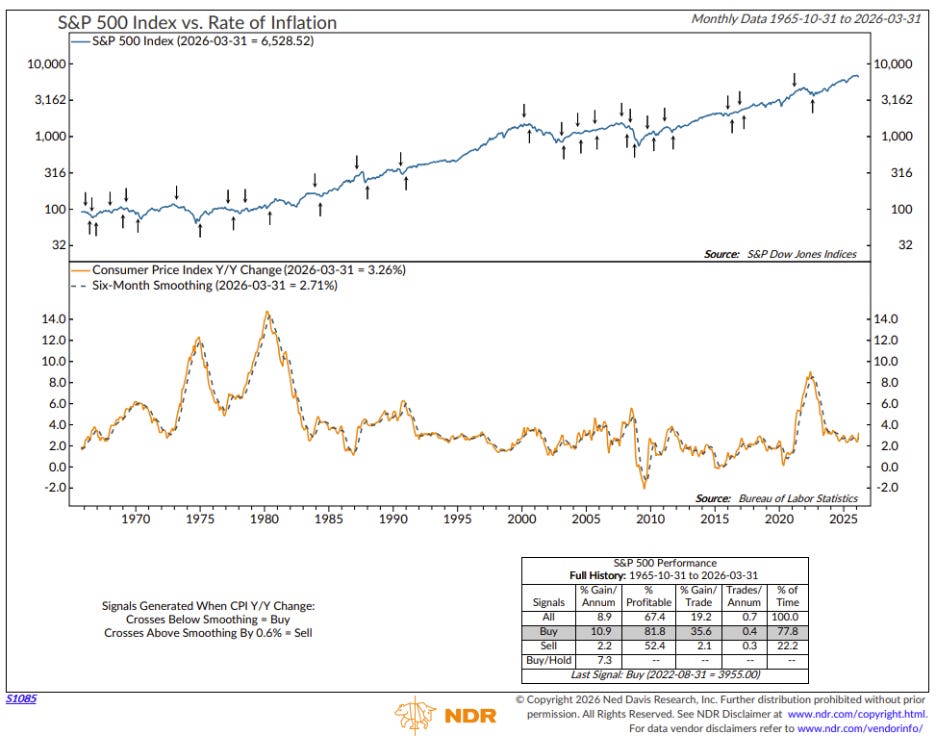
The Message from Our Indicators
In the past week, many stock market indices climbed back to their all-time high levels. The quick recovery is historic in nature. The market recovered its -10% correction in 11 trading days. That is the fastest recovery of a -5% to -10% correction in history. While it is interesting to see history made, a study by Bespoke Investment Group suggests we shouldn’t read too much into the implications for the rest of the year. Previous quick recoveries have been followed by an average return of 4.6% in the subsequent six months. More importantly, we’re keeping an eye on the quality of the rally. We would like to see a high percentage of stocks, industries, and global markets rally together. Thus far, we haven’t gotten enough confirmation to confidently proclaim that the volatility is behind us. Nevertheless, our trend indicators remain bullish, which shouldn’t be much of a surprise given fresh all-time high.
From a macro perspective, the data remains mixed. As discussed above, inflation is top of mind for consumers, and as a result, we’ve seen consumer confidence erode. But real-time economic measures suggest that the expansion remains intact. In fact, the Citigroup Economic Surprise Index, which measures whether reports are coming in above or below expectations, has been positive all year. But the inflationary impulse has taken the Fed from easing mode to neutral. That’s not necessarily a bad thing, but stocks have performed best when the Fed has been lowering rates.
One of the ongoing sources of economic support has been the corporate profit cycle. Earnings season for Q1 is underway, and preliminary results have been strong. Analysts estimate that earnings will have grown by double-digits for the sixth consecutive quarter. Rising profits have supported the labor markets. Interestingly, the inflationary impulse that may become a headwind to stock prices is a likely tailwind for earnings, meaning that earnings are likely to rise more than stock prices. That combination is not necessarily a bad thing because the result would be cheaper valuations. For now, the message from our indicators remains constructive.
Always constructive,
Tim
Tim:
Thank you so much for this wonderful reflection. Your writing is poignant and places emphasis on all those great things that make our lives so rich.
Many thanks!