


A fun problem I’ve occasionally run into with a handful of clients is how to breathe fresh life into financial planning when you seem to have more money than you know what to do with. We’ve got an exercise for that.
But the far more common challenge is the opposite: What do you do when your dreams outrun your dollars? This is a vital question to answer, because none of us has enough total wealth—time, influence, money, energy, and relationships—to do everything we want. Now.
Most people assume this is where financial planning becomes an exercise in limitation—scaling back expectations, lowering the bar, or quietly abandoning the dream altogether.
It doesn’t have to be.
Done well, financial planning isn’t about killing the dream. It’s about learning how to translate it. In this week’s Financial LIFE Planning installment, we’ll walk through that translation process before Tony’s Weekly Market Update gets us up to speed on a very volatile stretch for the markets.
Thanks for joining us for this week’s Net Worthwhile weekly!
Tim Maurer, CFP®, RLP®
Partner
In this Net Worthwhile® Weekly you'll find:
Financial LIFE Planning:
Pursuing The Impossible Dream
Quote O' The Week:
J.R.R. Tolkien
Weekly Market Update:
The Frequency of Corrections
Financial LIFE Planning
What To Do When Your Dreams Outrun Your Dollars
In the parlance of one of the most powerful training programs I could ever recommend for a financial advisor—the Kinder Institute of Life Planning—“the impossible dream” is the term used both as an homage to Man of La Mancha and the term to describe how we navigate the challenge of dreams that appear to outrun our dollars. The good news is that there’s an exercise for this challenge, too. Let’s walk through it.

The Kinder Institute method is often referred to as EVOKE, an acronym that is even more powerful than it is memorable:
E - Explore
V - Vision
O - Obstacles
K - Knowledge
E - Execution
Why We Start Without Constraints
The method is deliberately designed to cast constraints aside for the first two steps. In the Explore phase, we ask three of the most informative (if not gut-wrenching) questions you’ve likely ever been asked to prime the pump, and in the Vision phase, we do the more expansive work of “lighting the torch” with a dream-like goal set that we imagine coming to fruition within 18 months.
In the first two phases, we deliberately remove constraints. This is not because they don’t exist, but because our default tendency is to shrink our dreams too quickly or never translate them into action at all.
This could be for any number of reasons, but especially:
Status quo bias keeps us anchored to what is, instead of what could be
Identity lock-in convinces us that who we are today is who we must remain
Loss aversion makes the cost of change feel larger than the reward
When Reality Re-Enters the Room
In the Obstacles phase, we don’t challenge the dream. We protect it.
Then we ask a different question: What stands in the way?
Not our answer—the client’s. Only after they’ve named their obstacles do we carefully add any blind spots that could derail them.
But what happens when those obstacles don’t feel like speed bumps, but a wall?
What “Impossible” Actually Looks Like
Many impossible dreams show up in our work lives:
The corporate attorney who wants to teach high school history
The surgeon who wants to paint
The CFO who wants to run a small nonprofit
The financial advisor who wants to be a full-time writer or coach
Others are about major life or lifestyle shifts:
Selling the house and moving to the Italian countryside
Buying the family farm back
Spending a year sailing the world while homeschooling the kids
Going back for a theology degree
And some are about radical generosity:
Building a school in Africa
Getting involved as a foster parent or adopting
Setting a “financial finish line,” where everything made in excess of what you consider your needs is given away
If this whole notion of taking a more radical approach to your financial planning is new, understand this: Every single one of the above “impossible” dreams is based on a true story. I’ve seen all of them—and more—and several have absolutely been accomplished.
The first step in managing an impossible dream is to determine whether it’s actually impossible in the first place, because it often isn’t. And there are few more energizing pursuits in wealth management than expanding what feels possible and setting a course toward it.
When the Dream Is Possible
Take a friend of mine who had a dream of sailing with his school-age children for a year.
And he did it.
For 11 months, his family became an experiential classroom under sail, starting in New Zealand.
Yes, it required a fair amount of luck—like a friend with a catamaran he wasn’t using—and a significant amount of coordination—like arranging for colleagues to absorb much of his workload. But it absolutely happened. And can you imagine the stories his kids got to tell at their next “What did you do last summer?” session at school?
This is what intentional planning makes possible—experiences most people assume are out of reach.
When the Dream Isn’t—Yet
But if you can’t do it (yet) that doesn’t mean you abandon the dream. You translate it.
Start smaller. Learn to sail this year. Get licensed as a captain next year. Charter a boat the following summer. Spend two weeks exploring the Abaco Islands.
This is where financial planning becomes less about limitation and more about sequencing.
The Power of a Test Drive
There’s another benefit to this approach: you might discover the dream isn’t actually yours. You might get seasick. Or find that you don’t love the mechanics of sailing. Or realize that your spouse doesn’t share your enthusiasm for open water.
I have another friend who was a marketing executive who dreamed of owning a coffee shop. He loved the daily interaction with baristas and the rhythm of the café. He was serious enough to test it, and a generous shop owner let him work as a barista for two weeks.
What he discovered was that only a small fraction of the job involved pleasant interactions. Most of it was fast-paced, high-pressure service, and a surprising amount of time washing dishes in the back.
He didn’t abandon the dream. He clarified it. And in doing so, avoided turning a pleasant fantasy into a costly mistake.
Don’t Kill the Dream—Translate It
Most people assume financial planning is about choosing between what you want and what you can afford.
But it’s not. It’s about refusing to let either one dominate the conversation.
If you ignore reality, your dream stays a fantasy. If you surrender to reality too quickly, your dream disappears altogether.
The work is in between. Sometimes that means discovering the dream is more possible than you thought. Sometimes it means translating it into something smaller, slower, or staged over time. And sometimes it means realizing the dream wasn’t really yours to begin with.
But in every case, the goal is the same:
Don’t kill the dream. Translate it.
Because the best financial plan isn’t the one that perfectly optimizes your money. It’s the one that gives your life its shape.
Quote O' The Week
J.R.R. Tolkien (1892–1973) was an Oxford professor, linguist, and author of The Hobbit and The Lord of the Rings — widely considered the father of modern fantasy literature. What fewer people know is that beneath the world-building was a deeply romantic soul: Tolkien fell in love with his wife Edith as a teenager, was forbidden from contacting her for years, and waited. When he finally could, he wrote to her immediately. She became his Lúthien — the immortal elf-maiden who gives up eternity for love — and when they died, both their gravestones at Oxford were inscribed with the names Beren and Lúthien. He built entire worlds. But the love story was always personal.

Weekly Market Update
The markets have a lot of information to process these days, and it led to a mixed bag:
- 2.12% .SPX (500 U.S. large companies)
- 0.60% IWD (U.S. large value companies)
+ 0.36% IWM (U.S. small companies)
+ 1.65% IWN (U.S. small value companies)
+ 0.90% EFV (International value companies)
+ 0.07% SCZ (International small companies)
- 0.17% VGIT (U.S. intermediate-term Treasury bonds
The Frequency of Corrections
Contributed by Tony Welch, CFA®, CFP®, CMT, Chief Investment Officer, SignatureFD
We’ve experienced something of an oil shock in the short term. The rising cost of oil has the potential to negatively impact consumer sentiment, corporate earnings, and economic growth. One interesting trend: the futures curve for oil has not shifted much in the longer term. That implies that market participants expect oil to revert back to pre-conflict pricing in the next few years.
BCA Research shows an interesting chart in which they plot the 5-year futures price for oil against the breakeven price for U.S. oil producers. It has tracked tightly since 2016. That makes intuitive sense as the U.S. has become the largest producer of oil. BCA posits that it isn’t a question of “if” oil reverts to U.S. production costs, but rather “when” it will begin to do so. There are many wildcards in the Iranian conflict, and predicting near-term moves is extremely difficult. But over the longer term, we might expect oil prices to ease, eventually bringing support to consumers. However, that could be a theme for 2027 or beyond.
Chart O’ The Week
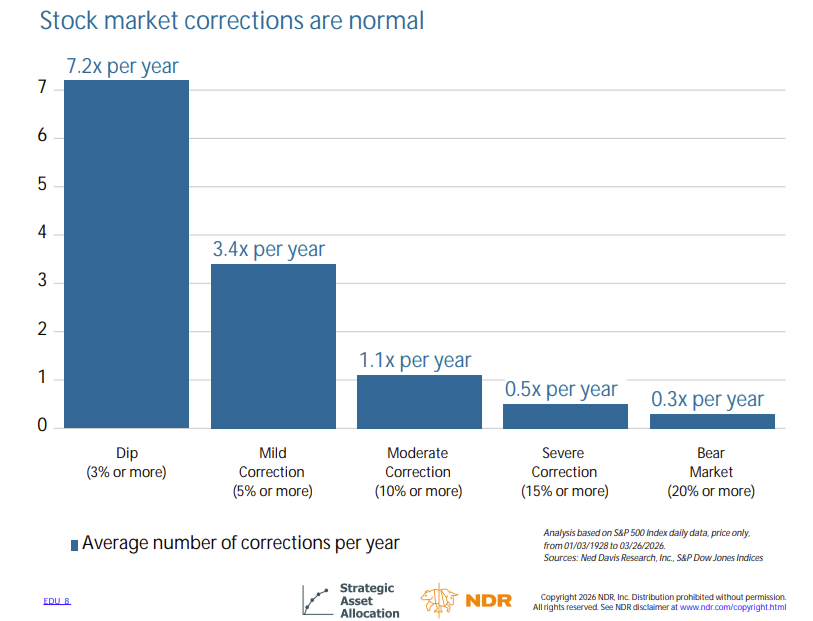
The Message from Our Indicators
The longer the conflict with Iran presses on, the more likely it is to damage some of the bull market tailwinds that have been in place since 2022. Ned Davis Research estimates that if oil prices were to settle at their current level for the rest of 2026, it would add about 1% point to consumer inflation and detract about 0.5% points from economic growth. We already had some signs that inflationary pressures were building in the February data. That means that if inflation were to be around 3% by year’s end, oil at these levels would instead push it to about 4%. Economic growth in 2025 was about 2%. Subtracting half a percentage point may not seem like much when the economy is growing quickly, but at a 2% growth rate, it would be more meaningful. The stock market has historically struggled when inflation is accelerating and economic growth is decelerating, so these are certainly trends worth watching. For now, the economy does remain in expansion, and inflation has not broken out to problematic levels.
From a fundamental perspective, the macro dynamic could squeeze profit margins. Analysts expect double-digit earnings growth in 2026, which is important for a number of reasons. Employers typically maintain or expand employment when earnings are growing. And the stock market has tended to avoid major bear markets in the absence of earnings contraction. The extent to which margins are squeezed, by some combination of weaker sales (owing to softer economic growth) or higher input costs, matters. Much like the broad macro environment, the fundamental backdrop is positive, but we’ll be watching Q1 earnings calls for signs that analyst earnings assumptions are being challenged.
Finally, from a trend perspective, the market is oversold, and sentiment is pessimistic. We expect some form of market rally in upcoming weeks. We can watch the quality of that rally to help make an assessment regarding the rest of the year’s trajectory. We want to see strong market participation whereby most stocks, industries, and global markets rally together. We also want to watch the trend in interest rates. Stable to lower rates have been a tailwind for stocks since 2022, but rates have been moving higher in anticipation of the aforementioned inflation pressure. A reversal in the rate trend could also be a positive influence. For now, the message from our indicators suggests that we take a neutral stance toward risk.
Hoping your weekend is more positive than neutral!
Tim
I'm going to be thinking about The Impossible Dream for a while this weekend, Tim. Thanks for sharing!