


Every week, I’m inspired by the conversations I have with truly great financial advisors—the ones who really get it. This week’s inspiration came from an awesome Aussie advisor I met for the first time who told me that his original motivation for joining the profession was nothing short of being one of the most pivotal relationships in the lives of his clients, outside of their immediate family.
Seems like a lot, right? An audacious aspiration?
Maybe, but this week, we’ll explore three potential layers of outsized impact that a financial advisor can have when we assume a humbler posture in our work. And Tony tells us why a weak jobs report may not necessarily signal a weak economy.
Thanks for joining us!
Tim
Tim Maurer, CFP®, RLP®
Partner
In this Net Worthwhile® Weekly you'll find:
Financial LIFE Planning:
Pursuit, Not Persuasion
Quote O' The Week:
Rachel Naomi Remen
Weekly Market Update:
A Weak Jobs Report, But Not Necessarily a Weak Economy
Financial LIFE Planning
Pursuit, Not Persuasion
How A Humbler Approach To Financial Planning Could Be More Transformative
Ironic, isn’t it, that we could have an even more transformative role in the lives of clients if we assumed a humbler posture? But before we could even hope to ascend to one of the most impactful relationships in someone’s life, we have to have any impact at all, right? And preferably a positive impact.
If we’re being intellectually honest, we must first acknowledge that this may be where the financial services industry has struggled historically. When I started in this business—in the 1900s—I’ll never forget several snapshots about my first orientation to the financial advisory business.
One of those snapshots involved observing a group of stock brokers and their daily habits. Every morning, they went to the company cafeteria and collectively discerned what a handful of defensible transactions could be for that day. They might be buys or sells of individual stocks or options (covered calls, to be specific). Didn’t really matter, because they’d make money either way.
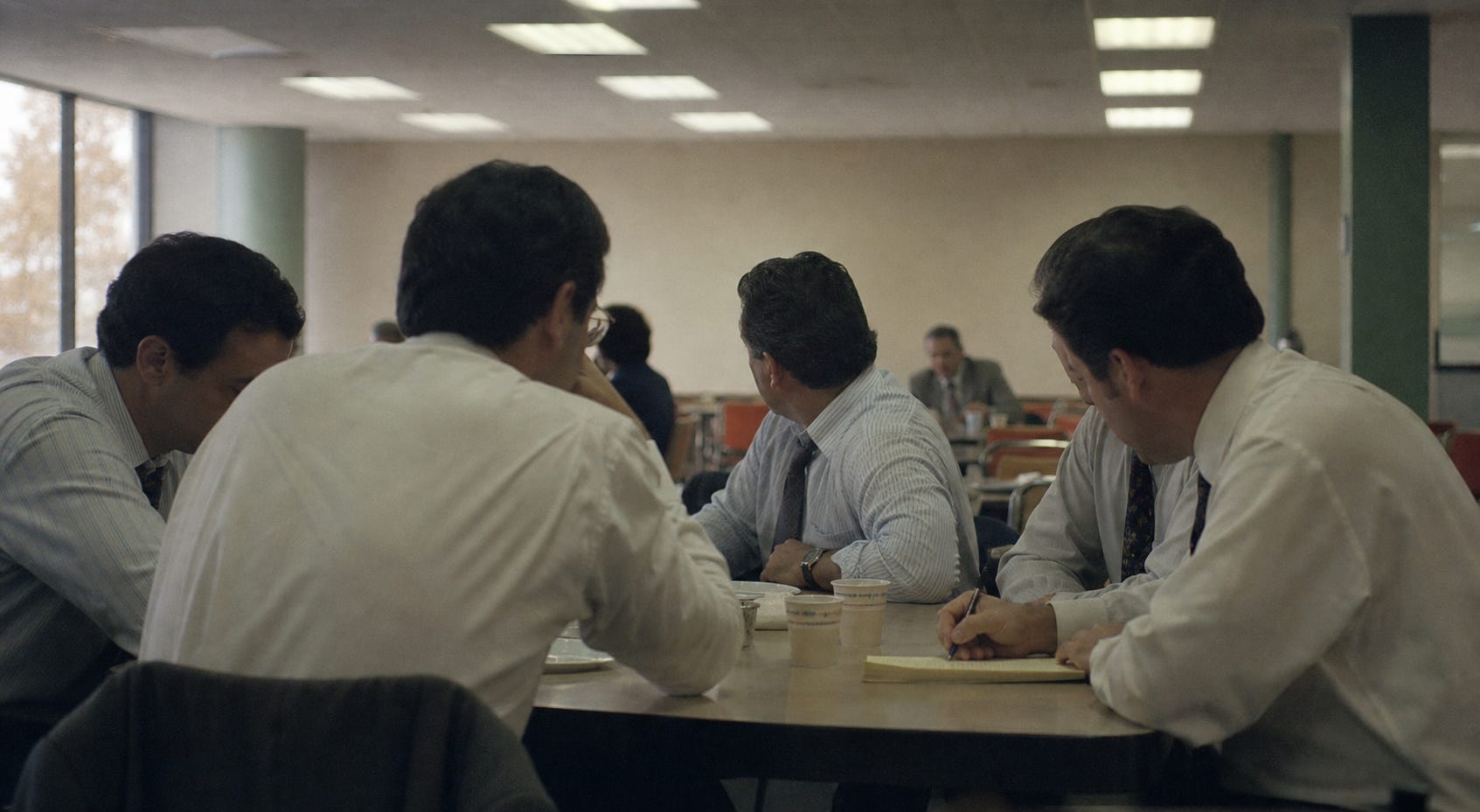
Each transaction would be accompanied by a commission, and the broker cohort could therefore calculate precisely how much money they wanted to make that day. Then they’d refill their coffee, head upstairs to their respective corner offices, make the calls and deliver the accompanying sales pitches to their clients—customers, really—and likely make all the money they wanted to make that day before lunch.
Now, this might sound like a thing of the past, but I’m not that old, and it wasn’t that long ago that this method was common industry practice. And, as a current or prospective advisory client, I assure you that some version of this method is still alive and well in any of the domains where the advisory relationship is contingent or centered on products or even planning techniques, rather than on you, the client—your hopes, dreams, fears, concerns, goals, and values.
Most Important Meeting This Week
Or, think about it this way: Advisors—you may struggle to become one of the most impactful relationships in the life of a client if you don’t first have the ability to “make someone’s day” or facilitate what could easily be the most important meeting they have that week. And we don’t do this through convincing, but through curiosity. It’s through pursuit, not persuasion.
The late MIT organizational guru, Edgar Schein, calls the better path “humble inquiry,” saying it is “…not a checklist to follow or a set of prewritten questions—it is behavior that comes out of respect, genuine curiosity, and the desire to improve the quality of the conversation by stimulating greater openness and the sharing of task relevant information.”
I want to acknowledge for a moment that this might sting for many advisors who have learned the practice of financial planning through checklists and prewritten questions. (But take heart, friend, that’s why they call this a practice.) Therefore, imagine for a moment the difference between a meeting where an advisor has a predetermined outline that includes a rote review of the portfolio, an update on the newest tax regs, and a pitch for long-term care insurance—versus an open-ended discussion that creates the space for the client to share that they’re considering a career change, where the advisor then pivots to a white-boarding session to explore the options the client has considered…that results in two new possibilities that weren’t on the table before they came to the office that day.
The first version of this meeting could be productive, but the second version could be legitimately transformative. Indeed, why shouldn’t every meeting we have with a client be the most important or impactful that they have that day—or that week?
Life Changing
A good friend of mine regularly employs hyperbole with one of his conversational taglines: “It’ll change your life.” He could be talking about chicken tenders, a particular cigar, a vintage album, or a new book. And the funny thing is that it’s often not an exaggeration.
Nor do I believe it’s exaggerative to imagine that the influence we have as financial advisors could be genuinely life-changing. Not when I think about the role that a truly great advisor has in the life of his or her clients. Not when I think about who clients partner with in preparation for the most joyful moments in their lives—college, graduations, weddings, births, career changes, home sales and purchases, geographic moves, unforgettable experiences, and just about every major life transition.
And let’s not forget that life change isn’t always of the headlining variety. It may be directly through financial planning, but it may also be, like the friend I mentioned, through a simple suggestion or the gift of a book with a timely inscription that you move the needle for your clients in a measurable way.
One Of The Most Impactful Relationships In Life
But if you’re still wondering if it’s a reach to imagine a financial advisor being one of the most impactful relationships in someone’s life, think about this:
Who is likely to be among the first 10 phone calls after any number of life’s most disappointing moments—a fire, car accident, disabling injury, or the call that every advisor will inevitably receive when someone passes away.

Indeed, audacious though it may seem on its face, I don’t think it’s a stretch to imagine that a great financial advisor could be one of the most impactful relationships an individual has, outside of immediate family and close friends. But that role also comes with more weight and responsibility than we might imagine.
Indeed, the very advisor who inspired this post—Aaron Greaves, the Founder and CEO of Money Compass Wealth—offered an important caveat to his founding aspiration. He acknowledged that it may have been, in part, born of a touch of youthful naivety and even selfishness, because it initially put him in a starring role.
What he’s since learned is that we can only become one of the most impactful relationships in someone’s life if we’re willing to assume the role of the servant, not the superhero. “All of a sudden, you’ve got a huge amount of obligation and responsibility that comes with that.”
This is the responsibility of a true fiduciary—a true helping professional—a true advisor. And I’m using the qualifier “true” here as operative, because it’s no small effort to check all the boxes to become a fiduciary contractually with the word advisor emblazoned on your business card. But that’s an exterior effort.
The true advisor who aspires to be one of the most impactful relationships in the lives of his or her clients likely must also pursue a great deal of interior work.
And that, by the way, is why I’m writing this post—not because I’ve figured it all out, and certainly not because my own interior work is complete—but because in that work I’ve found this profession to be a path of transformation, for both client and advisor.
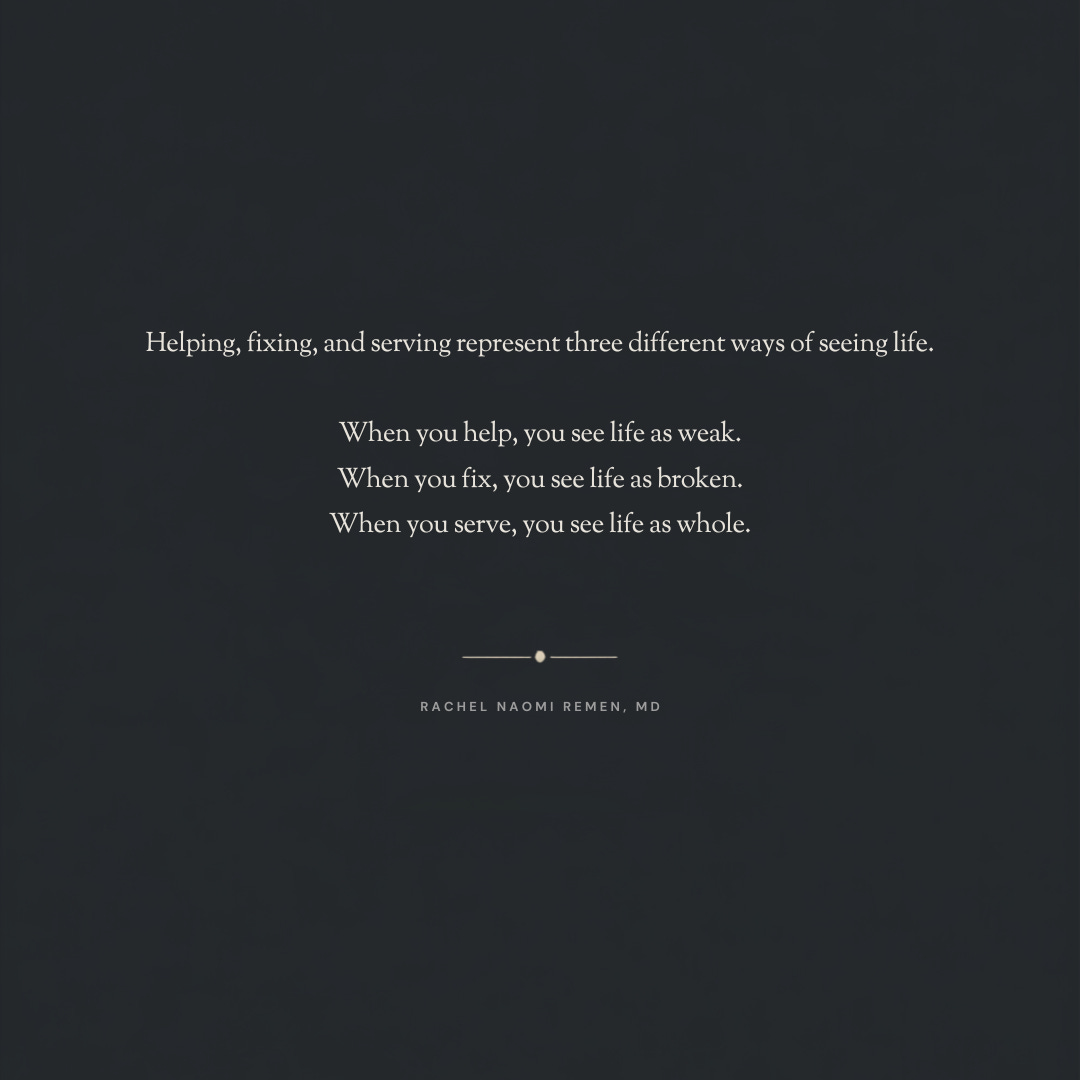
Quote O' The Week
Rachel Naomi Remen, MD is a Cornell-trained physician, Clinical Professor of Family and Community Medicine at UCSF, and founder of the Institute for the Study of Health and Illness at Commonweal. Her curriculum "The Healer's Art" is now taught in 90 American medical schools and in seven other countries. She's also had Crohn's disease since she was fifteen—more than sixty years—which means she has spent her entire career on both sides of the exam table.
Weekly Market Update
Up. BIG.:
+ 3.58% .SPX (500 U.S. large companies)
+ 2.28% IWD (U.S. large value companies)
+ 3.56% IWM (U.S. small companies)
+ 1.93% IWN (U.S. small value companies)
+ 1.71% EFV (International value companies)
+ 3.46% SCZ (International small companies)
+ 0.12% VGIT (U.S. intermediate-term Treasury bonds
A Weak Jobs Report, But Not Necessarily a Weak Economy
Contributed by Tony Welch, CFA®, CFP®, CMT, Chief Investment Officer, SignatureFD
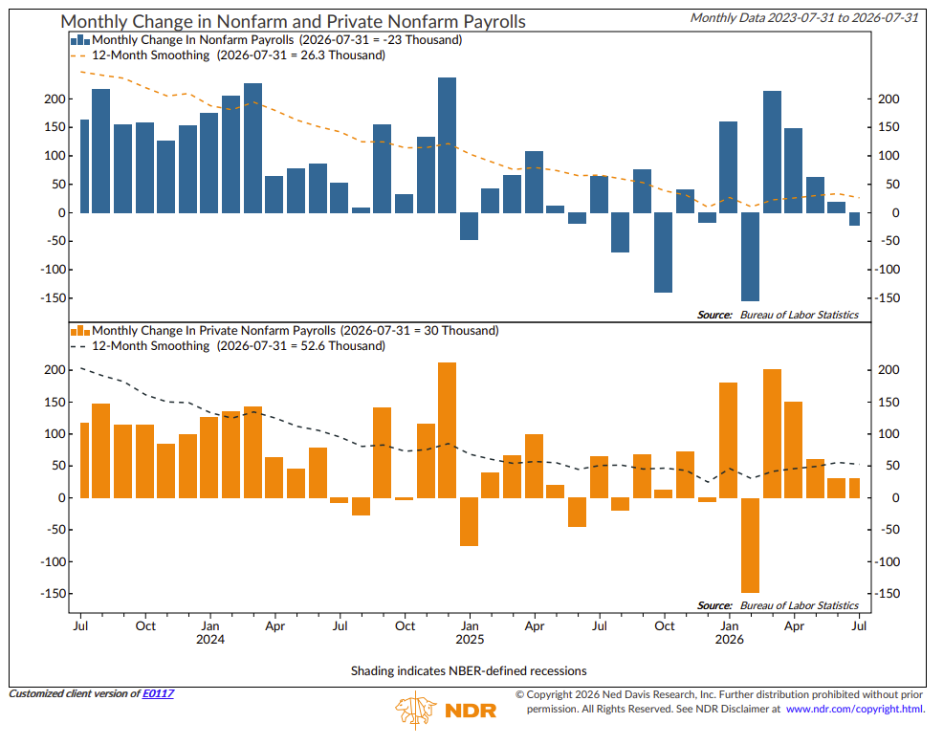
The July employment report delivered a disappointing headline, with nonfarm payrolls declining by 23,000 and prior months revised lower by a combined 103,000 jobs. On the surface, that is clearly a softer labor-market signal.
But the details were considerably less alarming.
Healthcare continued to add jobs, while both manufacturing and construction employment increased. Much of the weakness was concentrated in retail and leisure and hospitality, which lost 19,000 and 40,000 jobs, respectively. Strategas notes that some of this weakness may reflect the fading impact of one-time events such as the World Cup and America 250. Excluding those two categories, overall payroll growth would have been modestly positive.
Other measures also suggest the labor market is cooling rather than collapsing. The unemployment rate actually declined to 4.1%, although falling labor-force participation contributed to that improvement. Wage growth was similarly restrained, with average hourly earnings rising just 0.1% for the month and 3.2% over the past year.
That wage number looks particularly benign when viewed alongside improving productivity. Productivity has now grown at least 2% year-over-year for three consecutive years, while unit labor costs increased just 1.4% over the past year, the slowest pace outside the pandemic since 2017.
The labor market is unquestionably less dynamic than it was a few years ago, but slower job creation needs to be considered alongside slower growth in the available labor supply. For now, we believe the evidence looks more consistent with a “low hire, low fire” environment than an economy sliding toward recession.
Chart O’ The Week
The Message from Our Indicators
The economic and market backdrop remains constructive, even as several indicators suggest investors should be prepared for a bumpier stretch.
Economic momentum has actually strengthened recently. The ISM Manufacturing PMI jumped to 55.6 in July, its highest level since May 2022 and a level historically consistent with continued economic expansion. Production, employment, and new orders all improved. Services remain in expansion as well, with the ISM Services PMI at 54.1 and the S&P Global composite PMI reaching its highest level since last October.
Corporate fundamentals tell a similar story. With most S&P 500 companies having reported, second-quarter earnings growth has reached nearly 50%, more than double the 24.4% expected at the start of the quarter. Revenue growth has also exceeded expectations, and nearly every sector has surpassed its initial earnings-growth estimate.
Our market indicators also continue to favor equities. NDR’s U.S. Asset Allocation Model remains at its maximum 70% equity allocation, while both its price-based and macro/fundamental composites favor stocks over bonds and cash. Longer-term breadth has also remained resilient despite significant rotations beneath the surface of the market.
There are, however, reasons to expect more volatility. August through October has historically been the weakest three-month period of the year. At the same time, inflation pressures remain elevated in portions of the economy, particularly within services, where the ISM prices index has climbed near its highest level since late 2022.
We believe the weight of the evidence continues to favor the bull market. Economic activity is expanding, corporate earnings are considerably better than expected, and our primary market indicators remain constructive. But strong fundamentals don’t eliminate volatility. With seasonal headwinds building and inflation still complicating the Fed’s job, we believe investors should expect a less linear path higher.
Wishing you strong fundamentals and low volatility this weekend!
Tim