


“You can’t always believe what you think you’ve heard.” It’s one of the more transformative lessons I’ve learned (from Dr. Ted Klontz) that has reshaped the way I interact with clients, colleagues, and hopefully everyone else.
I was reminded of the power of this truth recently after being introduced to a hilarious—but all-too-close-to-home—clip from the TV show, Silicon Valley. For maximum enjoyment, I suggest you pause for two minutes and watch it to avoid the spoiler to follow (and note there is a bit of choice language involved if little ears are nearby)…
But in the case that viewing isn’t an option, I’ll summarize in this week’s post below and suggest how “the humble inquiry” provides us with a framework for understanding people better, at work and at home.
Also this week: Tony’s market update, Don’t Fear New Highs, offers a timely and reassuring read on what new market records actually mean.
Thanks for joining us, and of course, Happy Mother’s Day, Mom, and all the moms out there!
Tim Maurer, CFP®, RLP®
Partner
In this Net Worthwhile® Weekly you'll find:
Financial LIFE Planning:
The Bear Is Sticky With Honey
Quote O' The Week:
Fran Lebowitz
Weekly Market Update:
Don’t Fear New Highs
Financial LIFE Planning
The Bear Is Sticky With Honey
And The Humble Art Of The Clarifying Question
If you haven’t seen the clip, the scene opens with an apparently important individual—Gavin—struggling to sweeten his hot tea. As he’s walking briskly to a waiting car, he’s discussing a current project, and then just before he closes the door and speeds away, he says, “Oh, and the bear is sticky with honey.”
Cut to a room full of earnest corporate minions in a conference room with a whiteboard, trying to dissect and discern the deeper meaning of the cryptic observation of their sage. It gets increasingly ridiculous and funny, of course, before another run-in with Gavin reveals that the plastic bear container of honey he uses for his tea has become sticky—and is in need of replacement.
(Ahhhh…)

We laugh, but we do this all the time in big ways and small. One financial advisor told me a story about an interaction with one of his favorite clients. The client asked the advisor if he could produce the precise number of fees paid in the prior year. The advisor sprang into action and launched into a lengthy defense of the value he’d provided for the client over the course of many years—only to be interrupted by the client halfway. “No, no…I’m thrilled with your work. It’s just that my CPA asked how much I paid in advisory fees last year to determine if it might be deemed a deductible expense on my taxes.”
(Ahhhh…)
Thankfully, there’s a (free) insurance policy that can spare us the embarrassment and save us vast amounts of time if we’re willing to use it. It’s called—drumroll, please: the clarifying question.
But first, why do we have a tendency to jump to conclusions?
Why Do We Jump To Conclusions?
We’re simply wired that way—and it’s for a good reason! Our brain’s default mode is fast, associative, and pattern-matching. This is the processor in our brains that Daniel Kahneman referred to as System 1, and its tendency is to grab the nearest plausible explanation in response to external stimuli and run with it before our slower, more thoughtful and deliberate processor, System 2, can intervene.
I wince when I’m also reminded of the Fundamental Attribution Error, an observation that Lee Ross made all the way back in the 1970’s, noting that we systematically over-attribute other people’s behavior to their character or intent rather than to their circumstances—while simultaneously presuming that any harm that befalls us, individually, is surely due to our circumstances, not our character. That’s why it’s always the other driver’s fault when we get frustrated on the road.
Daniel Freeman further found that our tendency to jump to conclusions based on limited information accelerates when facing a social threat. And that’s the whole point: Our System 1 is activated because it is a protective mechanism. It may not always be right, but it is operating for our benefit. Millennia ago, it might have saved us from a predator, but it makes sense that it also triggers when we perceive that our livelihood may be at risk, like disappointing your boss or client.
So, how do we retain the protective benefits of our System 1 while better tapping into the more deliberative System 2?
Ways To Ask Better Clarifying Questions
Research from Zenger and Folkman in 2016 found that the best listeners ask questions that promote discovery and insight for the speaker, rather than us, the listener. Remember Dr. Klontz’s maxim—you can’t always believe what you think you’ve heard—and consider that whatever you’re hearing from the speaker is likely not a perfect articulation, and we can play a role in helping them find clarity.
Klontz invited me to put it to the test by practicing simple reflection. With this method, you simply parrot back to the speaker what you heard, verbatim to the best of your ability. “So, if I heard you correctly, the last time you reviewed your estate planning documents was in 2006?”
Sometimes it can seem almost silly, but I have been surprised, indeed, to note how often the speaker adjusts his or her statement, especially if you combine the question with a touch of simple silence. “Wait, no—that’s not right. It was actually 2004, right after Sarah was born. Jack was born in 2006, but life was so hectic then, I don’t think we ever updated them again.”
And if you’ve done a good enough job listening in the past, you may also employ strategic reflection. This is when you take what you’ve heard and report back to the speaker by imputing additional meaning or intent to confirm you’re correct. “Ahh, 2006 makes sense. That was when Jack was born, right?”
Maybe you were right, but sometimes this step also illuminates additional meaning that you didn’t necessarily foresee. “Yes, it was when Jack was born. But come to think of it, I don’t think we updated our documents then, after all. I remember being so intimidated by the legalese the first time around that I confess I was looking for an excuse not to go back to the attorney and feel like an idiot.”
Of course, they’re not an idiot, and neither are you for jumping to conclusions, but we could all use a touch of humility to make us better listeners.
Humble Inquiry
The late MIT Sloan School of Management professor, Edgar Schein, literally wrote the book on Humble Inquiry, noting that American professional culture, in particular, is deeply biased toward telling over asking. He describes the practice as “the fine art of drawing someone out, of asking questions to which you do not already know the answer.”
He encourages us to exhibit genuine curiosity longer than we may feel comfortable, and he insists that this is not some token “soft skill” that will slow down our processes. “Relationships are the key to good communication,” Schein says, and “good communication is the key to successful task accomplishment.”
Yes, we should save time in the long run by applying more effort in the short run to better understand what we’re actually hearing.
So, how would Schein have recommended we respond to the client inquiry about fees? He makes the distinction between three types of inquiry:
Confrontational Inquiry is asking to challenge or test: “So, you think someone’s going to do a better job for you for less??”
Diagnostic Inquiry is asking questions that lead toward a conclusion you’ve already reached: “Oh, are you unhappy with my performance?”
Humble Inquiry, however, is asking a question you genuinely don’t know the answer to, from a place of curiosity rather than agenda, which Schein describes as asking “from ignorance.”
Perhaps a humbler approach to the fee question could be: “Of course, I’d be happy to get that for you. And can you give me the context, to be sure I give you all the details that may be helpful?”
And please note that Schein’s claim is that humble inquiry isn’t just a technique that should lead to better outcomes—though it may well be—but it can be far more. It’s a signal of relational trust. When you ask before you tell, and you’re genuinely curious, you’re communicating “I care, and I’m not afraid of what you might actually mean.” And that genuine curiosity can breed confidence that makes clients feel safer, more than any rehearsed value proposition.
And just for fun, how do we think Schein would’ve counseled Gavin’s eager support team following his statement, “The bear is sticky with honey”?
The confrontational version (“Gavin, are you saying we’re doing too much?”) would’ve likely landed them in even more trouble. The diagnostic version (“Is this about the presentation having too much…pizzazz?”) would’ve been presumptive. The humble version, although almost insultingly simple, would’ve likely eliminated all confusion:
“Hey Gavin—what bear?”
Of course, then we all would’ve missed out on a good laugh.
Quote O' The Week
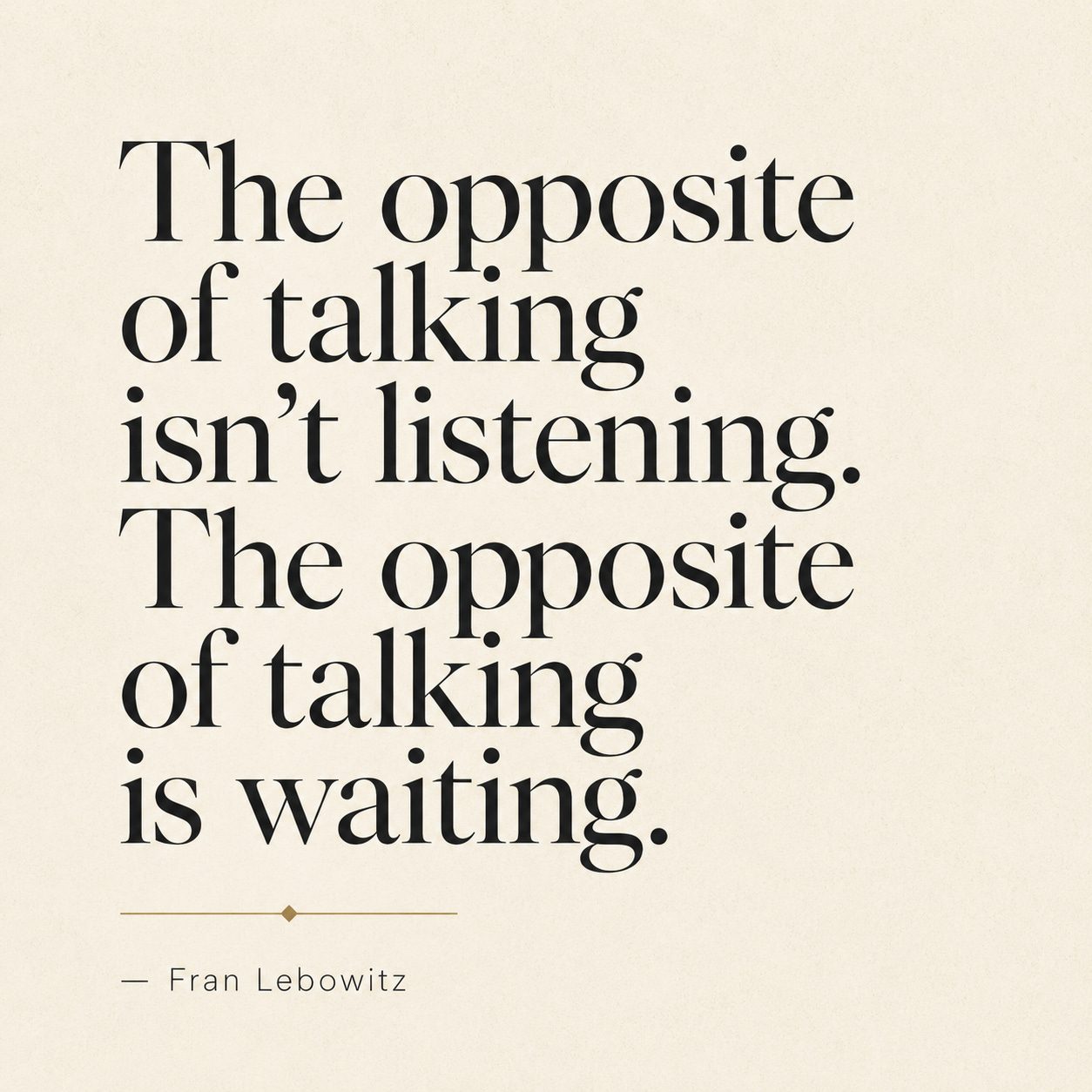
Fran Lebowitz is a New York City-based author, cultural critic, and professional contrarian best known for two slim essay collections — Metropolitan Life (1978) and Social Studies (1981) — that cemented her reputation as one of the sharpest wits in American letters. A self-described slow writer (she has been "nearly finishing" a third book for decades), she has spent the intervening years doing what she does best: talking. Martin Scorsese documented her acerbic observations on New York, culture, and the general decline of everything in the Netflix series Pretend It's a City (2021). She is, in her own estimation, always right.
Weekly Market Update
Wow, it was a good week for stocks. Let’s check in with Tony below to see what new highs really means:
+ 2.33% .SPX (500 U.S. large companies)
+ 1.32% IWD (U.S. large value companies)
+ 1.75% IWM (U.S. small companies)
+ 1.63% IWN (U.S. small value companies)
+ 0.87% EFV (International value companies)
+ 2.94% SCZ (International small companies)
+ 0.14% VGIT (U.S. intermediate-term Treasury bonds
Don’t Fear New Highs
Contributed by Tony Welch, CFA®, CFP®, CMT, Chief Investment Officer, SignatureFD
One of the most common questions we hear when markets reach record highs is: “Should we really be investing new money here?” It’s a fair emotional reaction. New highs can feel like a warning sign, especially when headlines continue to focus on tariffs, deficits, geopolitical tensions, or concerns about the economy.
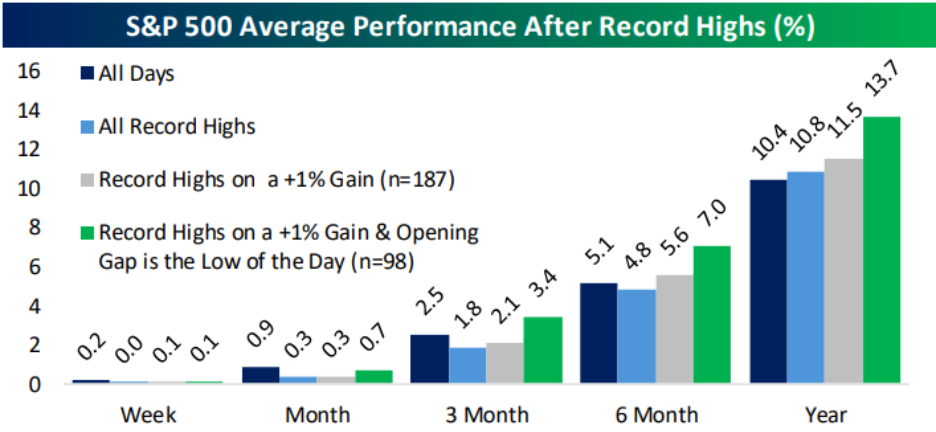
Historically, though, new highs have tended to be a sign of market strength rather than exhaustion. The chart below from Bespoke Investment Group shows that after the S&P 500 reaches a record high, forward returns have generally been better than average over the next 12 months. In other words, markets making new highs is a normal feature of long-term bull markets.
What makes this week particularly interesting is how the market reached those highs. On Wednesday, the S&P 500 opened strong and never looked back, finishing up more than 1% with the opening price marking the low point of the day. Historically, those types of “buyers in control all day” sessions have been followed by even stronger-than-average returns. The green bars in the chart highlight this setup, showing better forward returns over the next year than the market’s typical experience.
None of this means markets move straight up from here. We expect there will still be pullbacks, volatility, and plenty of reasons for investors to feel uneasy in the short run. But history suggests that new highs, especially those achieved on strong and broad buying pressure, have more often reflected momentum and improved confidence rather than signaling an imminent peak.
Chart O’ The Week
The Message from Our Indicators
The macro backdrop remains more resilient than many expected just a few months ago. This week’s labor market data reinforced that message. April payroll growth came in solid, unemployment held steady at 4.3%, and weekly jobless claims remain contained. While there are pockets of softness, particularly among lower-income consumers facing higher energy and food costs, the broader labor market still appears stable enough to keep recession fears in check for now. At the same time, the combination of AI-related capital spending, fiscal support, and steady employment growth continues to cushion the economy from the inflationary shock tied to the conflict in the Middle East. We believe the result is likely a Federal Reserve that remains patient, balancing still-firm inflation pressures against an economy that continues to expand rather than contract.
Corporate fundamentals also remain stronger than the headlines suggest. One of the more important observations we saw this week came from Strategas, which noted that despite the market’s rally this year, the S&P 500’s forward price-to-earnings multiple has actually contracted by roughly 5% year-to-date while earnings estimates have risen by about 13%. In other words, the market advance has been driven more by improving earnings than speculative multiple expansion. That distinction matters. It helps explain why the current environment differs from prior late-stage bubbles where valuations detached from fundamentals. Earnings growth tied to AI infrastructure spending, improving corporate profitability, and resilient economic activity continues to provide support underneath the market even as inflation and geopolitical concerns linger in the background.
From a trend and sentiment perspective, however, leadership remains narrower than we’d like to see. Semiconductor and AI-related stocks continue to experience an extraordinary melt-up, with some industry groups now trading at historically stretched levels relative to their long-term trends. Strategas highlighted that the semiconductor index is more than 50% above its 200-day moving average, a level only previously seen during the late-1990s technology boom.
At the same time, broader participation beneath the surface remains more muted, with only about half of S&P 500 stocks currently in confirmed uptrends. We do not view this as an outright bearish signal today, particularly with credit spreads remaining calm and cyclical leadership still constructive. But for the bull market to sustain itself over time, we believe leadership likely needs to broaden beyond the AI infrastructure trade into a wider set of sectors, industries, and company sizes. Encouragingly, we are beginning to see some signs of that beneath the surface, including relative strength from small caps, cyclicals, and international equities.
I hope you have an amazing Mother’s Day—especially if you are one!
Tim
Perhaps a humbler approach to the fee question could be: “Of course, I’d be happy to get that for you. And can you give me the context, to be sure I give you all the details that may be helpful?”
I love this approach, Tim. Thank you for sharing. Wonderful read.