


Welcome back from our short 4th of July break! We hope it was a great one for you.
We’re boldly diving into the deep end this week, as we feature a counterintuitive insight for the third and final time from Jim Collins’ most recent book, What To Make Of A Life.
And in this case, we’re really featuring Collins’ wife’s insight, not his own, because it was Joanne Ernst who encouraged Jim to stop worrying about the notion of legacy. In this week’s post, we’ll walk through their logic and some of the evidence to support it—while leaving you with a highly practical suggestion that could change the way you think about work and money, life and death.
And Tony’s feeling positive this week, substantiating the question, “Is the good news getting even better?” in this week’s Weekly Market Update.
Thanks for joining us!
Tim
Tim Maurer, CFP®, RLP®
Partner
In this Net Worthwhile® Weekly you'll find:
Financial LIFE Planning:
The Dangerous Lure Of Legacy
Quote O' The Week:
Marcus Aurelius
Weekly Market Update:
Good News Getting Even Better?
Financial LIFE Planning
The Dangerous Lure Of Legacy
You Can Plan An Estate, But Not A Legacy
Legacy is a word that has gotten a lot of play in the wealth management space, and for good reason. Especially when we differentiate the word “legacy” from the word “estate,” we begin to tap into what I believe is the real essence of the best financial planning.
This is because an estate is something that has a clear legal definition—it’s what we call all your stuff left behind when you leave this earth. It’s whatever assets were in your name once there is no breath remaining in your lungs. An estate is, by definition, lifeless.
A legacy, however, is something quite different. I think of it as the impression that we leave on this earth once we’re gone. It’s the fragrance that remains despite our absence, and unlike the shirt left behind by your lover, the scent of the strongest legacies may endure indefinitely, and even grow over time.

Just think for a moment of Mozart, who, though certainly recognized for his brilliance during life, died in debt and was buried in a common grave. Edgar Allan Poe died shamefully destitute. And Vincent van Gogh famously died with scarcely a modicum of fame during his tumultuous, shortened life.
Yes, one’s assets may certainly be part of our legacies—how we deployed those assets during life and, surely, how they are handled after our passing. Therefore, we might consider the creation of a lasting legacy one of the worthiest of all goals, but how would we do that? And is it even possible?
The Litmus Test
Jim Collins—the legendary author of Good To Great and Built To Last (and from whom I borrowed the title of this post)—used to think so, but his wife convinced him otherwise. And she was the clear OG high achiever in their household.
In fact, before he ever became the good-to-great guy, Jim Collins quit his job at Hewlett-Packard to support the personal ambitions of his wife, Joanne Ernst. She was, without an ounce of hyperbole, one of the world’s greatest endurance athletes and the winner of the 1985 Hawaii Ironman Triathlon World Championship. She completed the 2.4-mile swim, 112-mile bike, followed by a 26.2-mile run, in 10:25:22, and was named Triathlete of the Year by Triathlon magazine in the same year. Truly a “power couple” if we’ve ever seen one.
Many years later, however, as Collins found himself regularly asked some version of the questions, “What do you want your legacy to be?” and “What do you want to be remembered for?”, he was struggling with an answer. So he went to Joanne and asked her.
Her response, as chronicled in Collins’ newest book, What To Make Of A Life, was, “It’s a waste of time to think about your legacy or how you want to be remembered. It’s self-centric and distracts from doing what’s right in front of you. Besides, you won’t be here to enjoy it anyway.”
This starkly different perspective struck Collins as the right, if counterintuitive, answer, and so he began using it as one of the litmus tests for those he researched in the book, written to illuminate the traits and decisions of those who appear to have lived the most meaningful and fulfilling lives.
If Collins and Ernst are right—and I think they are—that means that a legacy worth leaving is not so much a life goal as a byproduct of a life well lived. Here’s their final conclusion:
“What is so striking in the vast mountain of materials we collected in this study is how little the people spoke or wrote about ‘legacy’ or how they wanted to be remembered after they were gone. Yes, many of them made a lasting impact on the world they touched, but they did so by honoring the responsibilities they chose, by doing the work that lay right in front of them.”
Byproducts Masquerading As Goals
Legacy is in good company because there are several other of the most attractive traits and features of the good life that are byproducts masquerading as goals. In many cases, in fact, the direct pursuit of these aspirations is ironically counterproductive.
Love: Neediness tends to repel more than endear.
Respect: The more we demand it, the less deserving we appear.
Sleep: Sleep scientists treat “sleep effort” as a cause of insomnia.
Being Interesting: Dale Carnegie dropped this mic: “To be interesting, be interested.”
Humility: It evaporates the moment you notice you have it. Echoing C. S. Lewis, author Tim Keller wrote that the essence of humility “…is not thinking more of myself or thinking less of myself, it is thinking of myself less.”
Ensue, Don’t Pursue
And the granddaddies of them all—happiness and success—are perhaps the most elusive. Consider Viktor Frankl’s powerful instruction that could, I submit, provide us with a to-do to accompany our not-to-dos:
”Don’t aim at success—the more you aim at it and make it a target, the more you are going to miss it. For success, like happiness, cannot be pursued; it must ensue…as the unintended side-effect of one’s personal dedication to a cause greater than oneself.”
Combining both Collins’ and Frankl’s observations gives us, I believe, a short but powerful playbook on how to be successful and happy—and to leave a meaningful legacy:
Don’t pursue happiness (with all deference to Thomas Jefferson), success, or the creation of a legacy. Instead, discern your encodings—the durable, intrinsic capacities built into your person, awaiting discovery through the experiences of life—and deploy those encodings in pursuit of causes that are greater than yourself.
An estate can be planned and built, but a legacy cannot. It can’t be pursued—it must ensue. And what greater goal could we have, as financial advisors, than to guide our clients on this journey?
Quote O' The Week
Marcus Aurelius (121–180 AD) was Roman emperor for nearly two decades and the last of the "Five Good Emperors" — the most powerful man in the world, who spent his evenings writing philosophical notes to himself by lamplight on military campaign. Those private reflections, never intended for another soul's eyes, survived as Meditations, one of the most enduring works of practical wisdom ever written. The man who warned against chasing posthumous fame achieved perhaps history's greatest example of it: not by pursuing a legacy, but by doing the work — on himself — that lay right in front of him.

Weekly Market Update
The S&P 500 was up this week, but that was about it. Regardless, Tony’s humming a happy tune into this weekend. See why below:
+ 1.23% .SPX (500 U.S. large companies)
+ 0.01% IWD (U.S. large value companies)
- 0.53% IWM (U.S. small companies)
- 0.61% IWN (U.S. small value companies)
+ 0.66% EFV (International value companies)
- 0.11% SCZ (International small companies)
- 0.41% VGIT (U.S. intermediate-term Treasury bonds
Good News Getting Better?
Contributed by Tony Welch, CFA®, CFP®, CMT, Chief Investment Officer, SignatureFD
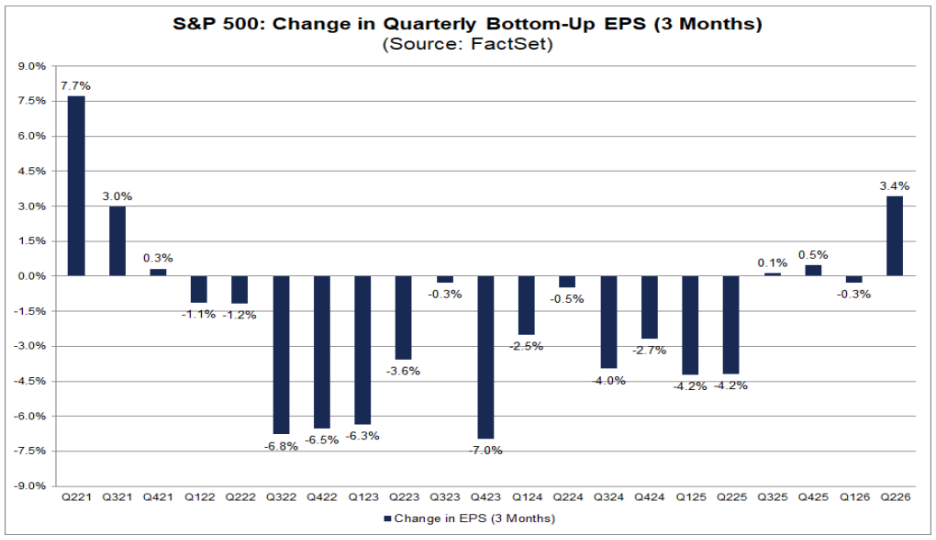
One of Wall Street’s unwritten rules is that analysts almost always lower earnings estimates as a quarter progresses. Companies provide cautious guidance, unexpected challenges arise, and expectations naturally drift lower. In fact, over the past 20 years, quarterly earnings estimates have declined by an average of more than 4% during the course of a quarter. This quarter has been anything but typical.
Instead of cutting estimates, analysts raised their earnings expectations for S&P 500 companies by 3.4%, marking the largest upward revision during a quarter since 2021. Even more impressive, earnings estimates increased across multiple sectors rather than being confined to just a handful of companies.
Markets ultimately follow earnings. While stock prices can certainly get ahead of themselves over short periods, long-term returns are driven by the ability of businesses to grow profits. Thus far, earnings and earnings expectations have delivered.
That doesn’t eliminate risk. Valuations remain above historical averages, and investor expectations have risen alongside the market. But stronger fundamentals give this rally a sturdy foundation.
Chart O’ The Week
The Message from Our Indicators
Our indicators remain constructive, though with a healthy appreciation for the risks that naturally accompany a strong market advance.
As noted above, fundamentals continue to provide the strongest support. Corporate earnings expectations have improved meaningfully in recent months, global economic activity remains resilient, and recession risks continue to appear lower than many feared earlier this year. The story is gradually shifting from enthusiasm surrounding artificial intelligence investment to the more important question of whether those investments begin translating into broader productivity and earnings growth across the economy. Thus far, the evidence is encouraging.
Technical trends also remain favorable. Markets continue to make higher highs and higher lows, with leadership gradually broadening beyond the largest technology companies. Healthy trends don’t guarantee higher prices tomorrow, but history suggests they deserve the benefit of the doubt until proven otherwise.
Sentiment, however, has become more optimistic. That’s understandable after a strong rally, but optimism also means expectations are higher. Investors will likely become less forgiving of disappointments during the upcoming earnings season, making company guidance just as important as the headline results.
Taken together, our indicators continue to support the bull market in stocks. While we expect periods of volatility along the way, we continue to believe that the combination of improving fundamentals and favorable market trends provides a constructive backdrop for long-term investors.
And on that good note, have a great rest of your weekend!
Tim
Thank you, Tim, for writing about legacy. It made me reflect on the importance of trusting the process, doing what truly aligns with your values, and living a life that is truly yours. It also reminded me to act prudently and honestly, and to focus on controlling what is within my control. Fame and recognition are not things we can fully control. So many of the people celebrated as heroes in our modern era eventually turn out to be untrustworthy or deeply disappointing in their private lives and actions.
A very timely topic and one we are taking seriously in our financial planning journey. Thank you for this!