


When I was in my late twenties, I had lunch with a close friend from high school who, upon obtaining an undergraduate degree in accounting, landed a job at an unnamed Big 6 (now Big 4) accounting and consulting firm. He loved the work, but he had learned of a disturbing fact about the firm that required him to face a difficult decision.
His goal upon taking the job was not easy, but it was simple: make partner. This would require years of grueling hours, loads of travel, abject submission to senior team members, and likely the willingness to move, perhaps more than once. But he truly loved the work, so none of those were deal breakers. And the rewards of achieving his goal of partnership were substantial, and not just financial.
The disturbing fact he’d learned, however, was that partners at the prestigious firm had a divorce rate he’d been told exceeded 70%—and my friend had just gotten married to his dream girl. And they were already talking about kids.
He purposed himself, there and then, to finding a different path to partner that would look a lot less like the workaholism that seemed to be the hallmark of his peers, and more like the life-giving balance required to be successful in multiple domains.
In this week’s Financial LIFE Planning section, I’ll take a look at what the founding father of individual psychology, Alfred Alder, had to say about workaholism (and it packs a punch). And, of course, I’ll let you know how my friend managed his career path nearly 25 years later.
And Tony tells us why the disinflation trend is something to watch in this Weekly Market Report.
Thanks for joining for this week’s Net Worthwhile weekly!
Tim
Tim Maurer, CFP®, RLP®
Chief Advisory Officer
In this Net Worthwhile® Weekly you'll find:
Financial LIFE Planning:
The Life-Lie Of Workaholism
Quote O' The Week:
Annie Dillard
Weekly Market Update:
Disinflation Trend Is Something To Watch
Financial LIFE Planning
The Life-Lie Of Workaholism
“He loves his work.” “She’s so passionate about what she does.” “He was born for this, and this alone.” “She’s so competitive.” “He’s so ambitious.” “She’ll do whatever it takes to get the job done.”
These and many more pseudo-complimentary statements about those whose personal identities become synonymous with their professions obscure a truth that feels particularly absent in a world of hustle culture and LinkedIn “optimization.”
(It must also be mentioned here that the deification of workaholism tends to differ based on one’s gender. Men seem much more likely to be given a pass—or even deified—as capable “providers” where women’s ambition in the workplace is often perceived, well, differently.)
And it goes a step further, when we give safe passage (or even encouragement) to workaholics whose roles outside of the workplace have atrophied. We’ve allowed ourselves to be bifurcated—one person in the office and on the road and another person at home, in the community, or in a place of worship.

The Three Life Tasks
The book The Courage To Be Disliked has reinvigorated interest in the work of the father of individual psychology (and notable dissenter from the Freudian camp), Alfred Adler. In Courage, we’re introduced to the three primary life tasks: work, friendship, and love. We’re implored to consider that none is listed as greater than the others, that, to the contrary, one task dominating the others isn’t considered to be discipline, but imbalance.
But running contrary to these three primary life tasks are life lies.
The Workaholism Life-Lie
“Adler called the state of coming up with all manner of pretexts in order to avoid the life tasks the ‘life-lie,’” we’re told, where “one shifts one’s responsibility for the situation one is currently in to someone else.”
Wait—what?
Yes, the suggestion is that we will manufacture diversionary pretext to avoid the things we most need to confront, thereby shifting the responsibility from ourselves to someone else. Let’s look at a few examples from the book, landing on the workaholism gut punch.
The Novelist dreams of writing a bestseller but “can never find the time.” She’s been stuck in book proposal mode for, uh, years, but she’s actually not making the time because she really doesn’t want to expose her work to criticism.
The Blushing Suitor has feelings for a woman he’s deemed incapable of expressing because he can’t approach her without blushing; but the blushing is actually an alibi that helps him avoid the risk of rejection.
But are you ready for the life-lie of the workaholic? I’ll warn you in advance that it might strike a little close to home for you, as it did for me:
“Workaholics are simply trying to avoid their personal and social responsibilities by using work as an excuse.”
Sit with that for a minute.
The Risk For Financial Advisors
While I’ll not posit too far beyond my scope, I can surely address the risks involved in being a financial advisor. In our space, it’s easy for advisors to pardon our failings in personal development, community involvement, and family presence because “we carry the weight of financial anxiety for scores of families.”
This life-lie is especially dangerous because it’s rooted in a half-truth. Ours is a genuine helping profession, and the work we do can have an enormous impact on a family—and even a business that has a further impact on additional families. But does this absolve us from neglecting our own family?
I have been there: Taking on too many clients, hiding in my office, excusing my absence because “something really important came up.” And again, it is true that something important does occasionally come up in any of our professional domains that requires a deviation in plan. But if we’re smart and sophisticated enough to be the financial life guide for many families, couldn’t we just as well apply that hard-earned wisdom to the creation of ways and means to effectively manage our client loads and the rest of our lives?
It’s one of the reasons that I believe personal development is just as important for financial advisors as is their professional and business development—and this can be said of any professional domain:
Our personal development is inescapably intertwined with our professional success. Great personal development habits can be an excellent floor for professional success, and a lacking attentiveness to the social and familial domains will almost certainly be a ceiling.
Conclusion
Back to my buddy. He’s still at the same company. He’s actually one of the handful of unicorns out there who has only worked at the same company. He put his time in with the audit space and was then wise enough to pivot to the advisory domain before burnout. He made partner years ago and now has 15 to 20 partners reporting to him.
And here’s what’s so beautiful about that. He realized years ago that, regardless of the technical nature of accounting or consulting (or financial advising, I’ll add), that true success is all about relationships. He’s never lost sight of the relationships that are most important to him: his wife and three daughters. And he’s just as likely to be known as “the girl dad” or “the diehard Ravens fan” as the Big 4 partner.
And although he probably doesn’t remember any reference to Alfred Adler in Psych 101, and I don’t think he’s ever even read The Courage To Be Disliked, he has capably avoided what the book references as the greatest life-lie of all: “not to live here and now…looking at the past or the future, thinking there’s a mold you must fit into.”
He took the simple step in his twenties that all of us can choose to take at any age, of defining precisely who we want to be, personally and professionally, and then being that person.
Quote O' The Week
Annie Dillard is a Pulitzer Prize-winning author and naturalist who wrote her masterwork, Pilgrim at Tinker Creek, in a library carrel over eight obsessive months — reportedly discarding six pages for every one she kept.
Weekly Market Update
The markets this week, especially the international markets, got walloped, as the U.S. and Israel went to war with Iran:
- 2.02% .SPX (500 U.S. large companies)
- 3.46% IWD (U.S. large value companies)
- 4.02% IWM (U.S. small companies)
- 3.61% IWN (U.S. small value companies)
- 7.00% EFV (International value companies)
- 5.67% SCZ (International small companies)
- 1.20% VGIT (U.S. intermediate-term Treasury bonds
Disinflation Is Something To Watch
Contributed by Tony Welch, CFA®, CFP®, CMT, Chief Investment Officer, SignatureFD
There are many potential implications from the Iranian conflict, but we believe that, for investors, the primary focus should be on the trend in inflation. Oil prices have been rising briskly as about 20% of the world’s fuel supply runs through the Strait of Hormuz. But other major commodities also pass through the Strait, including fertilizer, which could put upward pressure on agricultural commodities. Food and energy are often stripped out from the inflation calculation as they can be volatile, but the reality is that rising commodity costs, if sustained, do tend to find their way into core inflation eventually.
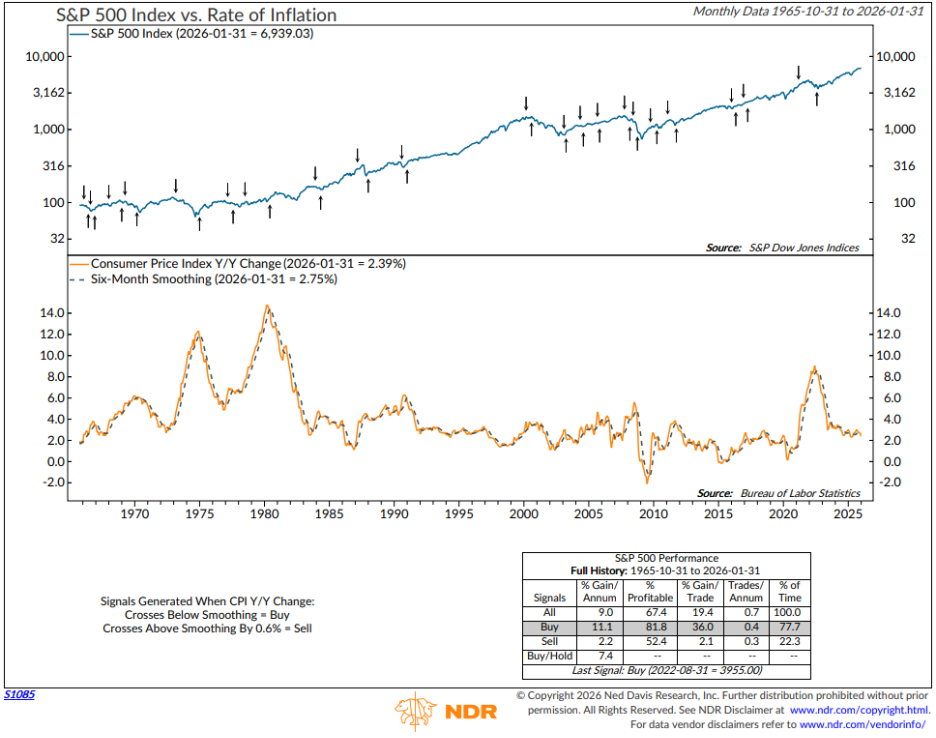
The chart below shows that this bull market, which began in 2022, has been underpinned by an easing rate of inflation. The market low occurred near the peak in the inflation rate. Note that when the rate of inflation has been falling, the S&P 500 has appreciated by 11% per year on average. When it has been accelerating, the market has dipped by -2% per year on average.
We expect the longer-term impact on commodities will likely be dictated by the length of the conflict and the tactics that Iran deploys. Should fuel and food prices run high for an extended period, we believe that would likely eliminate one of the tailwinds that the market has enjoyed since 2022.
Chart O’ The Week
The Message from Our Indicators
The market was mainly focused on Iran last week, and rightfully so. The history of conflicts like this one has seen a -5% median market correction over about two weeks, followed by about two weeks of recovery. The exceptions to the quick recovery trend have been when the economic trajectory has been altered. And there are some signs of economic softening, but most indicators point to an economy that continues to expand. Starting with the bad news, the February jobs report was a big whiff. Jobs were expected to rise by 50,000, but instead contracted by -92,000. The unemployment rate unexpectedly ticked higher to 4.4%. There may have been weather impacts, but the contraction is notable. Additionally, retail sales contracted in January by -0.2%, but that was above expectations for a -0.4% drop.
There was much better news in the purchasing managers’ indexes (PMIs) from ISM. Purchasing managers reported better-than-expected growth in February for both the manufacturing and service sectors. Jobless claims remain low, payroll processor ADP reported better-than-expected job growth for February, and productivity data was solid. The data tells a story of an economy that is likely growing at or below potential, but growing nonetheless.
Maintaining positive economic growth is important because valuations entered the year relatively stretched. If earnings were to contract, that would likely present a major headwind to stock prices. The good news is that fundamentals entered 2026 in good shape. Earnings for the S&P 500 grew 14% in aggregate in 2025. All 11 equity sectors (e.g. Tech, Financials, Industrials, etc.) saw positive earnings growth, helping to explain the strong advance last year. The sustainability of earnings growth will be an important question to answer in these next 10 months of 2026. And while analysts expect earnings to grow 16% in FY2026, inflation pressure could result in a negative impact on profit margins. In fact, analysts expect margins to expand this year, which may prove difficult. For now, corporate fundamentals are strong, but we’re watching downside risks.
From a trend perspective, the long-term bull market remains intact. -5% corrections are normal noise in the grand scheme of things, occurring an average of over three times per year. Even -10% corrections have occurred once per year. In mid-term election years, the median correction has been -19%. But these are difficult to time, and when those midterm election year corrections have resolved, it has tended to launch the strongest 12-month advance in the four-year Presidential cycle. We believe the trend evidence remains bullish for now, despite last week’s volatility.
Have a great weekend!
Tim