


I love finding true stories that are so crazy that we’d laugh if they were fiction. And I’m so thankful for a host of authors who bring these stories to life for us.
Laura Hillenbrand’s Unbroken, the tale of Louis Zamperini is probably at the top of this list for me. Still, the way David McCullough brings U.S. history to present-day life was my first taste of narrative non-fiction, followed by everything that Erik Larson has ever written. David Grann is now in the same category for me.
Killers of the Flower Moon left me jaw-dropped, and this week’s post kicks off with the central story in his book, The Wager, a seaborne tale that would read like a fish story if it wasn’t true.
Ultimately, we’re exploring whether or not wealth management is “wicked” or “kind.” It’ll make more sense, especially when you see how Daniel Kahneman used the very business of financial advice as his prime example on the topic.
Meanwhile, our investment insider, Tony Welch, discusses the Challenges of Extraordinary Expectations in this Weekly Market Update.
Thanks for spending a few moments of your weekend with us!
Tim
Tim Maurer, CFP®, RLP®
Partner
In this Net Worthwhile® Weekly you'll find:
Financial LIFE Planning:
The Wickedness Of Wealth Management
Quote O' The Week:
Voltaire
Weekly Market Update:
The Challenge of Extraordinary Expectations
Financial LIFE Planning
The Wickedness Of Wealth Management
A ghost ship, a lost cure, and why financial planning is a craft—not a formula.
Commodore George Anson left England in 1740 with around 1,854 men on six warships hunting Spanish treasure ships. I know, it sounds more like the set-up for the next installment of Pirates of the Caribbean, but it’s a true story—or series of unbelievable stories, really. And like so many from this era, it’s a mostly tragic tale.
This is because of the 1,854 men who reportedly started on the mission, roughly 188 survived. And while the tale, as told in David Grann’s page-turner, The Wager, absolutely includes shipwreck, battles, pirates, mutiny, (mostly) uninhabited islands and the like, it’s estimated that only four men—four—lost their lives at the hands of an enemy. For the remainder, it was exposure, shipwreck, and disease.

One disease, in particular, that is thought to have taken the lives of roughly 1,000 of the 1,854, was scurvy. TBH, having only ever heard the word uttered by fictional pirates in the movies, I may have thought scurvy itself was imagined, but it was—is—very real. What was imagined, however, were its causes: laziness, idleness, melancholy, homesickness, nostalgia, damp air, infection, spoiled food, an overabundance of salt, copper poisoning, not to mention “putrefaction inside the body,” were all proposed causes of this disease.
And the effects of the disease were downright ghostly, adding to its mystique and terror. What might start as fatigue and lethargy became easy bruising, joint and bone pain and swelling, and ultimately, the body basically fell apart. Loose teeth, spongy gums, and old flesh wounds and even bone breaks effectively reappearing.
That’s because scurvy is, in reality, a collagen collapse—caused by a lack of Vitamin C. That’s why ships beset with scurvy that came into tropical ports experienced seemingly miraculous healings when they traded with the locals for the ultimate cure: fruit.
Brutal, right? Maybe even wicked.
What are the rules of the game?
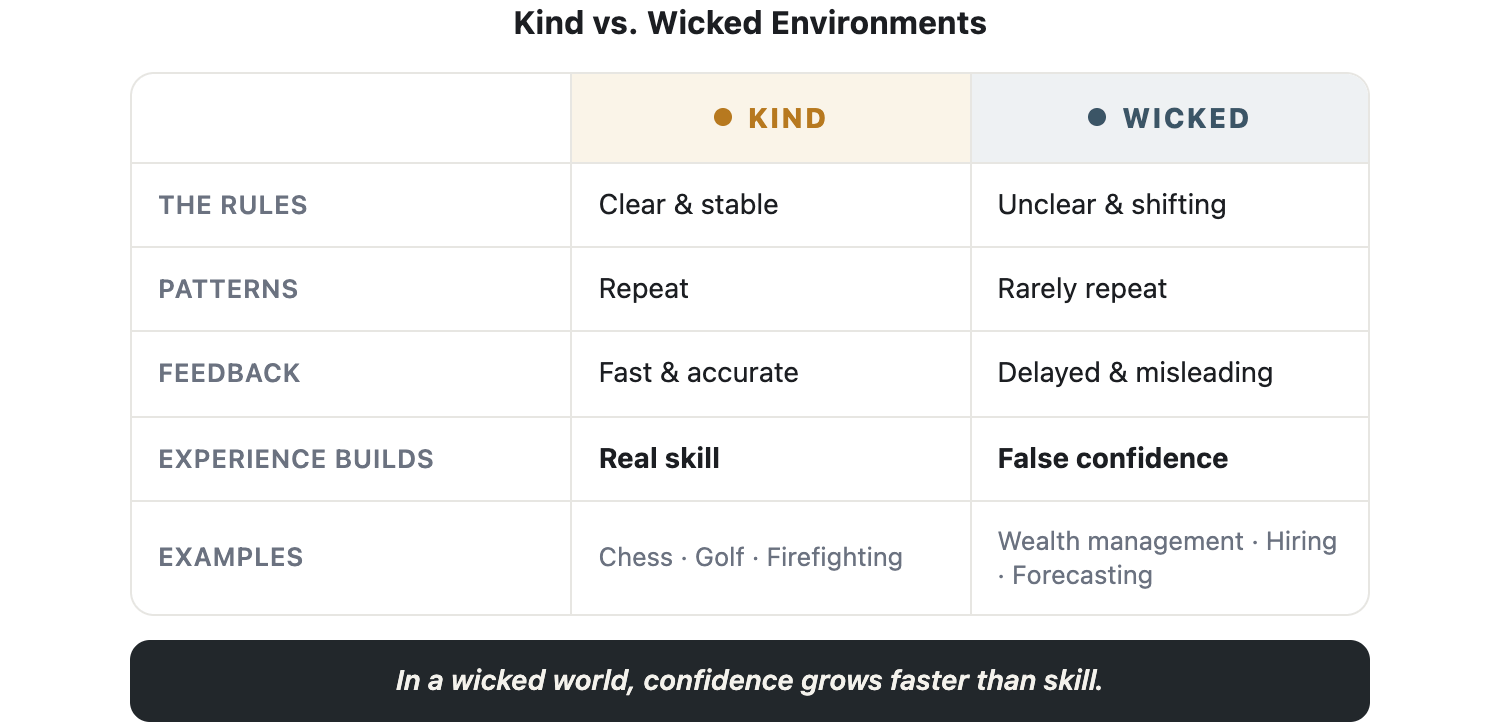
“Wicked” is the term that Robin Hogarth originated and David Epstein used in his book, Range, to differentiate from the term “kind.” They’re describing two different types of decision-making environments.
Kind environments involve patterns that “…repeat over and over, and feedback is extremely accurate and usually very rapid,” according to Epstein. Wicked environments, in contrast, involve situations in which “the rules of the game are often unclear or incomplete,” where “there may or may not be repetitive patterns and they may not be obvious, and feedback is often delayed, inaccurate, or both.”
The particular danger observed in wicked environments was that “experience had not helped at all. Even worse, it frequently bred confidence but not skill.” That’s why the logs from the Wager read almost laughably in 2026, as the captain posited many false claims about the origin of the scurvy outbreak that turned his boat into a literal ghost ship.
Robin Hogarth’s example is memorable: much of the world, he says, is “Martian tennis.” “You can see the players on a court with balls and rackets, but nobody has shared the rules. It is up to you to derive them, and they are subject to change without notice.”
An “Adversarial Collaboration”
In 2009, one of the regular heroes of this newsletter, Daniel Kahneman, entered into a debate with the American research psychologist, Gary Klein, who pioneered the study of how people actually make decisions under real-world time pressure and uncertainty, beyond the lab. A skeptic of Klein’s work, Kahneman referred to it openly as an “adversarial collaboration.”
Klein studied experts whose gut proved reliable while Kahneman focused on those whose gut betrayed them—and what they ultimately determined is where this whole story transforms from interesting to applicable:
They agreed that intuition can be trusted in kind environments but should be distrusted in wicked ones.
So which is which? (I’m glad you asked.)
The Firefighter Versus The Stockpicker
Klein created the RPD—Recognition-Primed Decision—framework, and his chief example was an experienced firefighter, where an apparent “sixth sense,” hard-earned by years of practice, enables the first responder to arrive at an apparent gut feeling that is actually well-informed intuition. Despite its brutality, the fire is, in this example, a kind environment—because fires obey physics, feedback is immediate, and patterns repeat.
What, then, was the wicked example that Kahneman used to counter? Stockpickers.
Kahneman was asked to consult an investment firm and looked at 25 anonymous stock pickers and the selections they made to buy and sell over the course of eight years. He took a surprisingly simple approach, computing the correlation of each picker’s ranking from one year to the next in order to determine if any of them were consistently good. The result?
The average correlation was essentially zero.
“The results resembled what you would expect from a dice-rolling contest, not a game of skill,” Kahneman said, concluding that the firm, which paid bonuses based on that annual performance, “was rewarding luck as if it were skill.”
He further concluded something that those of us who’ve been in the financial industry certainly sense: that “the illusion of skill is not only an individual aberration; it is deeply ingrained in the culture of the industry.”
Need further proof? Turn to virtually any print or online financial publication. Perhaps the question of why this illusion of skill has so effectively permeated the industry and perpetuated well beyond discoveries to the contrary is an interesting post for a different day, but for now, let’s conclude with an examination of the inherent wickedness of wealth management.
Why is wealth management so wicked?
It might be easier to answer how wealth management is not wicked, but let’s be sure to substantiate the claim of this post first:
Investment planning: Building on Kahneman’s hypothesis, we’re standing on solid evidence-based ground when we say that investors generally beat stock pickers, investments generally beat the very investors that hold them, and less active investments typically beat their more active counterparts.
Insurance planning: Here, we have some of the most actuarial evidence of any domain in financial planning, but none of it matters in the face of a client who “just doesn’t like talking about death.” Or a disabling injury, or a long-term health care event.
Tax planning: Plenty of information at our fingertips, but any and all of those rules are subject to change at the whim of a single politician.
Estate planning: What does it even mean to win this game? Is it leaving so much that your heirs don’t have to work—or dying with zero?
Retirement planning: The 4% rule (or 5%, or 3%) may be an oversimplification, but a complex Monte Carlo simulation built on a host of uncontrollable factors likely risks “complexifying.”
And let’s not forget that each of these oft-changing, multi-dimensional, individual pillars of personal finance are rarely operating in isolation. Most life decisions have implications in multiple of the above categories, further changing the dynamics of each.
It’s like in wealth management, we’re all playing games of 4D chess that regularly interact with other people’s games. Indeed, the wickedness of wealth management is rooted simply in its inherent and compounding humanity.
But the good news is that doesn’t mean we’re helpless or that the practice is pointless. In fact, I think it presents the very best case to be made for working with a financial advisor—and it’s why this financial advisor even uses his own financial advisor.
The 180-Year Delay In The Cure For Scurvy
The tragedy of The Wager happened in 1741. In 1747, James Lind ran one of the first controlled clinical trials in history aboard the HMS Salisbury. He gave 12 scurvy-stricken sailors, broken into six pairs, six different remedies. Only the pair given oranges and a lemon recovered—and the “cure” became a reality when Lind published A Treatise of the Scurvy in 1753.
The problem was that they proved correlation, but they didn’t really understand the cause. So, in the 1860s, a swap was made: Mediterranean lemons for West Indian limes—which have about 1/4 of the Vitamin C. Then, the lime juice was filtered through copper piping and exposed to air, which destroyed the little Vitamin C that remained. And the cure was incorrectly diagnosed as ineffective—for about another 70 years. And in all, it was about 180 years from the time that Lind correctly identified the cure until the world finally understood why it worked.
Fortunately, we don’t have to wait that long to find the wealth management industry solution. No, we don’t know how everything will turn out—and yes, there will be new evidence that comes to light that disconfirms previously held beliefs. (Remember when we were allowed to think that having a glass of red wine a day was actually good for us?)
And that’s because financial planning is not an endlessly complex equation for which we’re trying to solve. It’s not, in the parlance of this article’s research, kind. Instead, it’s wicked. It’s an unfolding story, an ongoing conversation. It’s a relationship that must be tended, a craft that will always be honed—one where even our errors can become assets, if we let them.
Quote O' The Week
Voltaire (1694–1778) — pen name of François-Marie Arouet — was the sharpest wit of the French Enlightenment: philosopher, playwright, and satirist, author of Candide, and by some counts the writer of 2,000-plus books and pamphlets and roughly 20,000 letters. He turned reason and ridicule into weapons against dogma, intolerance, and tyranny — which got him beaten, twice thrown in the Bastille, and exiled to England. His rallying cry against fanaticism was "Écrasez l'infâme" ("crush the infamous thing"), yet he also traded flattering letters with kings and princes when it served him — including the very 1767 letter this week's quote comes from. Equal parts gadfly and celebrity, he made doubt itself fashionable.
Weekly Market Update
Markets go up and down, and the ones we tracked did so this week:
- 0.61% .SPX (500 U.S. large companies)
+ 0.08% IWD (U.S. large value companies)
- 0.98% IWM (U.S. small companies)
+ 0.41% IWN (U.S. small value companies)
+ 0.75% EFV (International value companies)
- 0.19% SCZ (International small companies)
- 0.61% VGIT (U.S. intermediate-term Treasury bonds
The Challenge of Extraordinary Expectations
Contributed by Tony Welch, CFA®, CFP®, CMT, Chief Investment Officer, SignatureFD
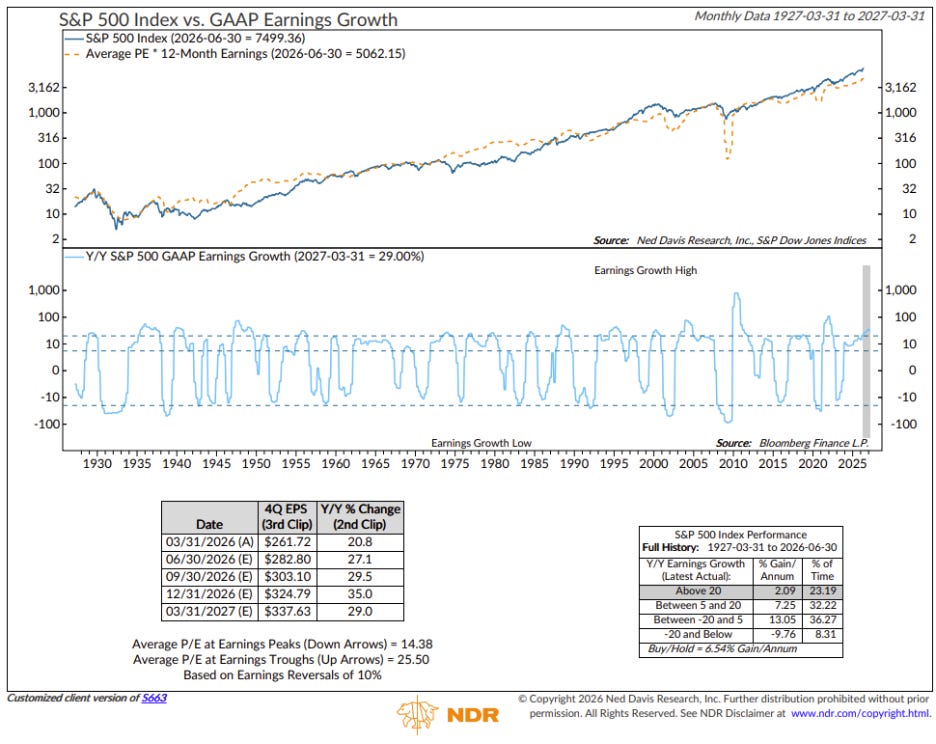
Second quarter earnings season has gotten off to an incredible start. According to WisdomTree, the first 128 S&P 500 companies to report have delivered earnings growth of nearly 25% on sales growth above 13%. At this point in the economic cycle, that’s remarkable. History, however, offers an interesting reminder.
The chart below shows that periods of earnings growth above 20% have actually produced some of the market’s weakest subsequent returns. That seems backward until you consider what stock prices actually discount. Investors typically anticipate strong earnings well before they arrive. By the time earnings growth reaches extraordinary levels, expectations are often equally extraordinary, leaving less room for positive surprises.
Importantly, this doesn’t necessarily signal trouble ahead. It simply suggests that the next leg of the bull market may rely less on valuation expansion and more on companies continuing to deliver on already lofty expectations. Strong earnings remain supportive, but the hurdle gets higher as optimism rises.
Bottom Line: Exceptional earnings are exactly what investors want to see. The challenge is that markets often celebrate the anticipation of great earnings more than the confirmation of them.
Chart O’ The Week
The Message from Our Indicators
Our indicators continue to paint a constructive picture of the economy and markets. Initial jobless claims recently fell to their lowest level since 1969, while leading economic indicators remain consistent with continued expansion rather than recession. Credit conditions are healthy, market breadth remains supportive, and higher long-term interest rates have yet to meaningfully disrupt financial conditions.
That does not mean the path forward will be smooth. The encouraging decline in June inflation was measured before oil prices rallied sharply in July amid renewed tensions with Iran. Petroleum product inventories remain tight, global refining capacity has been disrupted, and refining margins have risen sharply. These conditions increase the risk that energy prices reverse some of June’s inflation improvement and make upcoming inflation reports more volatile.
For now, we view this primarily as a potential supply shock rather than evidence of an overheating economy. Still, persistent pressure from oil could keep inflation expectations elevated, limit the Federal Reserve’s flexibility, and make it harder for already-high stock valuations to expand. Combined with elevated investor optimism and record margin debt, that may limit market upside or produce further consolidation over the coming weeks and months.
Bottom Line: The weight of the evidence remains constructive, supported by solid economic growth, strong earnings, and healthy market fundamentals. However, volatile oil prices and a less predictable inflation outlook may make the next phase of the bull market more uneven and increasingly dependent on continued earnings growth rather than higher valuations.
What book(s) are you reading this weekend?
Tim