

Is fitness to finance a leap? Not much, I don’t think.
It’s an oversimplification to say that either of them is just an equation, right? I mean, it may be true that they are both math problems in a way. For example, there is some combination of sleep, diet, and exercise that is likely optimal, but optimal for whom? Every person is different, and that changes the equation.
Similarly, there is some combination of growing, protecting, living, and giving that will be optimal for each person, each family, but in more than 25 years, I’ve never seen two identical financial plans.
So this week, we’ll take a look at a comparison between fitness and finance—and the danger of reaching for too much precision in either.
Thanks for spending a part of your weekend with us!
Tim
Tim Maurer, CFP®, RLP®
Partner
In this Net Worthwhile® Weekly you'll find:
Financial LIFE Planning:
Vaguely Right > Exactly Wrong
Quote O' The Week:
Ursula Le Guin
Weekly Market Update
Wages Failing to Keep Up
Financial LIFE Planning
Vaguely Right > Exactly Wrong
What the HIIT vs. Zone 2 debate can teach us about managing our money
In addition to finance, I’m definitely into fitness. Perhaps it’s especially because I know that no amount of money can buy you additional years of life—and having a three-year-old at the age of 51, I know I’m going to want all the (healthy) years I can get!
I was into fitness even before our little surprise came along, though. I’ve been in the gym since my teens when lifting was mandated for sports. Then, vanity kept me physically fit through my twenties. And a big driver of my fitness journey over the past 20-some years has been my two older kids (ages 22 and 21). First, I wanted to set a good example for them—and now I’m just trying to keep up with them.
That means I’ve seen a lot of fitness fads over the years related to diet, exercise, and sleep. We went from no fat to low fat to healthy fats. From no carbs to slow carbs. From paleo to Whole 30 to The 4-Hour Body to intermittent fasting. From just go kill yourself fitness in the 90s to HIIT to Crossfit.
And one of the more recent findings (or fads?) is (or was?) Zone 2. The basic, and frankly welcome, idea with Zone 2 is that you don’t have to kill yourself to get a good workout. In fact, you may be able to increase the probability of achieving many of your goals—like fat burning, increased endurance, and even gut health—through more moderated exercise, like a light jog, a brisk walk, or a hike.
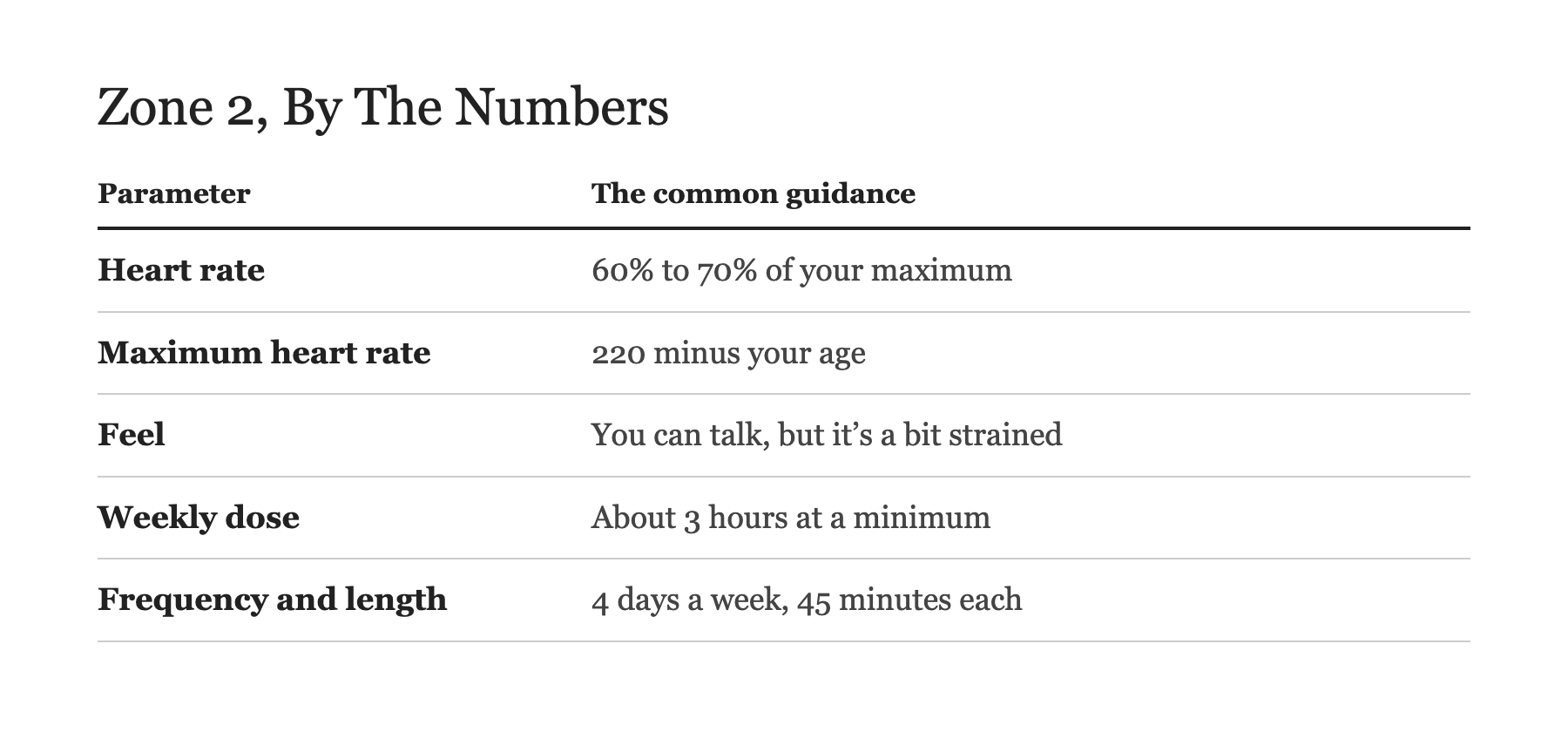
So, it’s Zone 2 of five (with five being the most intense) that most of our smart watches, health bands, Pelotons, and Tonals track automatically. Except that Zone 2 is not exactly easy to calculate. The mainstream Zone 2 prescription is basically to stay in Zone 2, which is 60%-70% of your maximum heart rate, which is calculated as 220 minus your age, for about three hours at a minimum per week, split up as three to four days a week, sustained for 45 to 60 minutes each.
Got it?
No, of course you don’t. But hopefully the following chart will make the summary a little easier:
But almost immediately on the heels of all of us completely buying into Zone 2 has come—ta-dah!—new studies showing that Zone 2 might not be all it was cracked up to be.
Thankfully, there are those who have the knowledge and the ability to synthesize all the information and get us back to thoughtful, practical guidance. Author and performance coach, Steve Magness, for one, suggests that we settled the Zone 2 vs. HIIT debate in the 1950s.
He suggests that the best recipe for optimal exercise has been clear—for decades—and he sums it up thusly:
“Lots of easy, some moderate, a touch of hard.”
Indeed, Zone 2 is vindicated (easy). And HIIT, too (hard). And everything in between (moderate). We should do all of them, to the best of our ability, with whatever time we can in the day, as many times as we can every week.
But why do we always end up here, in this endless debate pitting slices of studies against other slices of studies? Magness offers an answer to that, too.
Why do we get overly prescriptive?
“It got popularized as some overly specific zone because it’s easier to sell false precision than the nuance of reality. And that did folks a disservice. Because that false precision sets up a straw man argument, where people can dismiss “zone 2” training because it describes a nebulous, hard-to-define, narrow band of training that isn’t really distinct from what’s a bit slower or faster.”
Did you catch that powerful two-step explanation that brings it all into crystal clarity?
First, it’s “easier to sell false precision than the nuance of reality.” Especially in an era of short-form one liners and hot takes, it’s the sensationalized slice of half truth that cuts through the noise better than the longer-form synthesis, including context and nuance.
And that’s sad because, once the more marketable, overly-precise half truth gets set up on the tee, it makes it all the more vulnerable, because “that false precision sets up a straw man argument” that is much easier to dismiss.
The end result is that followers likely went from overemphasizing HIIT to under-doing it in favor of Zone 2; then they gave up on all of it and opted for the dreaded GLP1-couch combo.
And here’s where the jump from fitness to finance is all too easy.

Applications In Personal Finance
We do a LOT of this in the arena of personal finance. Here are just a handful of hot takes that turned out to be oversimplifications:
The 5% rule, suggesting that you could safely pull 5% of the value of your retirement portfolio in income each year and still sustain your portfolio was a long-running anecdotal bit of advice. Then, in 1994, a study showed that the number was actually 4%. By 2006, it was 4.5%, and in 2025, it was upgraded to 4.7%.
There have also been a number of retirement “magic numbers” reported, suggesting with surprising specificity that $1.27 million would cut it in 2023, while it would take $1.46 million in 2024.
A long-standing planning convention suggested that you’d need 70% to 80% of your working income to live comfortably in retirement.
An even older investing convention suggested that you should determine the appropriate percentage of exposure to stocks in your portfolio by subtracting your age from the number 100.
And I could likely list scores of similar oversimplifications if I chose, but sometimes the problem is actually complexification. We can run very detailed retirement income plans that purport to pin down as many detailed assumptions on rates of return, sequence of returns risk, tax rates, life expectancy, and more.
The problem here is that if a plan hinges on a host of unknowable assumptions to arrive at an apparent probability of successfully making it through retirement without running out of resources, and then even one of those assumptions changes, it can have a dramatic impact on the probability. And much like the fitness enthusiast who eventually loses confidence in his or her plan because of changing assumptions, studies, and recommendations, the planning client who sees meaningful variability in their financial planning calculations will eventually lose faith in, well, all of it.
And that’s the real risk here, whether we’re talking about fitness or finance. If we lose confidence in the recommendations we receive and abandon the plan entirely, everyone loses.
So what’s the solution?
Vaguely Right Vs. Exactly Wrong
While often attributed to Keynes, it looks like it was actually Carveth Read who, in 1898, wrote:
“It is better to be vaguely right than exactly wrong.”
We can go even further back for additional insight and inspiration, in this case to Aristotle:
“It is the mark of an educated man to look for precision in each class of things just so far as the nature of the subject admits.”
So in matters of multi-tiered complexity that invariably involve too many variables to be reliably precise, I believe we must become comfortable with imprecision. We must become comfortable with a general aim combined with a willingness to adapt as necessary.
Yes, I believe we must develop a plan and take action, but then we must walk out that plan over days, weeks, months, years, and in the case of much in personal financial planning, decades, finding comfort not in precision, but progress.
Quote O' The Week
Ursula Le Guin (1929–2018) was born at the start of the Great Depression to two writers and scholars in Berkely, California. Her range was exceptional, as she wrote 23 novels, 12 volumes of short stories, 11 of poetry, 13 children’s books, five essay collections, and four translations. She married her husband, the historian Charles A. Le Guin, in Paris, but they lived for 60 years in Portland, Oregon, where Le Guin died in her home.

Weekly Market Update
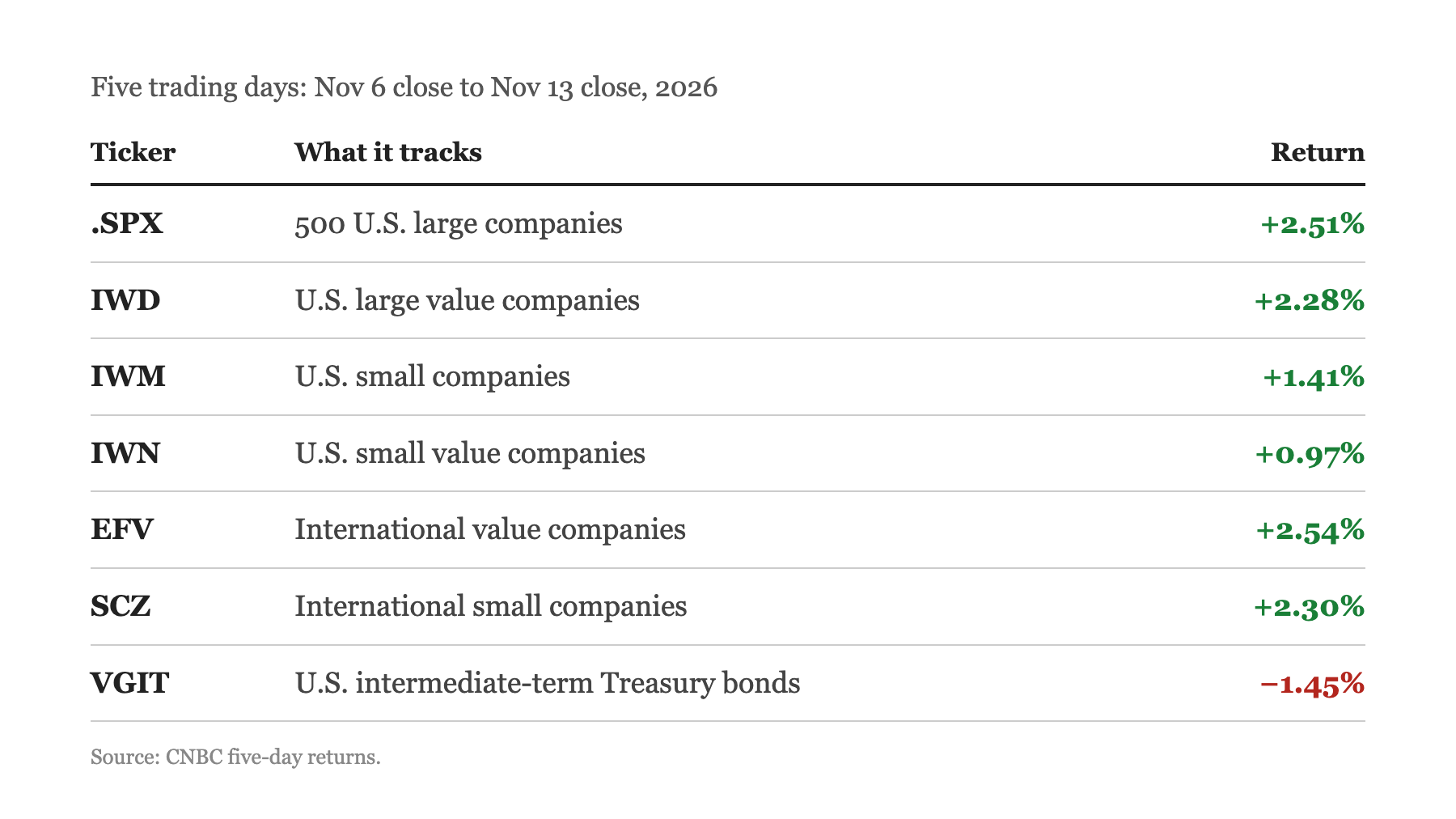
A big up week for most of the markets we follow:
Wages Failing to Keep Up
Contributed by Tony Welch, CFA®, CFP®, Chief Investment Officer, SignatureFD
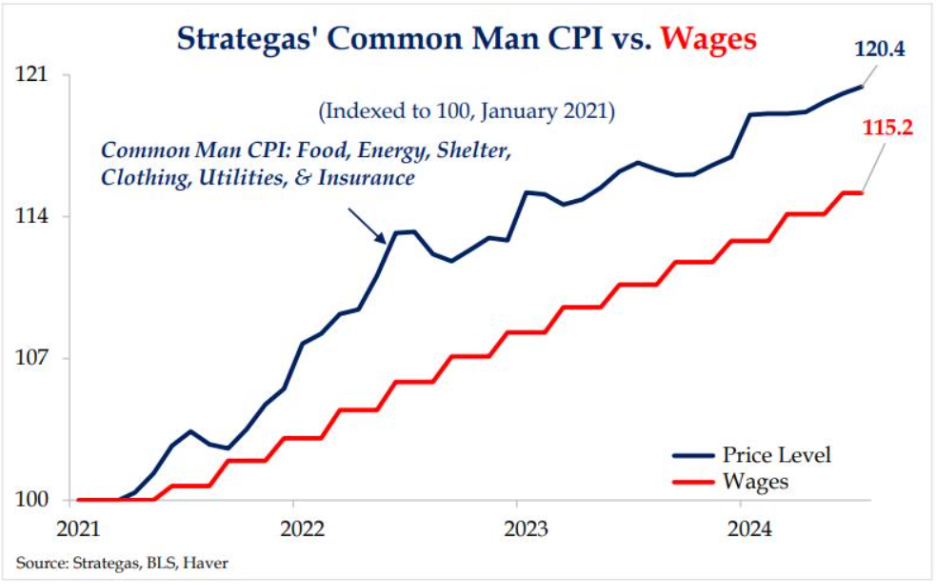
The BLS reported consumer prices rose 0.4% in October and an estimated 3.9% in the past 12 months. Because food and energy are volatile categories, the BLS also reports “core” inflation, stripping those categories out. Core CPI was up 0.3% in October. But our friends at Strategas argue that food and energy are categories of “must” buy rather than “nice to have.” So Strategas created what they call the Common Man CPI that includes the major needs categories of food, energy, shelter, clothing, utilities, and insurance. Strategas estimates that their Common Man CPI was up 4.2% over the past 12 months.
While the rate of inflation is well above the Fed’s target, the cumulative inflation since 2021 has been difficult on consumers. The chart below plots the level of the Common Man CPI in blue and the cumulative pick up in wages in red. The reality is that people have fallen behind and have not yet been able to catch up.
This matters both politically and economically. The gap between inflation and wages has depressed consumer sentiment despite an ongoing expansion. And the depressed consumer sentiment helps explain the constant flipping of party control in the legislative and executive branches. Those of us trained in the dark arts of economics focus on the rate of inflation but the below is a good reminder that the level of prices also matters quite a bit.
Chart O’ The Week
Last week was eventful to say the least. The relatively hot CPI report reinforces the high probability of another Fed rate hike in December. The economy has been resilient as evidenced by the October employment report which showed an addition of 165,000 jobs with prior months also revised upward. We think the market can remain resilient through a measured and shallow hiking cycle. If the Fed needs to be more aggressive, that could be a much greater headwind.
The other big event on the week was the resignation of Jenson Huang as CEO of Nvidia. Nvidia is a $4 trillion market cap company so naturally that event created some serious ripples. Nvidia sold off on the news while Nvidia competitors rallied. It was an interesting development because for years analysts have argued that with the market as concentrated as it is, if anything happens to a top stock, then the whole market will come under pressure. That certainly could be the case but remember that if the top companies trip up, there are smaller companies waiting to capitalize.
That doesn’t mean market breadth isn’t important. The strongest advances have historically tended to be met with broad participation. But it is encouraging that corrections have been more rotational in nature this year. In other words, instead of a panic event whereby investors have sold stocks indiscriminately, investors have been more selective. We believe that is a healthy development at this point in the bull market cycle.
Corporate fundamentals have provided a big source of support this year. Q3 earnings growth is tracking about 30%. Technology is certainly a major driver, but all 11 sectors are reporting positive earnings growth. Because earnings have been so strong, the S&P 500 has been able to return about 11%, yet valuations have cheapened. NDR reports that the forward P/E ratio was 23.2 one year ago and is now 18.8. The forward P/E has only fallen at least four points in a year six times since 1983. 2026 is the only instance in which the P/E has dropped this much and stocks were positive. So, we’re somewhat in unchartered waters. Regardless, a lower starting valuation has historically been good news for forward investment returns.
All told, our indicators continue to paint a picture of an aging expansion and bull market. But it would be premature to conclude that either are near death. We continue to give the benefit of the doubt to the bull.
You know, Sundays are a little simpler now that we don’t have to worry about the Ravens disappointing. Indeed, we know they will. :-) Have a great one!
Tim