

NBA All-Star Draymond Green asks tennis superstar Roger Federer what has been his secret to such sustained success, and Federer answers the question by giving him a rundown of his typical day.
Nobel Prize-winning psychologist Daniel Kahneman and a team of researchers develop the Day Reconstruction Method (DRM) to help 909 study participants rate the various scenes of their typical days.
Centuries earlier, St. Ignatius develops a method of prayer that is designed to help us process—and grow from—each day while preparing for the next.
It might seem like an odd triplet to weave together in a blog post, but I hope you’ll find the outcome is quite practical in pursuit of spending our days the way we hope to live our lives.
Thanks for joining us this week!
Tim
Tim Maurer, CFP®, RLP®
Partner
In this Net Worthwhile® Weekly you'll find:
Financial LIFE Planning:
Was It A Good Day—Really?
Quote O' The Week:
Pythagoras
Weekly Market Update
As Divergent as it Gets
Financial LIFE Planning
Was It A Good Day—Really?
Reconstructing Your Day With Roger Federer, Daniel Kahneman, and St. Ignatius
“How do you sustain your success?”
That was the question that Draymond Green of the NBA’s Golden State Warriors asked tennis legend Roger Federer, known for both excellence and longevity. And his answer was almost certainly not what the team expected. Here’s how Warriors coach Steve Kerr recalled Federer’s response:
I get up every morning, I hug my kids and then I take them to school. I drop them at school and then I go practice tennis for about two hours. And I've figured out a really good routine where I don't destroy my body, but I can really get all the work in I need. And then I go have lunch with my wife. And then in the evening, you know, we cook dinner together and the kids are all home from school. We ask them about school and there's so much joy in the house. And then, you know, we put them to bed and then I put my head on the pillow and I go, man, that was just a great day. And I’ve been doing that for 20 years.
Wait, what? What about working harder and longer than anybody else was willing, Roger? What about maintaining a level of intensity that no one else could sustain? What about waking up at 4:00 am to grind and push and mold the world to your will? What about optimizing and maximizing?
Nope, one of the best tennis players in the history of the sport sleeps, eats, exercises, (truly) prioritizes his family, and has orchestrated a healthy rhythm of work designed to increase joy and avoid burnout.
I think there’s a whole lesson—or lessons, really—in there, but I’m inclined to take us in a different direction lest we relegate Federer’s example to an impractical anomaly. Instead, let’s start with a more practical question that applies whether you’re a student just starting out, an established professional, or an international superstar:
How do you rate your days? How do you know if it was a good day?
Seriously. Every day, we’re asked and answering the question, “How’s it going?” And typically we give the same reflexive answer without breaking stride. But was it—is it—really a good day? If so, why, and if not, why not? And what can we do about it anyway?
Let’s look at two methods, one from the realm of science and the other from spirituality, that offer us a way to assess our days in the present in pursuit of better days in the future.

The Day Reconstruction Method
A research team led by Daniel Kahneman and Alan Krueger tackled this question and developed the Day Reconstruction Method (DRM) as a result. Here were the instructions for the 909 participants, paraphrased, in an effort to provide a most substantive answer to the question, “How was your day?”
Think about yesterday as though it was a continuous series of scenes in a film, and give each scene a short name (like “commuting to work” or “at lunch with B”).
Write down roughly when each scene—likely between 15 minutes and two hours—started and ended. A new scene starts when the location, the activity, or the people change.
For each scene, note what you were doing, where, with whom, and how strongly you felt the following 12 feelings, from 0-6 with 6 being the strongest:
Positive feelings: happy, warm/friendly, enjoying myself
Negative feelings: frustrated/annoyed, depressed/blue, hassled/pushed around, angry/hostile, worried/anxious, criticized/put down
Situational feelings: competent, impatient, tired
Are you curious to know what scenes or activities the participants rated the highest and lowest? Here’s a ranking from the study:
5.10—Intimate relations
4.59—Socializing
4.42—Relaxing
4.35—Pray/worship/meditate
4.34—Eating
4.31—Exercising
4.19—Watching TV
3.95—Shopping
3.93—Preparing food
3.92—On the phone
3.87—Napping
3.86—Taking care of my children
3.81—Computer/email
3.73—Housework
3.62—Working
3.45—Commuting
But what do we do with this insight? Kahneman and Krueger offered more in a follow-up study a couple of years later, where they simplified this concept to a single U-Index. That’s U for unpleasant or undesirable, and the basic idea is to recognize and reduce the U’s in our lives, in order to increase our overall happiness.
The authors conclude that “those interested in maximizing society’s welfare should shift their attention from an emphasis on increasing consumption opportunities to an emphasis on increasing social contacts.”
But these behavioral economists weren’t the first to recommend reviewing our days, breaking them down into discrete chunks, and processing them as a daily habit. In fact, it was at least 456 years earlier that St. Ignatius developed the day-in-review form of prayer known as the Examen.
The Examen
I love seeing science corroborate centuries-old spiritual wisdom, and while Kahneman and Ignatius may have been approaching this from different angles and for different reasons, I believe they are both providing us guidance in how best to enjoy life. In the opening of The Spiritual Exercises, in which the Examen is found, Ignatius instructs:
For it is not knowing much, but realizing and relishing things interiorly, that contents and satisfies the soul.
(Did anyone else start to hear Bob Marley as you completed that quote?)
Dennis Hamm, a Scripture scholar who taught theology for nearly 40 years at Creighton University, has helped recast this concept in a more contemporary form (even as he acknowledged that it almost certainly drew from the Stoics and Pythagoreans, as well as earlier Christian thinkers).
Here’s Hamm’s 1994 adaptation of the Examen, as articulated in his famous article, “Rummaging For God: Praying Backwards Through Your Day”:
“Pray for light.” It’s not just recollection that we’re after, but reflection that leads to understanding.
“Review the day in thanksgiving.” Where Kahneman notes the enhanced power of our negative experiences, relative to the positive, Hamm suggests walking through our days through a lens of gratitude. “Walk through the past 24 hours, from hour to hour, from place to place, task to task, person to person, thanking the Lord for every gift you encounter.”
“Review the feelings that surface in the replay of the day.” Hamm concludes a decade before Kahneman confirms, “Our feelings, positive and negative, the painful and the pleasing, are clear signals of where the action was during the day.”
“Choose one of those feelings (positive or negative) and pray from it.” And please note this next line, because it may be the most instructive in this whole post: “The feeling is a sign that something important was going on.” Real life was happening, and we’re praying and processing through those feelings.
“Look toward tomorrow.” Here Hamm even recommends looking at our calendar, at the events upcoming, and any feelings that surface as we consider those upcoming scenes.
How We Spend Our Days
As the late, great Annie Dillard famously wrote, “How we spend our days is, of course, how we spend our lives.”
Roger Federer gave us a pretty inspiring example of a day well constructed for him and his family. But wherever you are in life now, you’re likely not starting from scratch, so that means you’ll be reconstructing your life, and we start that by reconstructing our days, in Kahneman’s parlance. And how can we do that if we haven’t first examined our days? Ignatius via Hamm gives us a simple structure for doing so.
So, how’s it going—really?
Quote O' The Week
Pythagoras lived from (about) 570-495 BC. Born on the Greek island of Samos, he founded a community around 530BC in Croton, Italy that was part school, part brotherhood, and part monastery, sharing property and living by a strict set of rules. Nothing that he wrote survives, but his words have been passed down over the ages, and his influence on Western philosophy and science, especially through Plato, has been substantial. Mathematics was a way of life for those in the school, seeing them as the order underneath the universe—and, of course, it’s how we all learned that a2+b2=c2. Although Babylonian mathematicians knew the relationship more than a thousand years earlier, he or his school may have been the first to prove it. Also notable is that women were permitted to join the community, a rarity in ancient Greece.

Weekly Market Update
All of the indices we track were down this week, but international companies led the southward charge:
- 0.27% .SPX (500 U.S. large companies)
- 1.01% IWD (U.S. large value companies)
- 0.16% IWM (U.S. small companies)
- 0.54% IWN (U.S. small value companies)
- 2.94% EFV (International value companies)
- 1.22% SCZ (International small companies)
- 0.65% VGIT (U.S. intermediate-term Treasury bonds
As Divergent as it Gets
Contributed by Tony Welch, CFA®, CFP®, Chief Investment Officer, SignatureFD
You will often hear us referring to “market breadth.” There are many ways to measure market breadth, but the idea is the same in all cases – we want to see a high percentage of stocks, industries, and global markets participating in a bull market to have greater conviction in the sustainability of the advance. The reason we prefer broad leadership over narrow leadership is that it insulates the rally somewhat. If a single stock, industry, or geography comes under pressure, the other ones are there to mitigate the blow. When gains are relatively concentrated in fewer names, if something goes wrong for one of those names, it can have an outsized negative impact on the index.
Recently, NDR Research pointed out that we had never been as close to all-time highs as we currently are, with as few stocks participating. On September 25th, the S&P 500 was less than 1% from its highest level ever, but less than one quarter of the stocks were trending higher. Rising interest rates have pressured much of the market while the AI theme has largely shaken off higher borrowing costs.
This doesn’t have to be an ominous signal. Oftentimes, market breadth improves to catch up with price. And only time can tell what today’s signal will mean. But it’s also notable that major breadth divergences have occurred before many major market peaks, like the one we saw in 2020. We would put this on the short list of things we’re watching. We suspect that market breadth could improve meaningfully in upcoming weeks if interest rates stabilize or even move lower.
Chart O’ The Week
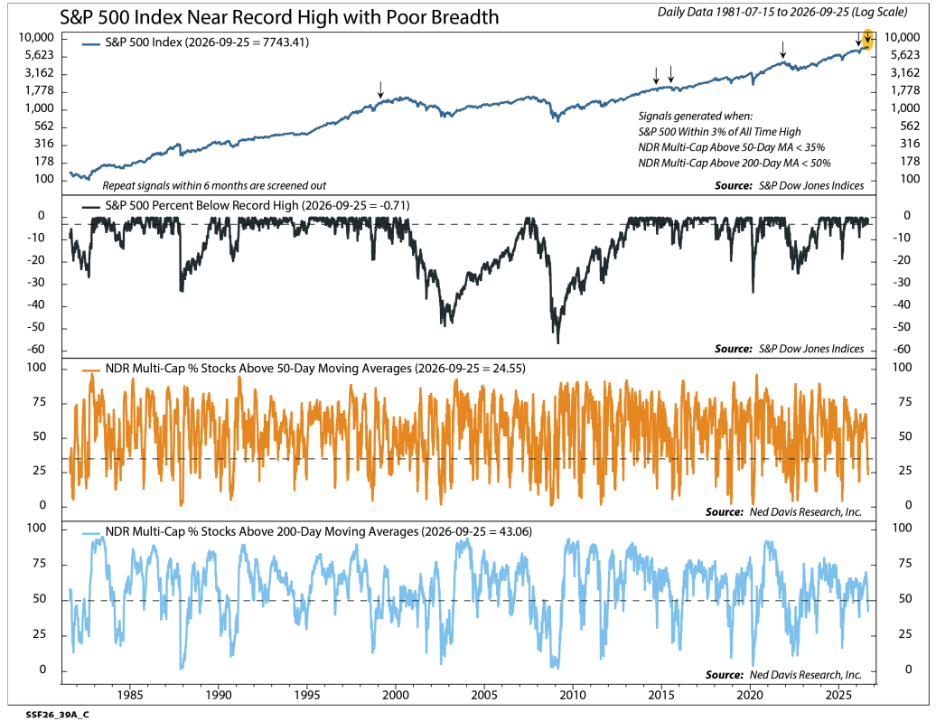
Despite the aforementioned breadth deterioration, the broad market uptrend has remained intact, especially when we compare stocks to bonds. We think the rate environment could improve in upcoming weeks and months as well, supporting riskier assets. Bond sentiment has become extremely pessimistic, and rate-sensitive sectors, like Utilities, are extremely oversold. Both conditions have historically preceded stable to falling interest rates.
And the economic data has not done much to suggest that the Fed will need to aggressively tighten. The economy is growing, but we’re not seeing inflation pressures evident in wage growth. In fact, the BLS Employment Situation report on Friday showed wages gaining about 3% in the past year, far from a level that would ignite a wage/price spiral. If commodity prices ease, then this year’s inflationary impulse could fade, allowing the Fed to end this tightening cycle sooner than if commodity inflation remains persistent.
From an earnings perspective, analysts estimate that Q3 S&P 500 earnings grew about 30% year over year. Earnings are being buoyed by the rebound in Energy prices, but the AI buildout also continues to be a massive contributor. Tech sector earnings are projected to have grown 66% in Q3. There are some unique factors that are playing into these outsized earnings growth numbers, but sales are projected to grow about 12%, which is a strong revenue showing this late into an economic expansion.
Inflation, interest rates, and market breadth are key indicators we are monitoring. For now, we believe the weight of the evidence continues to give the bull market in stocks the benefit of the doubt.
Enjoy the rest of your Sunday!
Tim