


This week’s Financial LIFE Planning post is a short one, but I think it might be the kind of short that lingers. I went looking for wisdom in an unexpected place: a Cistercian monk. What I found cuts to the heart of why so much financial planning doesn’t seem to stick, and it has nothing to do with discipline, systems, or trying harder.
Also, a small confession in the Quote O’ the Week: I’ve been using a quote for years that I originally thought belonged to Steven Covey, and then Thomas Merton, and it turns out it was neither of those guys—and the real story is even more interesting.
Meanwhile, in our Weekly Market Update, our resident investing guru, Tony Welch, offers a somewhat cautionary take this week, suggesting The Market’s Quiet Tailwind May Be Fading.
Thanks for joining us!
Tim Maurer, CFP®, RLP®
Partner
In this Net Worthwhile® Weekly you'll find:
Financial LIFE Planning:
What Are You Actually Working Toward?
Quote O' The Week:
Allen Raine
Weekly Market Update:
The Market’s Quiet Tailwind May Be Fading
Financial LIFE Planning
What Are You Actually Working Toward?
Thomas Keating, Thomas Merton, And The Goals You Never Actually Chose
I’m convinced that much of the wisdom needed to effectively navigate the intersection of money and humanity lies outside the financial domain. Outside of the financial industry establishment, in particular, because its economic bias is often in conflict with those it serves.
Lest you think I’m exaggerating, consider the simple fact that the industry proper profits most from its clients’ willingness to accumulate and warehouse its wealth rather than to activate or deploy it—you know, to use it.
I’m not anti-establishment, per se, and I think the industry offers much to benefit the consumers it serves and the true advisors who are the guides and sherpas for those clients. But it can’t be the sole source of truth.
It’s one of the reasons I so often feature wisdom from different fields: behavioral finance, economics, and psychology, sure, but also poetry, music, philosophy, and spirituality. And this week’s insight comes quietly from the latter, a Cistercian monk known for his wisdom in the contemplative tradition of Centering Prayer, where the deepest spiritual work isn’t striving harder but opening up. Not pushing, but allowing.

I’ll warn you in advance that his insight will almost immediately appear counter to what we’ve been taught about life, work, and money. So, let’s walk through it together.
Thomas Keating said,
“The chief act of the will is not effort but consent.”
How could that possibly be instructive in a world that is all about effort? It’s all about saving, buying, selling, reallocating, sheltering, skipping, deferring, growing, protecting, giving, and occasionally living.
The financial industry—and even the financial advice industry—is built almost entirely on effort. More discipline, better systems, stronger habits, tighter budgets, capturing beta, and pursuing alpha. And too often, it doesn’t stick, not because people aren’t trying hard enough, but because they’ve never actually consented to the goal. They inherited it. From their parents, their peer group, their spiritual tradition, their culture, and yes, their financial advisor.
They’re efforting toward something they never genuinely chose.
I believe the advisor’s real job—the one that separates true advice from sales, and even planning—is to help clients discover what they actually consent to before building a plan around it.
Let’s disabuse ourselves of the notion that this is some more passive approach, some sort of esoteric, woo-woo philosophy that is “out there,” disconnected from daily reality. It’s actually all about reality, and about tapping into a deeper reality that many of us never make the time or find the space to explore.
Another spiritual giant, Thomas Merton, said,
“The biggest human temptation is to settle for too little.”
It’s just that we often settle for too little by doing too much. And we often mistake activity for progress.
So, I’m curious: Have you ever actually asked yourself whether you consented to the goals you’re working toward? Are your aims rooted in your intentions, or someone else’s?
And if you’re a financial advisor, have you created the space for your clients to do so?
Quote O' The Week
I'll be honest: I think I’ve misattributed this quote more than once in the past. Steven Covey definitely paraphrased it, but it’s also often attributed to one of our sources of wisdom from this week’s post, Thomas Merton. But while researching today's post, I discovered it almost certainly isn't Merton’s. Quote Investigator traced it back to a 1915 Brooklyn Daily Eagle piece attributed to "Allen Raine," the pen name of a Welsh novelist named Anne Adaliza Evans. It spread through Stephen Covey, picked up Merton's name somewhere along the way, and has lived on the internet as his ever since.

Weekly Market Update
A Friday rout in particular led to a mostly red week for the markets we track:
+ 0.13% .SPX (500 U.S. large companies)
- 0.74% IWD (U.S. large value companies)
- 2.31% IWM (U.S. small companies)
- 2.67% IWN (U.S. small value companies)
- 0.90% EFV (International value companies)
- 1.90% SCZ (International small companies)
- 1.05% VGIT (U.S. intermediate-term Treasury bonds
The Market’s Quiet Tailwind May Be Fading
Contributed by Tony Welch, CFA®, CFP®, CMT, Chief Investment Officer, SignatureFD
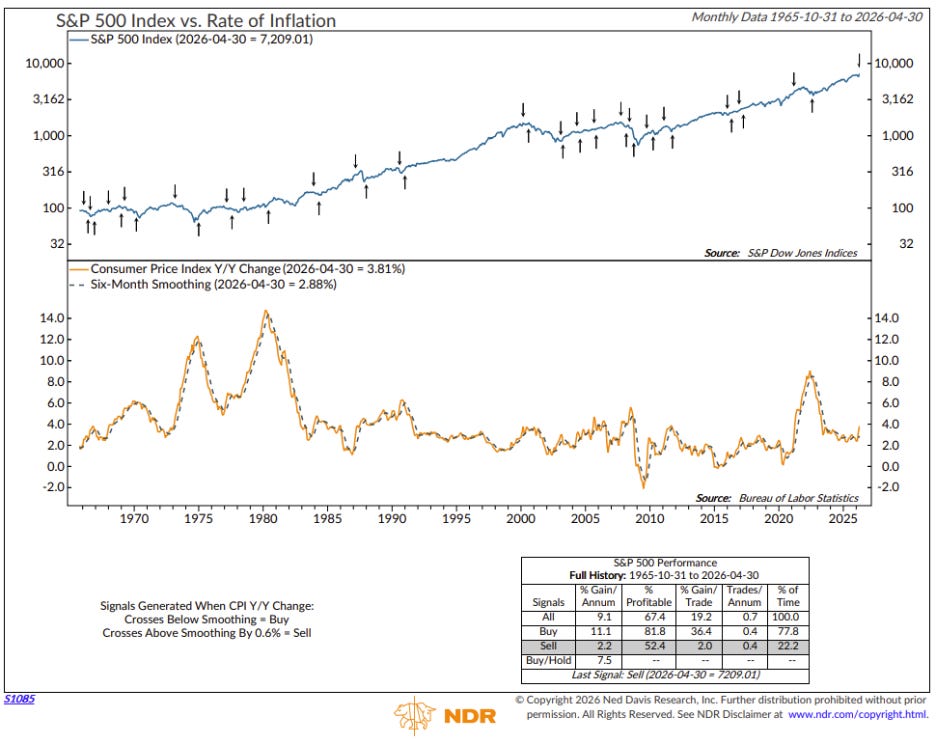
For much of the last two years, markets have enjoyed a powerful tailwind that rarely made headlines: inflation was steadily moving lower. That trend helped consumers feel better, gave the Federal Reserve room to pause interest rate hikes, and generally made life easier for investors. Now, however, that tailwind may be losing some force.
This week’s chart highlights an idea: Markets tend to care less about how high inflation is and more about whether inflation is getting better or worse. Think of it this way, investors can usually adapt to inflation if it is moving in the right direction. What tends to create problems is when inflation starts accelerating again after everyone thought the worst was behind us.
The signal in the chart recently turned less favorable, suggesting inflation has risen enough, and quickly enough, to warrant closer attention. That does not mean trouble is guaranteed. In fact, this same indicator stayed supportive through several inflation scares over the last few years. But it is a reminder that what had quietly been helping markets may now be, at best, neutral.
The good news? Markets are influenced by many forces at once. Earnings remain strong, consumers are still spending, and the economy has so far avoided the kind of wage-price spiral that made inflation so damaging in the 1970s. In other words, we believe inflation deserves more respect than it did a few months ago, but it is probably too early to assume the playbook has fundamentally changed.
Chart O’ The Week
The Message from Our Indicators
Inflation made an unwelcome return to center stage this week. Both consumer and producer prices came in hotter than expected, driven in part by higher energy prices tied to Middle East tensions. The encouraging news is that while prices have heated up, the more worrisome “second-round effects”, where inflation spills into wages and becomes self-reinforcing, still appear relatively contained. Consumers are still spending, the labor market remains stable, and retail sales suggest the economy is slowing only modestly, if at all.
Corporate fundamentals continue to provide an important offset. Earnings season has been stronger than expected, helping explain why stocks have remained resilient despite the inflation headlines. Interestingly, even as markets have climbed, valuations have actually become a bit less stretched because earnings have been growing quickly. Put differently, companies have been “growing into” their valuations rather than relying entirely on investor optimism to push prices higher.
From a market perspective, the picture remains constructive, though perhaps less forgiving. You may hear concerns that only a handful of technology companies are carrying the market higher. While leadership has certainly been concentrated, participation beneath the surface has actually been better than many assume. “Market breadth,” or how many stocks are participating in a rally, has been decent even if not exceptional. At the same time, investor optimism has returned quickly after the spring pullback, which can make markets more sensitive to disappointment. We continue to see signs of a healthy bull market, but the path higher may look bumpier than the relatively smooth ride investors have enjoyed recently.
Bottom line: Inflation has shifted from a tailwind to a watchlist item. We believe that deserves attention, but strong earnings, resilient consumers, and still-solid market participation suggest this remains a market to monitor carefully, not fear prematurely.
Have a great week to come!
Tim
Yea man, “The chief act of the will is not effort but consent.”....another great piece. Thank you. My mind and my heart have so many considerations.