


I had lunch this week with one of my favorite financial advisors. He’s the kind who practices advice as a craft, not a transaction—drawing wisdom out of clients, helping them discern what matters, then nudging them toward it.
And yet, like most conversations between two people in this profession, we didn’t spend much time on markets or money.
We talked about our kids.
Between us, we have five—two of mine in college, one of his in high school, another in middle school, and one of mine just beginning her transition out of diapers. (Long story.) And as often happens, two people who spend their lives helping others define what matters most ended up comparing notes on what matters most to us.
That conversation stayed with me later that night as I picked up Theo of Golden, a novel that has been quietly working on me. Somewhere in those pages, I was reminded of a piece of research I’d heard about years ago but never fully absorbed.
It’s a study that was done at Harvard years ago examining the messages we send our kids about what’s most important in life—and what they actually think we think about what’s most important. Would you be surprised to know that there’s a big gap? The result is that we may be raising high achievers who don’t know what true wealth is.
I examine that gap and the implications for our parenting and money management in this week’s Financial LIFE Planning section before our resident investment guru, Tony Welch, breaks down a Bifurcated First Quarter in the Weekly Market Update.
Thanks for joining us for this week, and Happy Easter!
Tim Maurer, CFP®, RLP®
Partner
In this Net Worthwhile® Weekly you'll find:
Financial LIFE Planning:
What Message Are We Really Sending Our Kids?
Quote O' The Week:
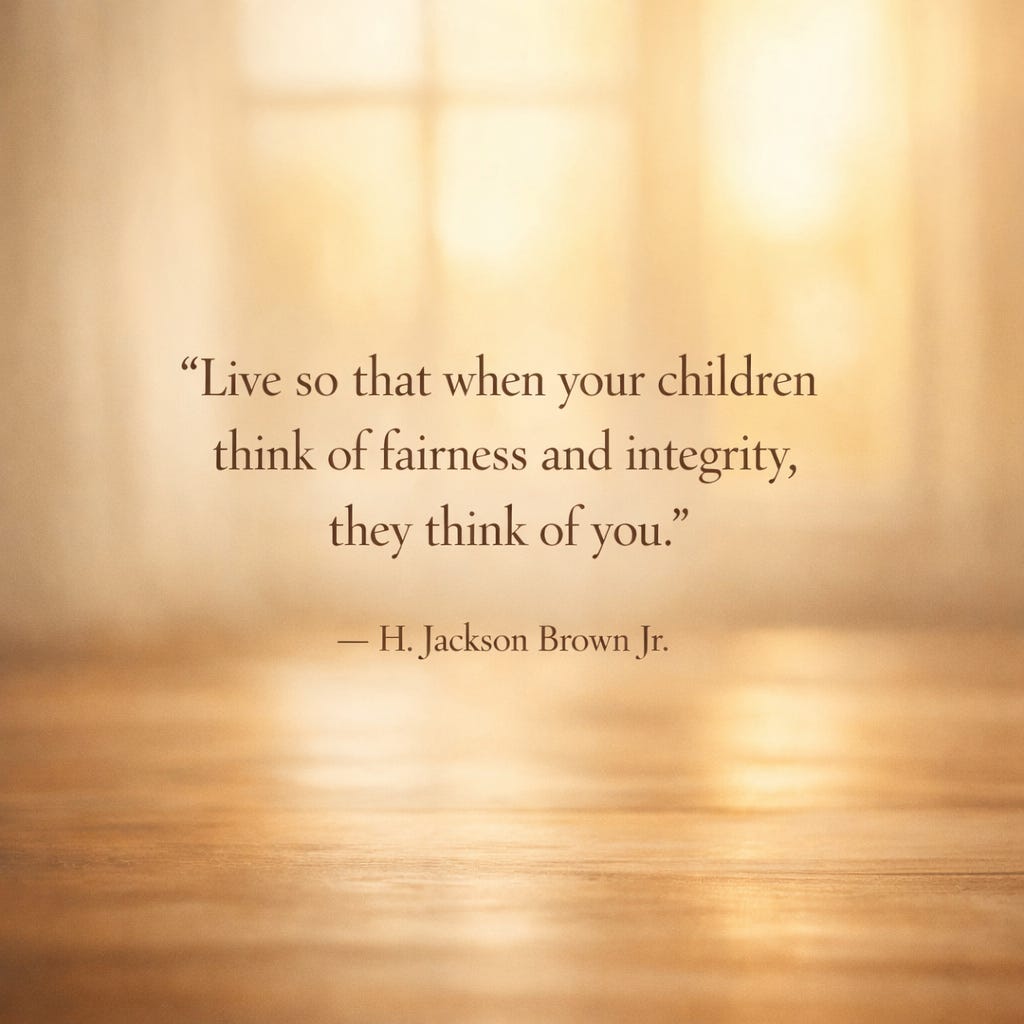
H. Jackson Brown, Jr.
Weekly Market Update:
A Bifurcated First Quarter
Financial LIFE Planning
What Message Are We Really Sending Our Kids?
So, is it possible that we’re raising high achievers who don’t know what true wealth is? That’s certainly what the 96/19 gap would suggest.
What’s the 96/19 gap?
A widely cited Harvard-based study on parent-child value perception found that 96% of parents say raising caring, moral children is essential.
But when their kids were asked what their parents actually prioritize?
Only 19% said caring for others.
The dominant answer was achievement—success, performance, personal happiness.
In other words, we say one thing. Our kids hear another.

It’s Not What We Say. It’s What They See.
To be fair, most parents are saying the right things. In the same research, over 80% of kids reported that their parents clearly communicate that kindness matters.
But here’s the problem:
Kids are sophisticated readers of subtext.
They notice what we celebrate.
They notice what we stress about.
They notice what changes our tone, our energy, our attention.
And in many homes, achievement simply carries more emotional weight.
Not because we’re insincere. But because our anxieties are louder than our aspirations.
The researchers called this dynamic “drowning out.” We don’t explicitly devalue character. We just inadvertently amplify everything else.
And it’s not just parents. Teachers show a similar gap between what they say and what students perceive. Which suggests this isn’t a failure of intent. It’s a failure of signal.
The Irony We Can’t Afford to Miss
Here’s the part that should give every high-functioning, well-intentioned parent pause:
The intense pressure to produce high-achieving kids doesn’t reliably produce high-achieving adults.
What it often produces instead is fragility.
When we over-index on protecting kids from failure or underperformance, we rob them of the very experiences that build resilience, judgment, and self-trust. The traits that actually underpin both success and well-being.
So in the pursuit of achievement and happiness, many kids end up struggling to find either.
And of course, the issue isn’t that achievement is bad. The issue is when achievement becomes the scoreboard for worth.
The Question I’m Almost Afraid to Ask
There’s a question I haven’t asked my boys—but I think I need to.
One is a senior at the University of Georgia. The other is a sophomore. I admire the young men they’re becoming—yes, for what they’ve accomplished, but far more for how they treat people.
Still, I’ve never asked them directly:
“Do you feel like it’s more important to me that you succeed—or that you care for others?”
I suspect their answers would teach me something. And regardless of what they say, it would give me a chance to close any gap between what I believe and what they’ve experienced.
Not just for them, but for their little sister who’s watching it all unfold in real time.
Closing the Gap
If there’s a takeaway here, it’s not to lower expectations or dial back ambition.
It’s to get more honest about what we’re actually reinforcing.
Because our kids won’t become what we say we value.
They’ll become what we consistently reward, react to, and model.
And if we’re not careful, we may succeed in raising kids who know how to win… but don’t know what’s worth winning.
If that happens, it won’t be an accident.
We will have trained them well.
If you’re interested in some more of the findings from the study, check out this graphical summary.
Quote O' The Week
H. Jackson Brown Jr. is an American author best known for Life's Little Instruction Book—a collection of wisdom he originally wrote as a going-away gift for his son heading off to college, which went on to become one of the bestselling books of the 1990s. The fact that his most famous work began as a father's letter to his child makes him a fitting voice for a post about what we actually pass on to the people we love most.
Weekly Market Update
Looks like some folks bought the dip this week:
+ 3.36% .SPX (500 U.S. large companies)
+ 2.60% IWD (U.S. large value companies)
+ 3.37% IWM (U.S. small companies)
+ 3.06% IWN (U.S. small value companies)
+ 4.37% EFV (International value companies)
+ 3.98% SCZ (International small companies)
+ 0.37% VGIT (U.S. intermediate-term Treasury bonds
A Bifurcated First Quarter
Contributed by Tony Welch, CFA®, CFP®, CMT, Chief Investment Officer, SignatureFD
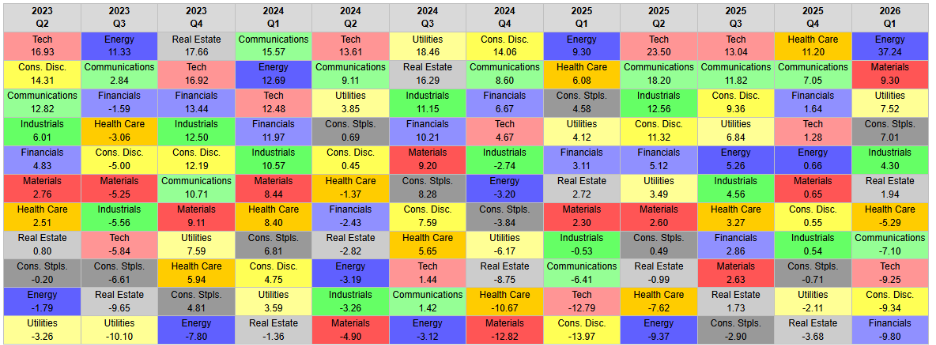
The table below shows S&P 500 sector returns by quarter back to 2023. In the far-right column, we can see that Q1 was a very bifurcated quarter. Energy was up big. Materials, Utilities, Staples, Industrials, and Real Estate were all positive for the quarter. But five sectors were negative. Health Care, Communications, Tech, Discretionary, and Financials lost value. The S&P 500 Index itself was down -4.6% for the quarter despite the strength in six of 11 sectors. The five sectors that were down total over 75% of the weight in the S&P 500. Energy, up 37% for the quarter, is a paltry 3.9% of the index.
We came into this year expecting some corrective market action, owing to relatively rich valuations and the uncertainty that a midterm year brings. Thus far, the correction has been driven by higher input costs, especially energy. It’s also interesting to note that in the prior two quarters (Q3 2023, Q1 2025) that Energy was the leader, Growthy sectors like Tech, lost value. But those strong Energy quarters were followed by a quarterly drop in Energy and a surge in Tech stocks. Commodity-linked sectors have therefore struggled to hold onto their leadership trends. It remains to be seen whether this time will be different.
Chart O’ The Week
The Message from Our Indicators
The monthly jobs report showed a much needed rebound from the February report, which was negatively affected by health care strikes. The economy added 178,000 jobs, with a large reversal in health care. Importantly, job cuts remain subdued. Payroll processor, ADP, also showed a 62,000 gain in March employment. The resiliency of the labor market is key among the uncertainty for inflation and interest rates. Market participants went from pricing more Fed rate cuts in 2026, to potential rate hikes. That is likely too hawkish an expectation, but clearly, the Fed’s path has become less clear.
The labor market has a circular relationship with corporate profits. Job creation and low unemployment help to feed consumer spending, boosting corporate profits. Solid profit growth keeps firms hiring, feeding the positive cycle. We have been on watch for a circuit breaker but thus far, profits and profit expectations are strong, and the unemployment rate remains a reasonable 4.3%. So far, so good from a fundamental perspective. Strong earnings are also important in driving stock market gains for 2026. Valuations remain relatively rich, so we do not expect gains to come from expanding valuations. Analysts expect 14% earnings growth in 2026 and we will soon start getting Q1 earnings updates. We’ll be watching for signs that profit margins may be under pressure.
From a trend perspective, the long-term uptrend remains intact but clear cracks in the trend evidence became evident in the March correction. Historically, April has been a solid month and given that the market is oversold and investors are pessimistic, we may expect an April rally. We’ll be watching the quality of that rally. Unlike Q1, where there was extreme bifurcation in the market, we would want to see most, if not all, sectors gaining in unison. That would give us more confidence that the coast is clear and the bull market has resumed. If a rally attempt is narrow and unconvincing, than the chances of a steeper correction would be greater. For now, we give the bull market the benefit of the doubt but the margin for error is shrinking.
Regardless of how you celebrate it, I hope you fully enjoy this weekend so often associated with rest and renewal!
Tim