


If you’ve ever found yourself paralyzed by a decision—not because you’re indecisive, but because the situation is genuinely, legitimately complex—this one’s for you.
I spent a good part of this spring sitting with that kind of complexity alongside some remarkable people. What emerged was a way of thinking about navigating life, work, and money that I haven’t been able to shake. I don’t think you will either.
So this week, we’ll examine what a Stanford professor, a 19th century German philosopher, and a modern-day Celtic poet have to tell us about navigating through the fog of irreducible complexity. Turns out, the answer is simpler than we’d expect and has nothing to do with thinking harder or working more.
Tony will also enlighten us on the machinations of one of the most complex mechanisms on the planet—the global markets—and how they reacted to the narratives of the week in the world, as he asks the operative question following another up week: Should investors fear a winning streak?
Thank you sincerely for spending any part of your weekend with us!
Tim Maurer, CFP®, RLP®
Partner
In this Net Worthwhile® Weekly you'll find:
Financial LIFE Planning:
What To Do When We Don’t Know What To Do
Quote O' The Week:
Marianne Williamson
Weekly Market Update:
Should Investors Fear A Winning Streak?
Financial LIFE Planning
What To Do When We Don’t Know What To Do
Think of a time when you were in the midst of a challenging situation, a major life transition, the beginning or ending of a key relationship, a shift in your career. Or perhaps you’ve made a bold decision to improve your mental, physical, or spiritual health—and yet you know it’s not just your life that will be impacted.
You probably don’t have to think too hard to pinpoint a situation like this, because the chances are good you’re facing at least one right now. It can feel like you’re navigating through thick fog. What is the fog? Jim Collins offers an answer in his new book, What To Make Of A Life:
Fog is when you go through a phase of immense uncertainty and lack of clarity about the best path forward, perhaps even having no clear idea where you want to go. When in the fog, you can feel confused or disoriented or unsteady or reeling—or maybe all of these. You might be expending a lot of energy in the fog, but it can feel more like wandering and stumbling than purposeful strides toward a clear destination. In the thickest fog, you can feel truly lost.
Sound familiar? It’s because life often is a fog; it is a complex system—or complex adaptive system, to be precise. And an understanding of this system, and the others by which we operate, matters because we’re often using the wrong solution to address the right problems.
Navigating Through The Fog
Brenda Zimmerman and Sholom Glouberman wrote the definitive paper on these systems that I’ll summarize briefly:
Simple: Following a recipe. Clear steps, predictable outcome, expertise is easily transferrable.
Complicated: Sending a rocket to the moon. Many variables, requires real expertise, but it is ultimately knowable and engineer-able.
Complex: Raising a child. Every child (and every parent) is different. Past success doesn’t guarantee future results, and expertise helps, but is not ultimately determinant in the outcome.
But even these three systems don’t entirely explain everything that will come your way in life, so under the header of complex systems, there are two additional variants that may just give you chills when you read them, especially if you’re in the midst of the fog right now:
Complex Adaptive: A family. CAS (thanks to research from the Santa Fe Institute) are those that have many interacting agents, requiring constant adaptation, involve emergent (unpredictable) behavior, and are non-linear—meaning, small inputs can have large effects, and vice versa.
Chaotic: A market crash or “tail event.” There’s no discernible cause-and-effect relationship in the moment. Historical patterns don’t hold, expert models fail in real time, and no amount of analysis produces a clear answer.
Here’s why it was so important to me to break each of these examples down for you: I want you to know that what you’re going through—the fog you’re in—is almost surely involving a complex adaptive system. So it makes sense that it’s hard, that it’s confusing if not confounding.
For example, just about everything in personal financial planning—especially if your plan involves anybody but you and/or is in any way related to financial markets—is a complex adaptive system. And yes, that means that just about all the schtick-based, guru-originated, do-it-my-way-or-the-highway, financial counsel out there often falls short; because they’re offering simple systems for complex, often complex adaptive, and occasionally chaotic situations.
So what can we do?

Simplex Stepping
In What To Make Of A Life, Collins borrows from his fellow professor, George Dantzig, the phrase “simplex stepping,” and he explains how to apply it:
Imagine you’re trying to find your way to a destination, but you don’t know what that destination is. Imagine all you can see is a small 360-degree circle around you, and you cannot see possible steps beyond that circle. So, you simply take what looks like the next best step within that small circle. Then you reset and look around the new location, and ask, “Okay, now standing here, what looks like the next best step?” You take that next step. Then you reset and take the next step. Even if a step doesn’t prove particularly helpful, or even feels like a small mistake you need to reverse, you simply readjust and ask, “Okay, so now what looks like the best next step?” You just keep next-stepping, one step after another, until you reach a destination. Now suppose, without ever knowing where all the other untaken steps could have taken you, you feel confident that you’ve reached a great destination. This is the essence of simplex stepping through the fog of life.
Simple, but not simplistic. And simply brilliant. This is how we navigate this territory, how we wade into the midst of a complex adaptive system and find our way out.
I’ve had the opportunity to participate in three Society of Advice Retreats over the past quarter, led by my friend, author, and artist, Carl Richards. The stated objective for every group (of no more than 10 participants, usually financial advisors, educators, and leaders) is to bring one big question, challenge, or opportunity that they are navigating with the goal of leaving with a clear next step that they can take, however small, in and through the fog.
The routine is that we walk through a mental model—like the simple—>complicated—>complex—>complex adaptive—>chaotic model I’ve shared with you here. And then we walk—literally—in and around beautiful outdoor spaces. Following Nietzsche’s guidance that “all truly great thoughts are conceived while walking,” we’d use the physical next steps to envision the next practical steps we could take in the navigation of our complex circumstances. Then we’d process our insight, and invite that of others, in dyads, triads, and as a larger group. Then we’d do it again, through the lens of another mental model, and perhaps a third.
What interested me the most is how often the mere willingness to create this space for these groups of high achievers resulted in nothing short of revelation—and how often the challenge they brought with them was different than that with which they departed. But everyone left with more clarity than they came with, and a few repeatable philosophies and processes that could be practiced and applied in just about every area of life and work.
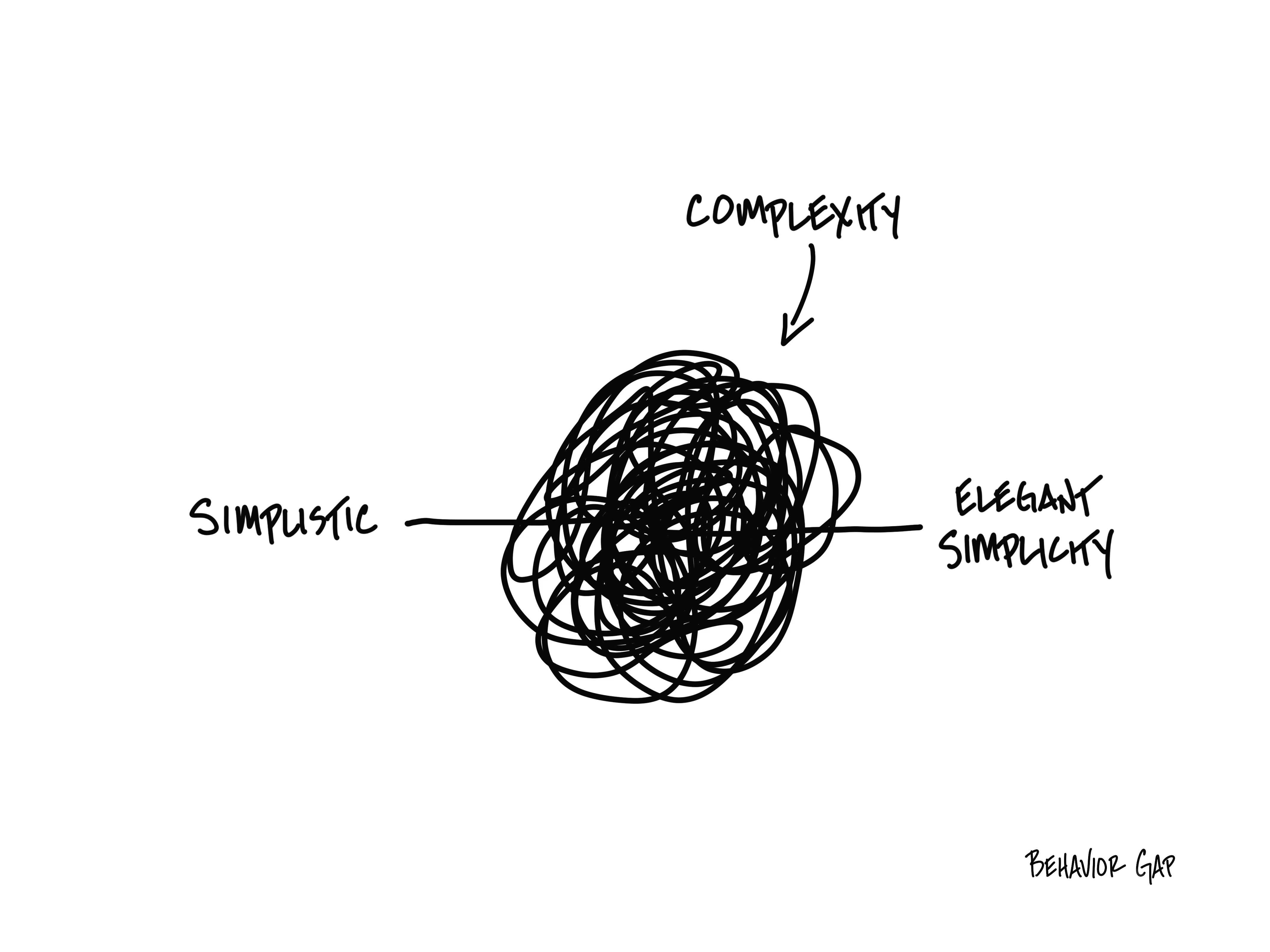
But I do have a warning, especially for those who, either through compulsion or impulsion, have a tendency to move too quickly through the fog.
Warning For Executives, High Achievers, And Quick-Starts
“The trap for high-achieving executives is that the discomfort of fog triggers premature action,” Collins says. “Leaping just to get out of the fog can send you right over another cliff.”
Too often, it seems, executive leaders are under immense pressure to act, and often to act boldly. Individual high achievers and “quick starts” may feel an impulsion to do the same. But the mature executive will be willing to apply simplex stepping systematically. And the mature high achiever can amplify their achievements and blunt their failures by making simplex stepping a core competency.
Start Close In
It’s not just business writers and academics, like Collins, who offer us direction for navigating the every-day complexity of life. I think precisely because of the inherent mystery in the myriad complexities we regularly face that we need the insight of philosophers and poets, like David Whyte, who offers us this guidance in his beautiful poem, Start Close In:
Start close in,
don’t take the second step
or the third,
start with the first
thing
close in,
the step
you don’t want to take.
And please note that last line, because it may be the most important of all the guidance in this post. In order to move forward—in order to simplex step through the complexity of life, work, and money—you will be called out of your comfort zone. In order to maintain your momentum and benefit from the new perspective offered, we need to exercise something that can’t be perceived; it must, instead, be practiced:
Courage.
And I pray you find it.
If you enjoyed this post and are inspired to read Jim Collins’ newest book, please hit the REPLY button in your email and type “Simplex Stepping.” If you’re the first to reply, I’ll be thrilled to send you a copy.
Quote O' The Week
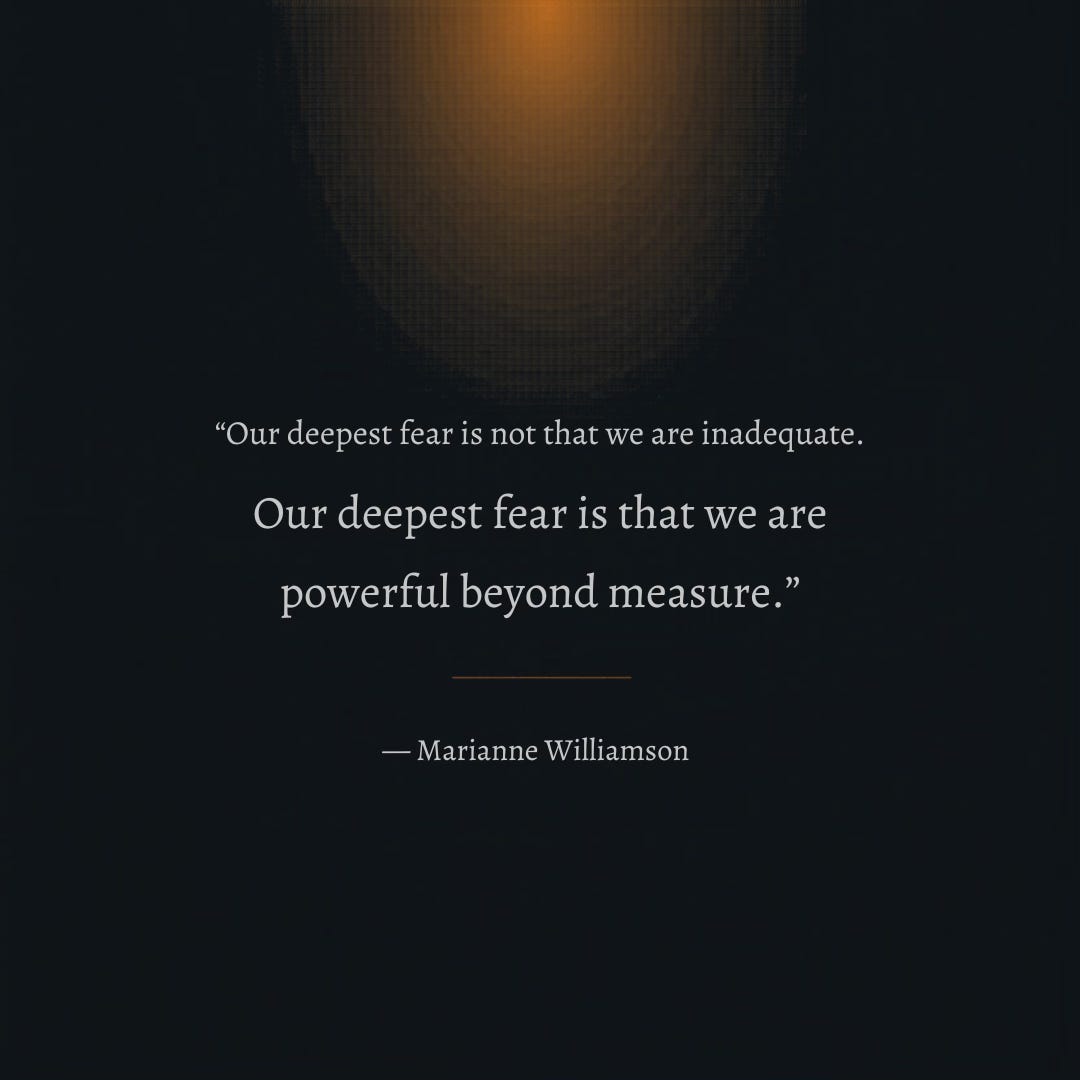
Marianne Williamson didn't arrive at wisdom easily. A cabaret singer turned spiritual wanderer, she spent years traveling, experimenting, and attending twelve-step programs before a bout of deep depression in her late twenties led her — reluctantly, given her Jewish faith — to a book called A Course in Miracles. That encounter reshaped her life. Her 1992 book A Return to Love became a #1 New York Times bestseller, and the paragraph below may be its most quoted passage — though you've almost certainly seen it misattributed to Nelson Mandela's inaugural address. It wasn't his. It was hers:
Weekly Market Update
With the exception of the tiniest little down tick for international value, the markets were cheering this week:
+ 1.43% .SPX (500 U.S. large companies)
+ 0.69% IWD (U.S. large value companies)
+ 1.86% IWM (U.S. small companies)
+ 1.21% IWN (U.S. small value companies)
- 0.01% EFV (International value companies)
+ 1.56% SCZ (International small companies)
+ 0.61% VGIT (U.S. intermediate-term Treasury bonds
Should Investors Fear A Winning Streak?
Contributed by Tony Welch, CFA®, CFP®, CMT, Chief Investment Officer, SignatureFD
Eight straight weeks of gains sound like the kind of thing that should make investors nervous.
After all, markets are not supposed to go up in a straight line. When stocks rally for this long, the natural instinct is to assume the market has gotten ahead of itself and a pullback must be around the corner.
That may happen in the short term. Markets rarely move higher without pauses.
But history tells a more interesting story.
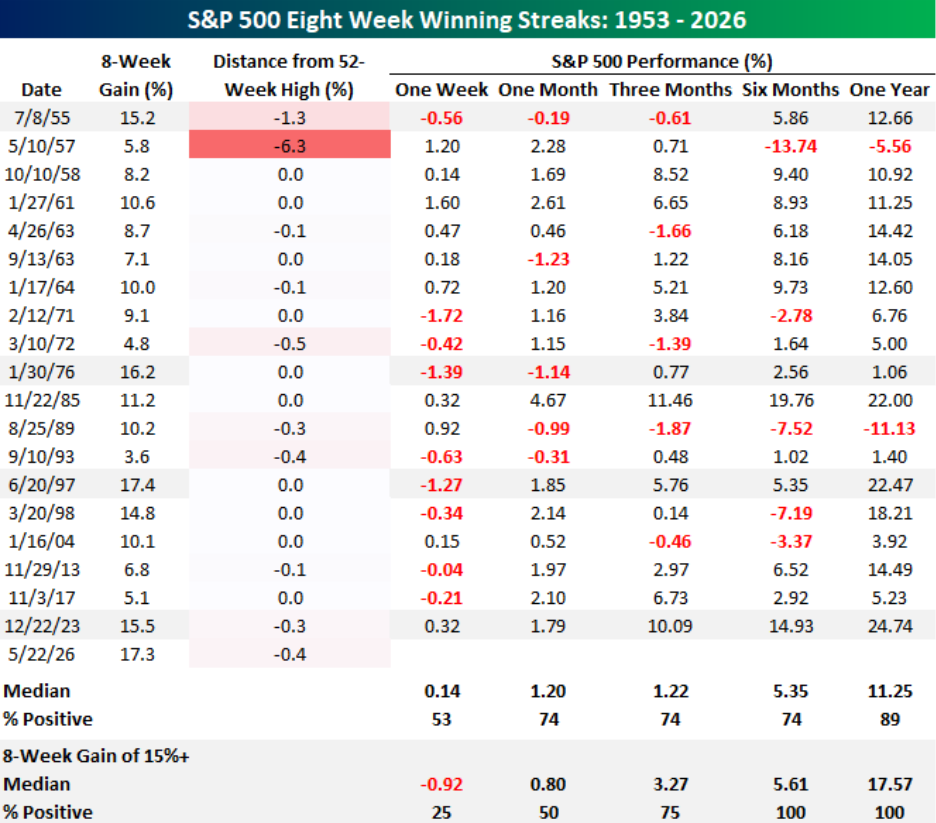
The S&P 500 recently logged its eighth consecutive week of gains, something that has only happened a handful of times over the past 70-plus years. Surprisingly, these kinds of winning streaks have not typically been signs of an exhausted market. In fact, they have more often occurred during healthy bull markets, periods when investor confidence and corporate earnings were improving together (table below).
In other words, strong momentum is often a symptom of improving fundamentals rather than reckless speculation.
Importantly, this does not mean markets are risk-free from here on out. Some past streaks were followed by short-term volatility, and no rally moves in a perfectly straight line. But the bigger lesson is that strength alone is not usually a reason to become pessimistic.
It is also worth noting that today’s environment differs from some of the market extremes investors understandably worry about. While excitement around artificial intelligence and upcoming mega-IPO activity has prompted comparisons to the late 1990s, earnings growth has been much stronger this cycle and has generally kept pace with rising stock prices.
The bottom line: a strong market can certainly cool off, but history suggests long winning streaks are often a feature of healthy bull markets, not necessarily a warning sign that the end is near.
Chart O’ The Week
The Message from Our Indicators
There is no shortage of things investors could worry about right now. Inflation remains higher than the Federal Reserve would like. Bond yields have stayed elevated. Headlines around artificial intelligence, trillion-dollar IPOs, and market concentration have sparked inevitable comparisons to the dot-com bubble. And after a strong rally, some level of investor caution is healthy.
At the same time, there are also meaningful reasons we believe the market continues to deserve the benefit of the doubt.
First, earnings continue to do much of the heavy lifting. First-quarter earnings season came in stronger than expected, and importantly, strength has extended beyond just a handful of mega-cap technology companies. While AI-related businesses remain major contributors, profit growth has broadened across much of the market. That matters because durable bull markets tend to be supported by improving business fundamentals, not just investor enthusiasm.
Second, while comparisons to 1999 are understandable, today’s backdrop looks meaningfully different in a few important ways. During the dot-com bubble, stock prices dramatically outpaced the growth in corporate profits. Today, earnings have largely kept pace with market returns. That does not mean pockets of speculation do not exist; they do, but it does suggest the foundation underneath this market is firmer than many assume.
Third, some of the classic signs of a late-cycle bubble still appear absent. Corporate investment in AI infrastructure has been massive, but unlike prior speculative periods, much of it is being funded by strong cash flows rather than excessive borrowing. Investor optimism has risen, but sentiment still looks more cautious than euphoric. In many ways, this continues to feel more like a market climbing a wall of worry than one fueled by unchecked enthusiasm.
None of this means risks should be ignored. Higher inflation could keep interest rates elevated for longer. Earnings expectations have become increasingly optimistic, which raises the bar for companies to continue delivering good news. And market leadership remains narrower than we would prefer.
Still, when we step back and look at the broader evidence, our indicators continue to point toward a backdrop that is more constructive than concerning. Markets rarely move in a straight line, and a pause after a strong run would not be surprising. But for now, we believe the combination of solid earnings, resilient economic activity, and still-improving participation suggests the bull market deserves the benefit of the doubt.
Thanks as always for joining us, and enjoy the rest of your weekend and week to come!
Tim