


In 1987, at the very moment REM was about to become one of the biggest bands in the world, Michael Stipe wrote a line so practical it could have come from a financial planning textbook.
It didn’t, of course. It came from a song. And this week, I’m making the case that it contains what may be the single most important precursor to a successful financial plan — one that comes before budgeting, before investing, and before the most famous maxim in personal finance.
We’ll take a look at it in our Financial LIFE Planning section. And don’t miss our Weekly Market Update, too, in which Tony Welch asks a question worth sitting with: Are Investors Already “All In”?
Thanks for joining us this fine Sunday morning!
Tim Maurer, CFP®, RLP®
Partner
In this Net Worthwhile® Weekly you'll find:
Financial LIFE Planning:
What We Want And What We Need
Quote O' The Week:
Henry David Thoreau
Weekly Market Update:
Are Investors Already “All In”?
Financial LIFE Planning
What We Want And What We Need
Why the confusion between wants and needs is upstream of even the most treasured financial maxims.
“Art imitates life” is a loose interpretation of an Aristotelian saying that Oscar Wilde, ever the contrarian, argued: “Life imitates art far more than art imitates life.”
I’m with Wilde. And thanks to a great piece of art—a musical quote, in this case—this particular post will be shorter than usual because it, as they say, writes itself.
This quote comes from the band REM and their first song on the 1987 album Document, which represents the beginning of what would become enormous commercial success. While I try to avoid over-engineering the meaning behind songs that regularly have multiple dimensions, it’s suggested that “The Finest Worksong” was a critique of work culture based on Henry David Thoreau’s observations at Walden Pond. I don’t think that’s much of a leap considering Thoreau, himself, is explicitly mentioned in the song.
But I don’t think we need to look too far for subtext when the text itself is so pointed and, I’ll suggest, practical:
“What we want and what we need has been confused. Been confused.”
Now I’d like to make the bold claim that eliminating this confusion—between what we want and what we need—is one of the precursors to any successful financial plan.
Furthermore, I submit that the elimination of this confusion is upstream of virtually every financial dysfunction: lifestyle inflation, status spending, over-saving at the expense of meaning, working too long, retiring too early. And the elimination of this confusion is even a prerequisite for the all-time, hall-of-fame, financial maxim to “live below our means.” The latter addresses a symptom; the former addresses the root.
The Zone, Not The Line
The challenge, however, is that the “line” between needs and wants is really more like a zone—and a zone that occasionally moves. I know this will sound silly, but for some, a second home or a country club membership registers as a need. If that sounds ridiculous, let’s rein it in just a touch: Don’t you think there are a lot of people out there—perhaps you’re one of them—who would consider providing their children with a car or a college education as, indeed, a need?
While on the other end of the spectrum, 80% of the world’s population doesn’t have access to a car at all. And there are those considered impoverished, or even homeless, in the United States whose financial wherewithal is greater than that of someone stably employed in much of the developing world.
So the REM front man, Michael Stipe, is verifiably correct that what we want and what we need have been confused, and a meaningful part of the work of financial planning—however seemingly tedious—is to draw our line (or establish our zone) between wants and needs for us. For our families.
A Different Kind of Accounting
You’ve likely heard the phrase, “Show me what you spend money on and I’ll show you what’s important to you.” But however true that might be, it sounds pretty judgmental and condescending, doesn’t it? It feels like the next thing coming is a guilt trip to spend less on yourself, give more to those in need, and the most ubiquitous of whipping posts, to watch less Netflix.
But what if we saw this less as a should and more of a can—less of a have to and more of a get to? My friend, and one of the great illuminators of the heart through the lens of money, Carl Richards, suggests that our acknowledgment of the connection between our values and our spending need not be a pejorative proclamation, but instead a generative journey.
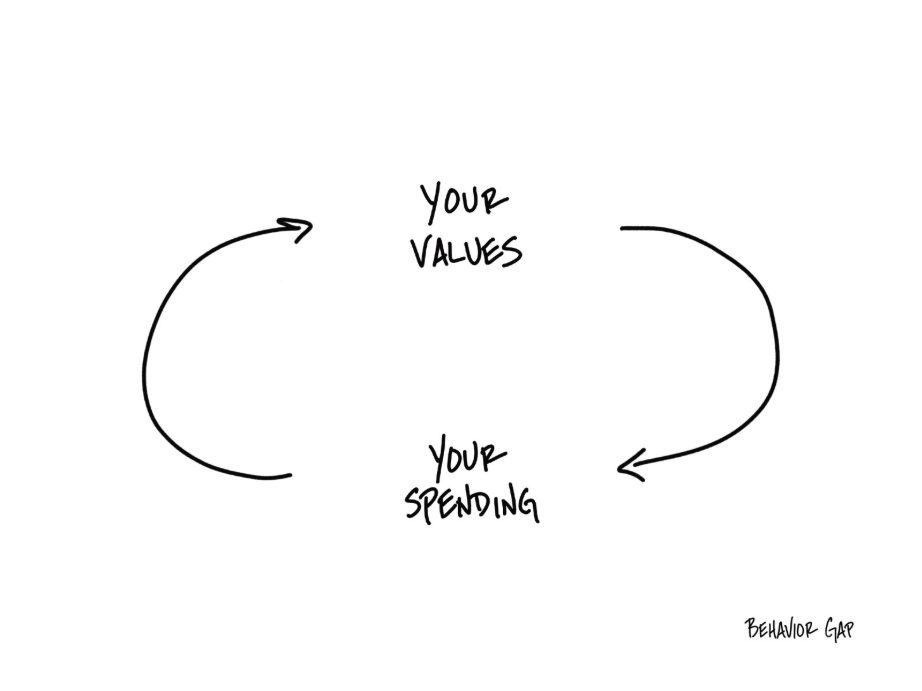
“What if our entire framework around spending money became a practice,” Richards asks, “in which we aligned our spending with what’s important to us?”
What could that look like? “You spend… you notice,” Carl suggests. “Spend… notice. Repeat.”
And he handles the tendency for self-flagellation here beautifully:
“If you don’t like what you see, yeah, it might hurt a little, but it gives you valuable information that allows you to change your behavior.”
And unlike the self-proclaimed personal finance guru crowd out there who seem so willing to suggest that there is inherent value in thrift, Richards concludes that “The goal here isn’t to spend less. It’s to spend lavishly on the things you value and cut ruthlessly on the things you don’t.”
We’re always talking about rebalancing our portfolios as a wise practice in wealth management—but what about our budgets and spending? Couldn’t it make sense to recalibrate our spending periodically, too?
And this is where the help of a financial advisor can come into play, not to tell us what our line is between needs and wants, or to impute his or her values into our plan to drive our spending—but to create the safe space and ask the potentially hard questions that help us see where our current line is, to identify where we want it to be, and then to live and spend and save in accordance with the values we’ve identified and articulated.
Thoreau retreated to Walden to figure out what he really needed. Stipe seems to have written a song to wrestle with the challenge, right as REM was launching into super-stardom. What about you? How do you want to address your needs and wants, your spending and saving, and how well they’re all aligned with the stuff in life you say is the most important?
Maybe you can enjoy The Finest Worksong while you’re considering those questions.
Quote O' The Week
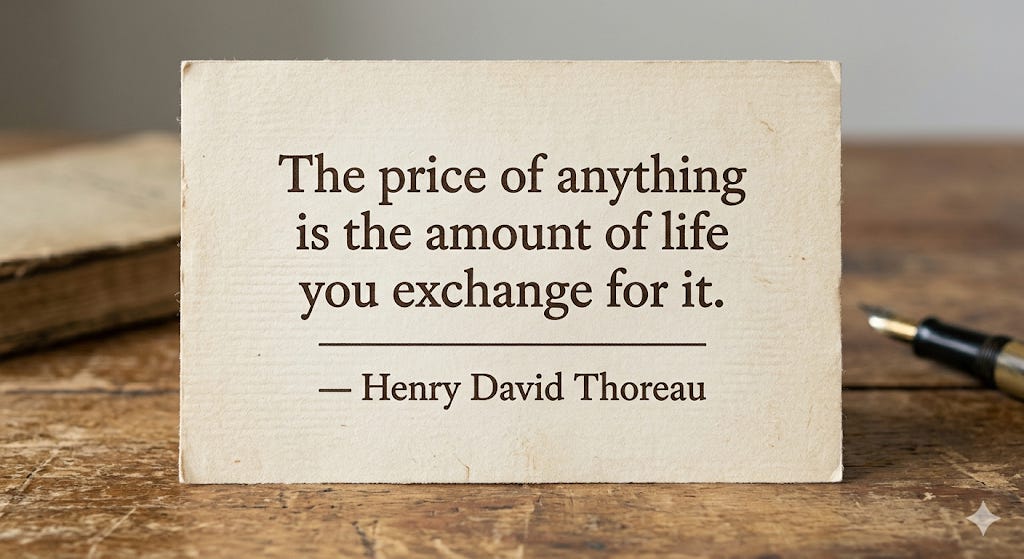
Henry David Thoreau (1817–1862) was an American author, philosopher, and naturalist best known for an experiment he conducted in the woods of Concord, Massachusetts. In 1845, he built a small cabin by hand on the shores of Walden Pond and lived there for two years, two months, and two days — deliberately stripping his life down to its essentials to answer a question most people never stop long enough to ask: What do I actually need? His account of that experiment, Walden, remains one of the most searching examinations of the relationship between how we spend our days and what we say we value.
Weekly Market Update
Markets were mixed this week, with domestic stocks eeking out another weekly gain while international stocks went the other way:
+ 0.55% .SPX (500 U.S. large companies)
+ 0.22% IWD (U.S. large value companies)
+ 0.32% IWM (U.S. small companies)
+ 0.25% IWN (U.S. small value companies)
- 2.46% EFV (International value companies)
- 3.18% SCZ (International small companies)
+ 0.30% VGIT (U.S. intermediate-term Treasury bonds
Are Investors Already “All-In”?
Contributed by Tony Welch, CFA®, CFP®, CMT, Chief Investment Officer, SignatureFD
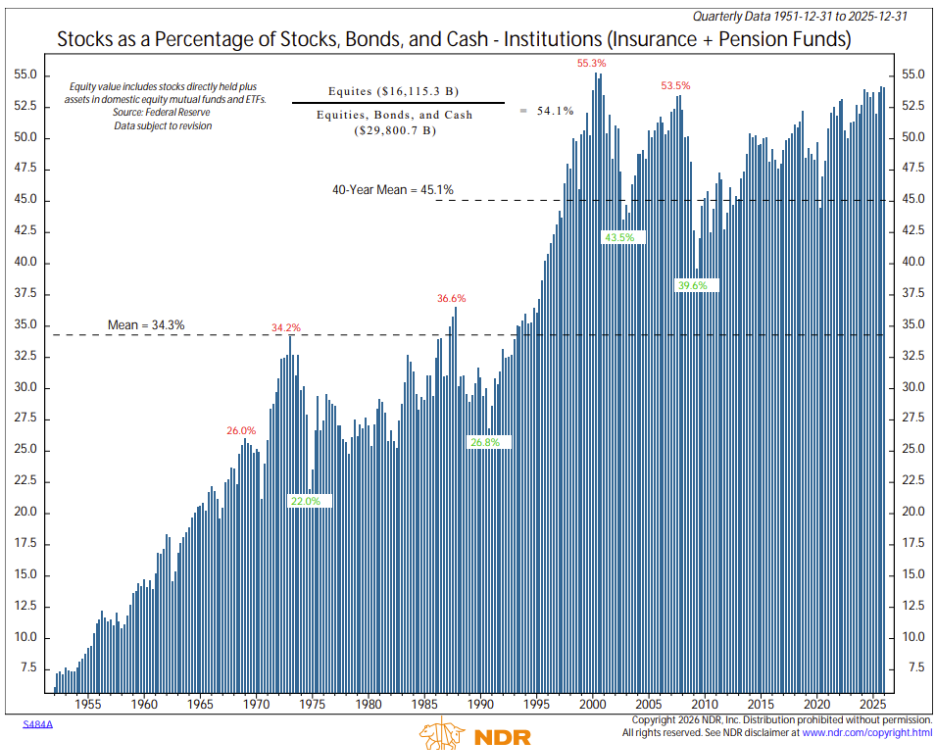
Ned Davis Research attempted to answer a compelling question last week: if investors are already heavily allocated to stocks, what drives markets higher from here? The chart this week shows that institutional equity exposure is sitting near the upper end of its historical range, levels that, in the past, have coincided with periods of strong optimism and near the end of bull markets.
That might sound ominous, after all, if everyone is already invested, who is left to buy? But markets rarely move on positioning alone. In fact, history shows that elevated allocations can persist for extended periods when the underlying backdrop remains supportive. In other words, “fully invested” doesn’t necessarily mean “fully valued” or “fully played out.”
What stands out in the data is that this positioning comes with some important offsets. Corporate profitability remains strong, supported by years of efficiency gains and relatively low labor cost pressures. Companies are also sitting on healthy cash reserves, giving them flexibility to invest, buy back shares, or weather volatility. Additionally, the proliferation of defined contribution retirement plans has been a steady source of demand. So while positioning may limit how fast markets move, the fundamental backdrop still helps explain why investors have been willing to stay invested in the first place.
Chart O’ The Week
The Message from Our Indicators
The economic data continues to paint a resilient, if slightly more complex, picture. Business activity is holding in expansion territory, with recent data showing a pickup in both manufacturing and services. At the same time, inflation pressures are re-emerging, driven in part by higher energy prices and renewed supply chain frictions tied to geopolitical tensions. Consumers, however, continue to show durability, with retail spending remaining firm even as prices rise. Taken together, we believe the economy looks less like it is rolling over and more like it is navigating a period of steady growth with pockets of inflation, enough to keep the Federal Reserve patient, but not enough to derail the expansion.
From a fundamental perspective, the story remains constructive. Profit margins are holding near cycle highs, with much of the recent earnings strength coming from areas where scarcity still exists, namely energy and technology. Over time, imbalances like the ones we’re seeing in oil and AI infrastructure tend to normalize, but for now, they are helping support index-level earnings and, by extension, equity markets.
From a trend and sentiment standpoint, the market’s recent rally has been impressive, but not without nuance. Momentum has been strong, historically strong in fact, but some of the confirming signals we typically look for, like broad participation, have been more muted. That leaves us in a familiar position: the trend is positive, but not yet fully validated. Layer on top of that the reality that investor positioning is already elevated, and it suggests that future gains may come with more volatility and less margin for error.
Putting it all together, we remain balanced in our positioning. The economy is holding up, fundamentals are still supportive, and trends are constructive, even if not perfect. At the same time, we are mindful of concentration risks and the potential for leadership to evolve. That’s reflected in our recent moves to add exposure to areas like small caps and international markets, where valuations are more reasonable, and the opportunity set is broader. In an environment like this, we believe staying invested matters, but so does staying diversified.
Mindfully,
Tim