


There’s a debate out there that the research has largely settled, but I surmise very few really believe it deep in their core. The suggestion is that our decision-making processes and finely tuned workflows are where we should place our focus in just about every endeavor—not on the outcome.
But is it realistic? I mean, doesn’t the world tend to reward us for what we actually produce, not our processes?
We’ll take a look at the research this week and propose an intellectually honest approach to what we aim at versus what we judge by—from the preacher’s pulpit, to the athletic practice field, to the poker table (and back).
Meanwhile, Tony updates us on the markets, where inflation appears to be a non-issue for stocks.
Thanks for joining us!
Tim
Tim Maurer, CFP®, RLP®
Partner
In this Net Worthwhile® Weekly you'll find:
Financial LIFE Planning:
Who Pays You For Your Process?
Quote O' The Week:
James Clear
Weekly Market Update:
Inflation a Non-Issue for Stocks
Financial LIFE Planning
Who Pays You For Your Process?
From the pulpit to the practice field to the poker table--the case for grading the decision, not the result
I recently heard a preacher say, “Saying yes is the win, not the outcome.” From the pulpit, he was suggesting this posture as a game plan for the effective navigation of life’s big decisions. But from his pastoral perspective, while certainly not easier, it is simpler to suggest that his parishioners might leave the outcomes to God—and that it’s the initial step of obedience to the divine that we’re called to follow.
But what if someone doesn’t believe in God, “the universe,” or some other higher power? It’s hard to entrust outcomes to an entity you don’t believe in, right?
What’s interesting, however, is that the advice we’re getting from some of the top minds in the highest level of sports and executive leadership development offers similar guidance, albeit for different, earthly, evidence-based reasons.
We’ll explore some of that guidance, but first I think we need to say something out loud:
The notion that our processes are more important than the outcomes derived sounds ridiculous in the real world!
How many people’s companies and bosses employ them—pay them—for their processes? No, especially at the higher end of the compensation spectrum, most people aren’t paid for their mere effort, but for the revenue generation that comes as a result.
Indeed, even some of the very same teams and companies who may preach a process over outcome mentality will distance themselves, surprisingly quickly, if and when the results don’t match the plans.
And shouldn’t they?
From The Top Minds In Sports
In 2013, 60 Minutes correspondent Armen Keteyian challenged the legendary football coach, Nick Saban, on his philosophy that focusing on winning the game—on the field or in business—was counterproductive.
“It’s like jumping out of a plane without a chute,” Keteyian quipped. “I mean in your business, what? We’re not going to focus on winning?”
Saban responded, “Right. But it really is the simple way to do it and it’s the best way to do it.”
And beyond the record that he had to prove it, Saban’s conviction didn’t come as a personal epiphany. It came from Dr. Lionel Rosen at Michigan State, who observed that football games were made up of a series of individual plays that consume about seven seconds on average. He concluded, therefore, that coaches should stop asking players to win the game—and instead ask them to win the next seven seconds.
Saban applied this strategy when his 4-4 Michigan State team entered a contest against THE Ohio State as a four-touchdown underdog—and won, 28-24, after trailing 24-9 at one point.
“That 1998 game changed my whole coaching philosophy,” Saban said.

And Nick Saban wasn’t the first high-level coach to employ this strategy. The men’s college basketball coach with the most championships all time, John Wooden, was famous for insisting on a focus other than winning.
“I never mentioned winning to my players,” Wooden recounted. “I mentioned constantly that all I wanted them to do was the best they could.”
But here’s the rub: Alabama didn’t hire Saban for his processes; they hired him for championships. And UCLA didn’t hire Wooden just to see a bunch of kids doing their best, but for the banners that will forever adorn their arena.
Both coaches were compensated for their outcomes, despite using a unique approach to get there. The real question, therefore, isn’t whether results matter—of course they do. The real question is: what is the best way to get there?
From The Top Minds In Research
In a recent 2024 study, “The performance and psychological effects of goal setting in sport: A systematic review and meta-analysis,” researchers found that self-referenced goals—focused on process, performance, and mastery—produced gains, while goals based on outperforming other people didn’t improve performance…and may have created measurable harm.
And isn’t this true in life and money? We’ve heard the now proverbial quote (likely misattributed to our 26th President, Theodore Roosevelt), that “Comparison is the thief of joy,” but according to this research, it’s also the thief of, well, winning.
So, the question remains, how can we better judge a person’s actions, if not by the outcomes or comparisons to others?
Another team of researchers—in this case, J. Edward Russo, professor of marketing and behavioral science at Cornell and Paul J.H. Schoemaker at Wharton—have given us a visual to guide us. It helps us determine when not to reward outcomes that may have been incidental (or even accidental) and when to reward excellent work that for other reasons may simply not have resulted in the desired outcome:
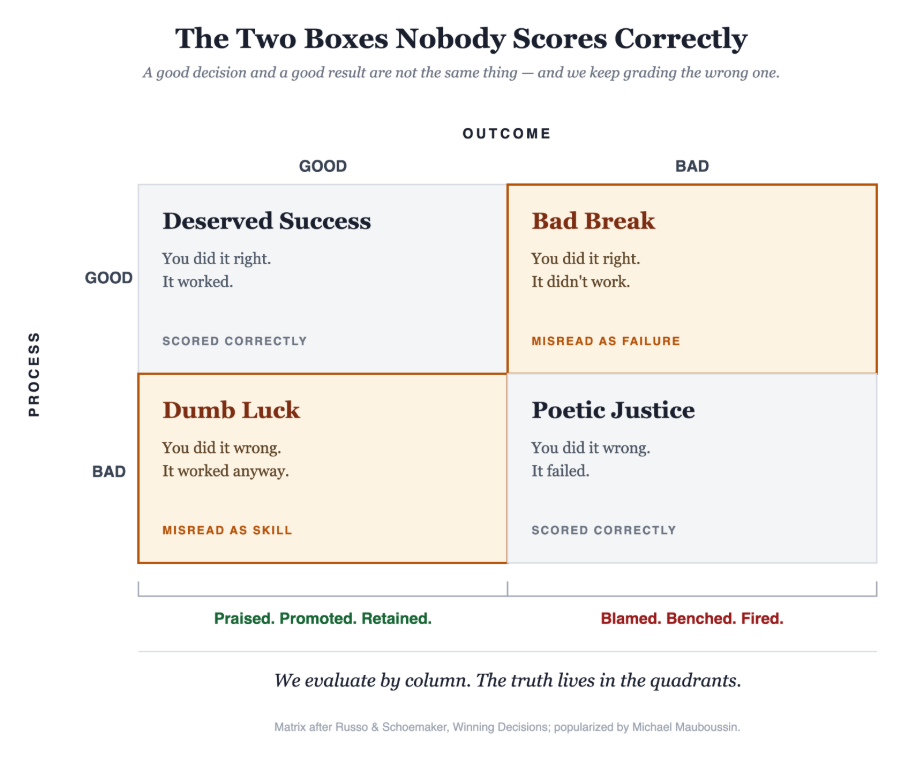
You see, in lieu of rewarding and punishing based solely on outcome, we can do so based on quadrant.
From Family Poker Night
A simple but powerful example of this can be seen at my kitchen table on any given evening. My wife and I love to host and to engage our guests in unique ways that incorporate our family members, often including some kind of games. One of our favorites is to play low-stakes Texas Hold ‘Em poker. We’re barely more than novices ourselves, but we often find ourselves having a blast teaching guests who’ve never played before the truism that poker takes an hour to learn and a lifetime to master.
We were doing just that about a week ago when one of our guests folded a hand—wisely, I might add—and yet asked if she could hold onto her cards so that she could see how the hand turned out, once all the community cards were on the table. At that moment, our 20-year-old son, who was sitting next to our guest, delivered one of the best lessons she could ever learn in poker—and probably also in life.
He said, “If you want to hold onto them just to see how it turns out for the sake of curiosity, do it. But a good rule of thumb is that when you fold for what you know is a good reason, you should hand those folded cards to the dealer and just forget about them. Because if you’d have ended up getting really lucky and winning the hand, it would likely only reinforce what could be a bad future decision.”
And in poker, the same is also true on the other side. There are times when you might stay in a hand with great cards and suffer a “bad beat” to someone who just gets lucky. You’ve lost your chips, but you played your cards right.

So a good rule of thumb, if winning is your objective, is to not focus on winning—and focus instead on the sound practices that should help you arrive at your goal?
World Series of Poker winner and author, Annie Duke, put it this way:
“People generally way too tightly link the quality of outcomes with the quality of decisions; they will often ignore the presence of luck when they’re evaluating, particularly, the outcomes of others.”
Duke is actually addressing three fascinating concepts here in one quote: First, she references the fallacy of resulting—a concept in behavioral finance where we incorrectly link the quality of outcomes with the quality of decisions. But she lands with another two-punch kicker combining the self-serving bias with the fundamental attribution error. Here, we tend to attribute our successes to our own ingenuity while assuming our failures are due to circumstances. Then, we turn that on its head with others, presuming that their successes were born of luck while faulting them for their failures. Ouch.
From Poker To The Pulpit
And with that, we conclude with what might appear to be an unlikely connection—from poker back to the pulpit. And it makes sense, because in the end, there is enough irreducible uncertainty in our lives, in our work, and in our financial planning that we must leave room for mystery.
And I think it’s one of the reasons that behavioral scientist and author Arthur Brooks insists that one of the keys to living a life of true joy is having a worldview—religious or otherwise—that helps us navigate the mystery in a way that doesn’t cripple us.
Because sometimes we’re going to win when we should’ve lost. Sometimes we’re going to lose when we should’ve won. And sometimes, winning is, indeed, just saying yes and taking the next step forward.
Quote O' The Week
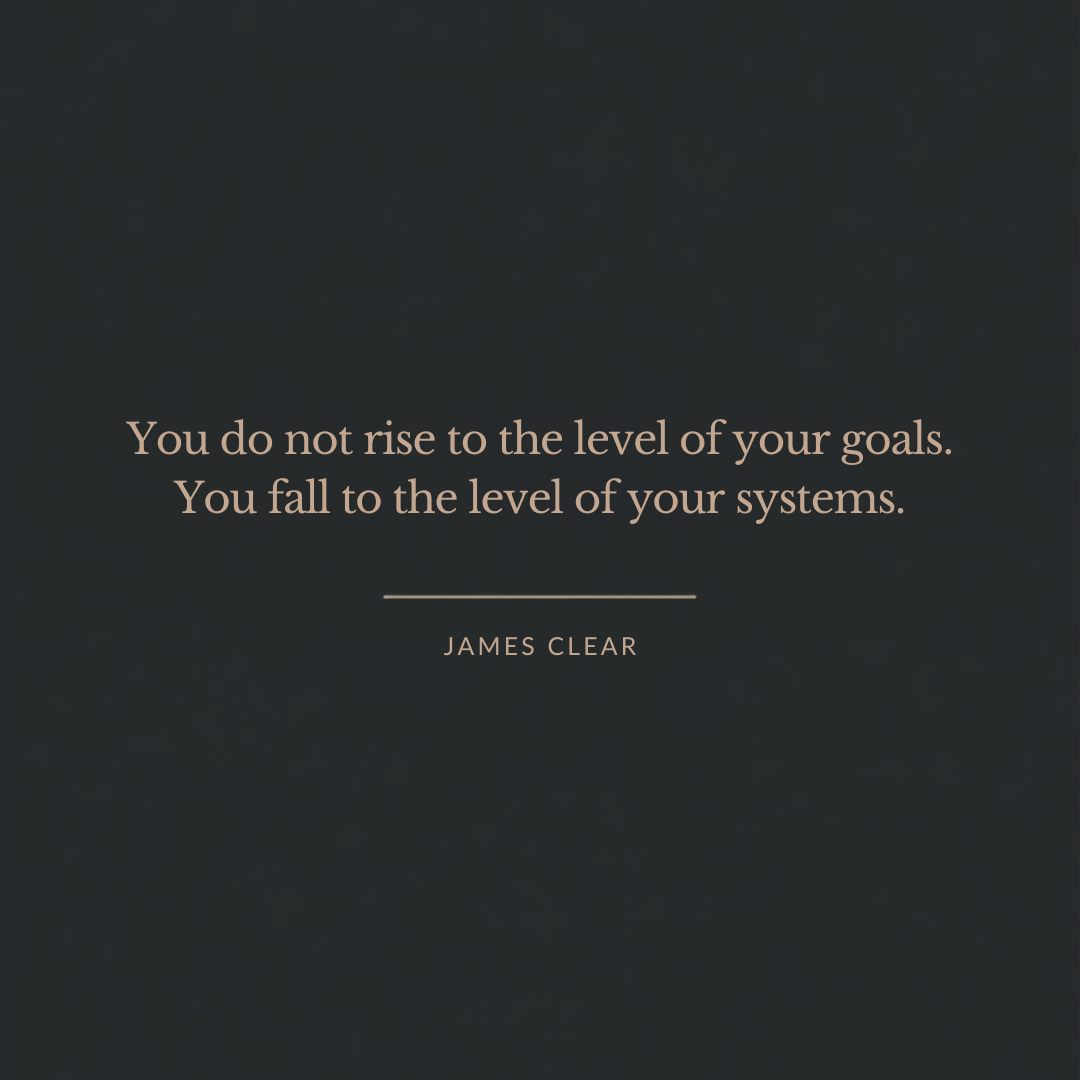
You probably know James Clear as the author of Atomic Habits, and for good reason. The book has passed 30 million copies sold, is in 60+ languages, and spent 350+ weeks on the New York Times list. But what you probably don't know is that on the last day of his sophomore year of high school, a classmate lost the bat in his hands and it hit Clear in the face, causing multiple skull fractures, the shattering of both eye sockets, and a broken nose. After a series of seizures, doctors induced a coma—the beginning of a months-long recovery. What came next wasn’t a headline. While his college peers stayed up late playing video games, Clear went to bed early, and did the work. Six years later, he was named the top male athlete at Denison University and selected to the ESPN Academic All-America team.
Weekly Market Update
Mostly moderately up:
+ 0.36% .SPX (500 U.S. large companies)
+ 0.39% IWD (U.S. large value companies)
+ 1.17% IWM (U.S. small companies)
+ 0.85% IWN (U.S. small value companies)
- 0.34% EFV (International value companies)
+ 0.39% SCZ (International small companies)
+ 0.02% VGIT (U.S. intermediate-term Treasury bonds
Inflation a Non-Issue for Stocks
Contributed by Tony Welch, CFA®, CFP®, CMT, Chief Investment Officer, SignatureFD
The change in the Consumer Price Index (CPI) for July came in right in line with expectations. CPI grew 0.1% on the month and 3.4% over the past year. Core CPI, which excludes food and energy, rose 0.2% on the month and 2.5% over the past year. Inflation remains stubbornly above the Federal Reserve’s target of 2%, but there isn’t much the Fed can do about supply constraints. We suspect inflation will be a major political lightning rod in upcoming months, ahead of the November mid-term elections.
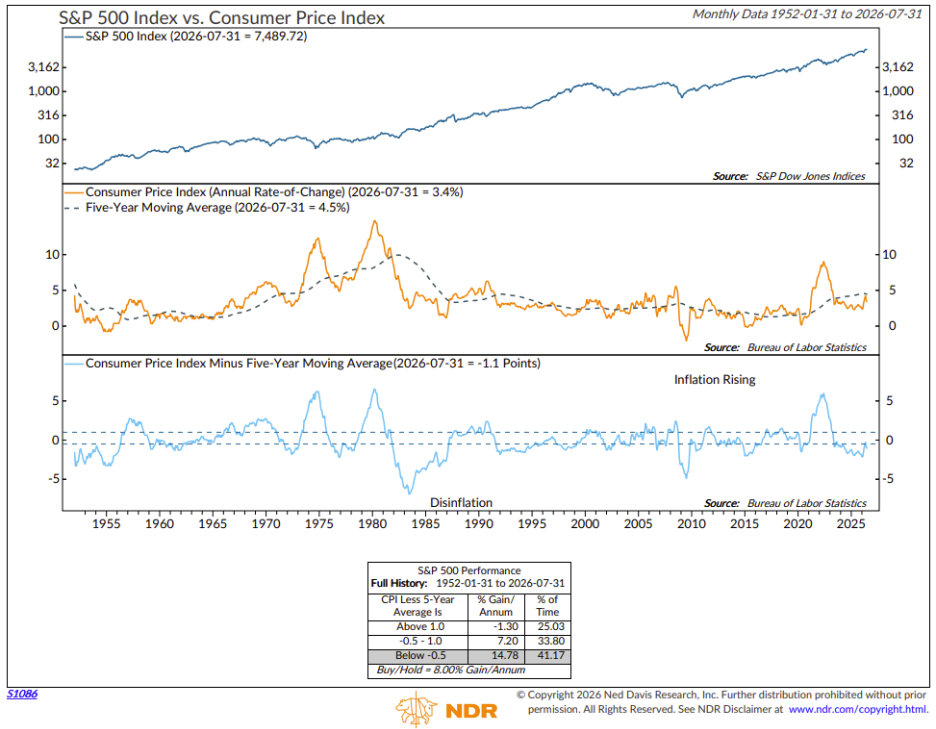
And though we believe inflation is likely to take center stage in the ads you see on TV, it’s important to note that for stocks, we believe inflation is not really an issue today. The chart below shows CPI in orange and compares the reading to its five-year average (black dashed line). When inflation is at least -0.5% below its five-year average, as it is today, the stock market has gained almost 15% annualized. That isn’t to say there are no potential market negatives, but inflation dynamics are not one of them.
Chart O’ The Week
The Message from Our Indicators
Interest rates have drifted higher this year as investors have been baking in the potential of a Fed interest rate hike this year. The softer inflation over the past two months likely gives the Fed more leeway to hold off on hiking. And in fact, following the CPI and producer price (PPI) releases last week, the odds of a Fed hike in September fell from about a coinflip to 31%, according to the CME Group’s Fed Watch tool. As the prospects for a hike fade, we expect that is likely to take some pressure off interest rates. That’s important because big macro variables like rates and inflation tend to influence stock market prices when they are volatile. But when they are relatively stable, we can comfortably shift our attention to corporate fundamentals.
And on that score, Q2 looks like a relative home run. According to WisdomTree, 456 S&P 500 companies have reported for Q2. In aggregate, they have reported about 37% earnings growth and 15% in sales growth. Much of the earnings growth is coming from “non-operating” earnings, which capture gains or losses from things outside the company’s day-to-day operations, such as investments. But operating earnings have also been strong, in line with the strong sales growth.
This year’s relative earnings boom has been important because we entered the year with stretched valuations. Strong earnings have allowed the market to rally this year without becoming more expensive. There are long-term risks to earnings, maybe most notably, any slowdown in the massive investment into AI and AI infrastructure that will be depreciated in coming years. But for now, earnings growth is a bullish input.
From a technical perspective, the uptrend remains intact, but market sentiment is beginning to stretch to an optimistic level. Historically, the best gains have occurred when market participants have been pessimistic. So we suspect sentiment is at least a near-term headwind. And the calendar is tricky. The combination of August and September has been the weakest stretch for stocks, historically. A correction around this time of year would be a completely normal development and can help alleviate the optimistic condition. For now, we would continue to give the bull market the benefit of the doubt.
Hoping your weekend is more signal than noise!
Tim
Unsurprisingly, another great read this week. Thinking about decision-making quality or the principles and process of great decision-making is so important and, I think, freeing/steeped in self-determination, autonomy, and resilience. It is my greatest hope for financial planning that we see more financial planners talk about their role as less of an advice giver and knower of outcomes and more into a decision-partner, helping clients to apply process and rigor to the decision-making process itself. I think this helps people get closer to what they individually want, over what society says we might want, and can help them pick themselves back up or shift with greater ease when the outcomes are not as we had planned/hoped.