


It’s Sunday—are you heading to church this morning? If not, this week’s Financial LIFE Planning article may make you think twice. It centers on a fascinating study that suggests poor people who go to church are happier than wealthy people who don’t.
But the truth is that it’s not just church, or any particular religion, that the study is about. It’s in part about the practice of transcendence and the ritual of community in our lives.
I confess that I didn’t take much convincing as a (mostly) lifelong churchgoer myself—but I was still surprised by the stark clarity of these secular studies.
I hope you enjoy the insight and the suggested application! And you’ll have to check out Tony’s Weekly Market Update as well, as he explores a counterintuitive perspective for a down week—that consumer optimism seems to be on the rise.
Tim Maurer, CFP®, RLP®
Partner
In this Net Worthwhile® Weekly you'll find:
Financial LIFE Planning:
Why Church Attendance Can Predict Happiness More Than Wealth Does
Quote O' The Week:
Pierre Teilhard de Chardin
Weekly Market Update:
Optimism Is Rising
Financial LIFE Planning
Why Church Attendance Can Predict Happiness More Than Wealth Does
Two secular studies and a lifelong churchgoer walk into the same data—and reach the same conclusion.
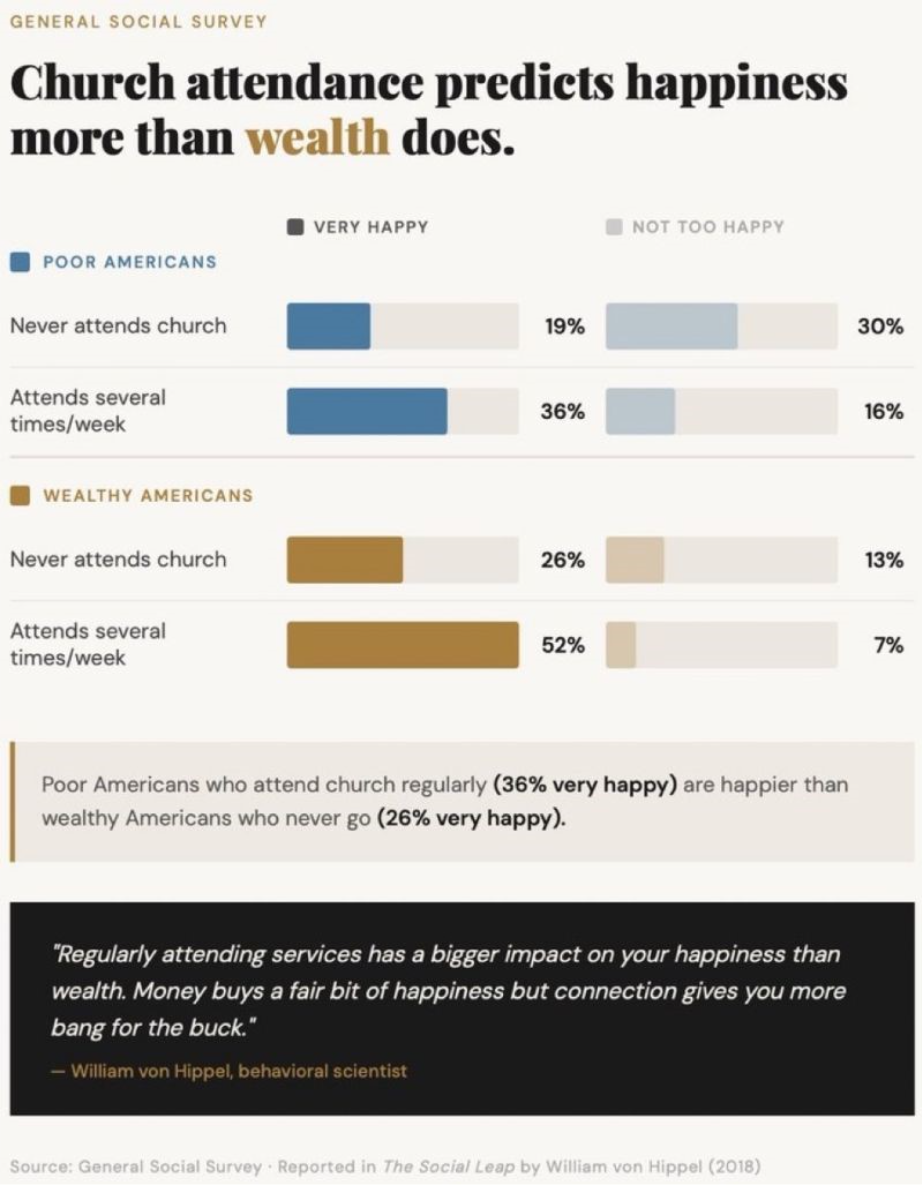
Poor people who regularly go to church are happier than wealthy people who don’t.
And although this might be my anecdotal observation as a lifelong church goer (with the exception of that six-year stretch in my early 20s) and 28-year veteran of the financial advisory world, this is a conclusion that comes from one of the most respected longitudinal social science datasets in the U.S. It’s a secular study run by the National Opinion Research Center at the University of Chicago.

So, this isn’t one of those retirement surveys done by a financial company—or a Christian organization telling you that filling their pews will make you happy. In fact, when William von Hippel, a behavioral scientist at the University of Queensland, first saw the data, he thought he’d made a coding error. Here’s a glimpse of a graphic that summarizes the findings that I saw thanks to the leader of one of the largest advisory firms in the country:
So, why does this interesting phenomenon show up, and what do we do with the information?
What’s The Meaning Behind The Data?
“Money buys you a fair bit of happiness,” von Hippel acknowledges, “but connection gives you more bang for your buck.”
Ahhh. Connection. Increasingly lacking in our fast-paced, technologically-driven lives. And that is often especially the case among the affluent and upwardly mobile.
“I suspect that wealthy, educated urbanites are paying a steeper price for their lifestyle than they realize,” hypothesizes von Hippel. “Many of us have paid too great a price in connection for our increased autonomy.”
How ironic, eh, that with increased income often comes increased responsibilities and lifestyle creep that crowds out the very connection that brings the greatest joy life has to offer?
Have you felt that in your own life and work?
Applications
So, how do we apply this insight? I don’t think it’s just about regular church attendance, but von Hippel isn’t the only social scientist to acknowledge the significant role of faith in human flourishing and happiness.
Two Harvard profs and authors have picked up on this as well, looking at it from a somewhat different angle, both supported by the longest-running study on human happiness at Harvard University.
Arthur Brooks, the author of From Strength To Strength, among others, says that you don’t have to adopt his religion—or any particular religion, for that matter—in order to get the faith bump in happiness. It’s about transcendence for him.
“When I say faith, that’s a handy way for me to talk about transcendence,” Brooks says. “Transcendence is thinking about something bigger than our everyday lives.”
And it’s the typical trappings of our everyday lives that often crowd out transcendence, isn’t it? Here’s how Brooks reconciles it for us:
“Your brain’s reward system keeps you chasing earthly delights that will enhance your reproductive fitness and likelihood of survival in comparison with others. These fall broadly into the categories of money, power, pleasure, and honor, which the medieval theologian Thomas Aquinas called substitutes for God. Whether you buy Aquinas’s assessment or not, you can’t really argue with him that these rewards overpromise and underdeliver happiness. They simply don’t satisfy.”
Did you catch that? “These rewards”—the stuff that so much of life seems to scream we need—“overpromise and underdeliver happiness.” But transcendence, he suggests, delivers.
And Brooks doesn’t stop short of practical application either. Here’s his direct recommendation for us:
“You need to curtail your worldly appetites, and instead pursue what truly brings enduring happiness: a faith or life philosophy, family relationships, real friendship, and meaningful work.”
Combined Wisdom
Lastly, Harvard epidemiologist Tyler VanderWeele, who directs the Human Flourishing Program at Harvard, has spent his career studying what produces human flourishing across cultures. His finding is quietly clarifying: private spirituality—meditation, personal prayer, individual belief—produces some benefit, but it’s not the full effects to be derived from persistent church attendance. Our presence matters.
“The teachings, the relationships, the spiritual practices, over time, week after week, taken together gradually alters behavior, creates meaning, alleviates loneliness, and shapes a person in ways perhaps too diverse to document,” VanderWeele says. “Such things alter health.”
And please note, he says this actually alters our actual health, not just our happiness.
Which brings us back to where we started. Poor people who regularly go to church are happier than wealthy people who don’t. And it’s not necessarily because of what they believe when they get there, but because they go. They are growing individually, in community.
So the question isn’t really whether you can afford a life of meaning. It’s whether you’re willing to show up for one.
Quote O' The Week
Pierre Teilhard de Chardin (1881–1955) was a French Jesuit priest, paleontologist, and philosopher who helped discover Peking Man, served as a stretcher bearer in World War I, and spent his career arguing that science and spirituality pointed toward the same truth. His major philosophical works were considered so controversial that the Jesuit order banned their publication during his lifetime — they circulated underground before finally being released after his death in 1955. He is now considered one of the most influential spiritual thinkers of the 20th century.
Weekly Market Update
After a strong run, profit takers dominated this week across the asset class spectrum:
- 2.59% .SPX (500 U.S. large companies)
- 0.65% IWD (U.S. large value companies)
- 3.02% IWM (U.S. small companies)
- 2.07% IWN (U.S. small value companies)
- 2.23% EFV (International value companies)
- 3.43% SCZ (International small companies)
- 0.90% VGIT (U.S. intermediate-term Treasury bonds
Optimism Is Rising
Contributed by Tony Welch, CFA®, CFP®, CMT, Chief Investment Officer, SignatureFD
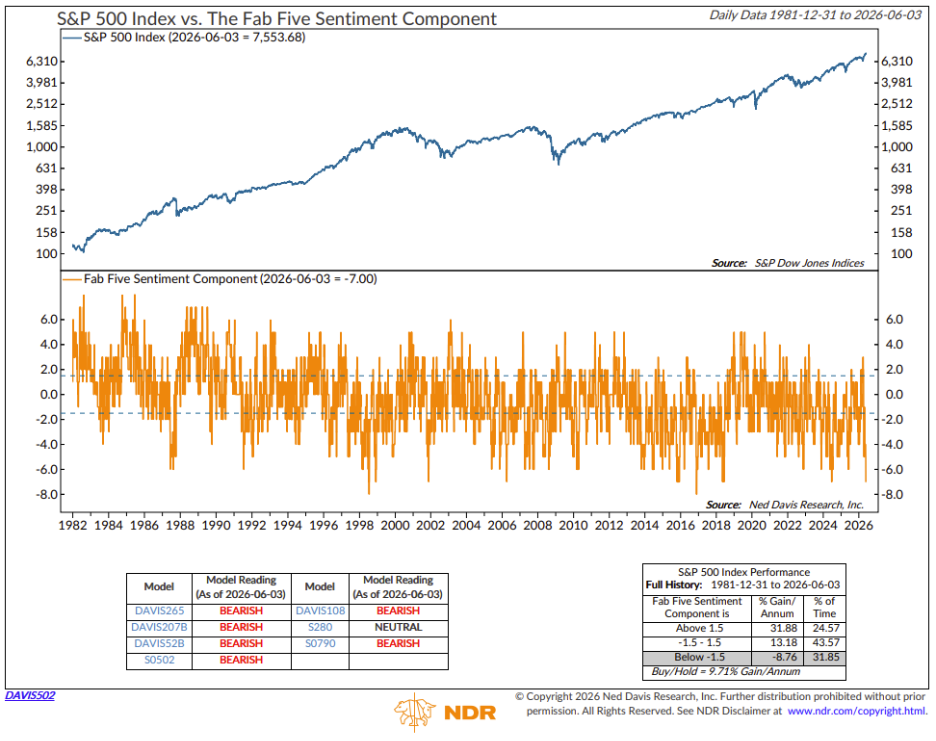
Investors have become increasingly enthusiastic about the stock market. According to Ned Davis Research’s Fab Five Sentiment Component (below), investor sentiment is now approaching one of its most optimistic readings of the past five years.
At first glance, that may sound like bad news. After all, excessive optimism is often associated with market tops. But history suggests the relationship is more nuanced.
When sentiment becomes very bullish, it doesn’t necessarily mean a bear market is around the corner. More often, it signals that markets may be vulnerable to a pause, consolidation, or short-term pullback as expectations become elevated. In fact, the last time sentiment reached a similar level in mid-2024, stocks ultimately finished the year higher, although investors endured an 8% correction along the way.
Today’s enthusiasm is easy to understand. Corporate earnings continue to surprise to the upside, AI-related investment remains robust, and economic data continues to point toward slower growth rather than a recession. At the same time, excitement surrounding a wave of high-profile IPOs has added another layer of optimism to investor psychology.
The lesson is not that investors should become fearful. Rather, it is a reminder that strong markets often climb a wall of worry, but they occasionally need to pause when optimism gets ahead of itself.
Chart O’ The Week
The Message from Our Indicators
The weight of the evidence continues to favor a continuation of the bull market, but investor expectations are rising. That doesn’t mean the trend is ending; it simply means markets may become more vulnerable to normal bouts of volatility along the way.
Recent data showed manufacturing activity reaching its strongest level in four years, job openings rebounding, and layoffs remaining unusually low. Corporate profits also continue to expand, providing an important cushion for both the economy and financial markets. Taken together, these are not the conditions that have historically preceded recessions.
At the same time, we are beginning to see a different type of signal emerge. Investor optimism has become increasingly widespread. Surveys show elevated expectations for future stock gains, IPO activity is accelerating, and market enthusiasm surrounding artificial intelligence remains exceptionally strong.
Importantly, optimism is not the same thing as risk. Bull markets often become more optimistic as they mature. However, periods of elevated enthusiasm can create conditions where markets become more sensitive to disappointing news.
For now, our indicators suggest the fundamental backdrop remains supportive. Economic growth is slowing but still positive. Earnings continue to grow. Labor markets remain stable. While some sentiment measures have become stretched, we have not yet seen the type of broad deterioration in economic or market data that typically accompanies a major market downturn.
Enjoy the first full weekend of June!
Tim
good points, good post. Faith communities also ground wealth in something less temporal, more transcendent. The very act of showing up is a reminder that you sit in a community of people with other talents, needs, issues, etc. There needs to be a great deal more research on this, but every study I've seen ends in the same place: communal faiths increase well being, material or otherwise.
Also an underrated palliative for class division. Church/synagogues etc. were often places people of different class/wealth status were equal participants. If you see each other as equals every week, harder to hate them on Monday.
Not surprised by this finding but definitely really interested in it. I've been engaged in non-christian faith communities (Reclaiming) and it definitely gave my life a sense of connection to the community that is missing now. For people who are not christian, I recommend checking out the Unitarian Universalist, especially multi-faith focused ones. The Quakers also are still around and have beautiful communities, with silent meeting and lots of programming happening in their buildings especially around activism. There is a new group called Sunday Assembly that is growing in the US. There are also pagan groups all around the US offering regular gatherings that can be really fun and definitely can always use support.