


I’m always interested in, but often skeptical of, parenting advice—especially the copy-paste approach that hopes to achieve the same results in a different household. Every parent and child is different, and no handbook covers all of it.
Which is exactly why I found Sting’s approach worth sharing. This week we’re looking at an approach to parenting around money that the wealthy rocker has articulated—and it seems to have worked for him and his kids. Some version of it may work for you and yours, but it’s really the deliberation he’s undertaken in determining how to apply his values that I’m encouraging. His conclusion is worth considering, too.
Also worthy of consideration is Tony’s Weekly Market Update, in which he asks an important question: Are we seeing a changing backdrop for the markets emerge?
Thanks for joining us!
Tim Maurer, CFP®, RLP®
Partner
In this Net Worthwhile® Weekly you'll find:
Financial LIFE Planning:
Why Sting, The $550 Million Rocker, Won't Spoil His Work Or His Kids
Quote O' The Week:
Warren Buffett
Weekly Market Update:
A Changing Backdrop for Markets?
Financial LIFE Planning
Why Sting, The $550 Million Rocker, Won't Spoil His Work Or His Kids
This past weekend, I had the opportunity to see the legendary artist and founding member of The Police, Sting, in concert. It was a special setting in Chastain Park, an amphitheater tucked in the middle of a beautiful neighborhood north of Atlanta, hidden amongst the trees.
One of the first things Sting mentioned to the crowd was his appreciation for the venue—acknowledging outright that he could make more money playing at a larger venue, but that it was a love for the setting of Chastain Park and the crowds it tends to draw that had made him choose this venue for “the eighth or ninth time.”

Before we move on, I’m curious:
To what degree is that type of ethos evident in your approach to work and money?
Are you doing work that you enjoy enough that you’d still be doing it in your mid-seventies?
And to what degree have you consciously considered the meaning in your work alongside the money it pays you?
Sting doesn’t need the money. With an estimated net worth of $550 million, the truth is that he doesn’t have to tour at all. Yet, at the age of 74, he’s chosen an even more demanding tour—the Sting 3.0 tour features a return to his Police roots as a power trio with its iconic frontman on bass and lead vocals—at venues that maximize meaning over money.
And that was just the first five minutes. Interestingly, Sting mentioned his financial, career, and estate planning multiple times throughout the show. He made a brief allusion to his primary homestead—”I suppose it’s a castle, really,” in a way that could only sound unpretentious coming from an affable Englishman who still seems a touch surprised by his own success. And he even referenced his plans for insulating his children from the trappings of wealth, a topic he’s discussed publicly multiple times. His strategy is pretty clear:
“I’m spending our money,” Sting said. “I’m paying for your education. You’ve got shoes on your feet. Go to work.”
And he insists it’s an act of love to withhold—and quite the opposite to spoil. “The worst thing you can do to a kid is to say, ‘You don’t have to work.’ I think that’s a form of abuse that I hope I’m never guilty of.”
And this isn’t a new idea of his. He’s been talking about it (and applying it) since at least 2014, when he acknowledged that he would certainly help his children out financially in a time of need, but “I certainly don’t want to leave them trust funds that are albatrosses round their necks. They have to work,” and he concluded, “they have the work ethic that makes them want to succeed on their own merit.”
What I do applaud—and what I think is worth emulating regardless of the conclusion you reach—is the deliberation Sting has clearly applied here. He and his wife have developed a philosophy for their family that is informed by their values around work, possessions, money, and experiences. The conclusion he’s reached may or may not be right for you. But the process of reaching one almost certainly is.
Quote O' The Week
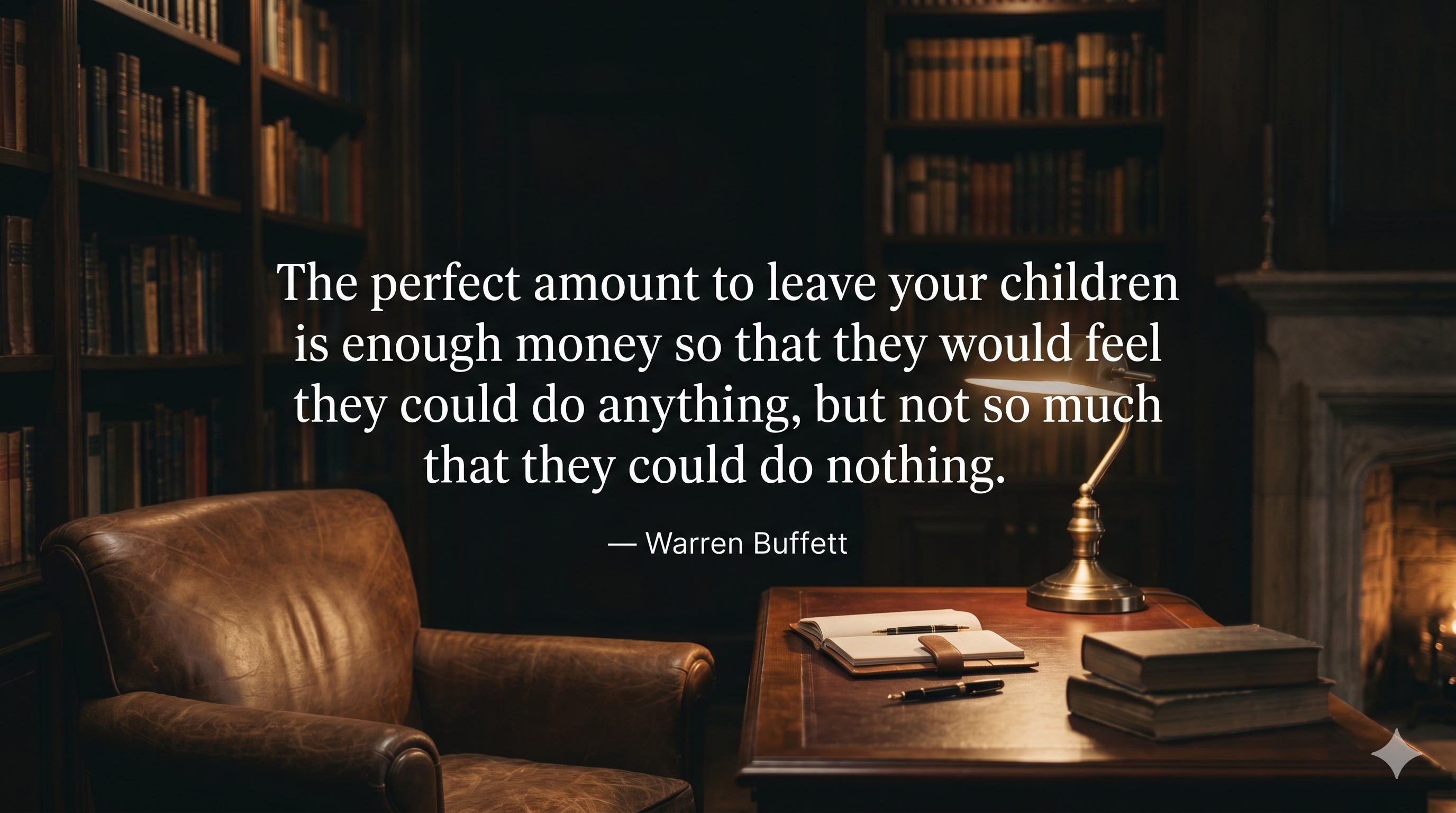
Warren Buffett, the legendary investor and CEO of Berkshire Hathaway, has been one of the wealthiest people on earth for decades — and one of the most consistent voices against passing that wealth directly to his children. He's pledged to give away 99% of his fortune to philanthropy, with his three children overseeing the distribution rather than inheriting it directly. The quote below has been his stated philosophy since at least 1986.
Interestingly, His son Peter received roughly $90,000 from a family farm sale at age 19 and used it to launch a music career. He's now an Emmy Award-winning composer and co-chair of the NoVo Foundation. It's arguably the clearest proof of concept for his father's philosophy: enough to do anything, not enough to do nothing.
Weekly Market Update
The market(s) rebounded nicely this week, with small and value leading the way:
+ 0.88% .SPX (500 U.S. large companies)
+ 1.78% IWD (U.S. large value companies)
+ 2.71% IWM (U.S. small companies)
+ 2.59% IWN (U.S. small value companies)
+ 1.79% EFV (International value companies)
+ 1.14% SCZ (International small companies)
+ 0.19% VGIT (U.S. intermediate-term Treasury bonds
A Changing Backdrop for Markets?
Contributed by Tony Welch, CFA®, CFP®, CMT, Chief Investment Officer, SignatureFD
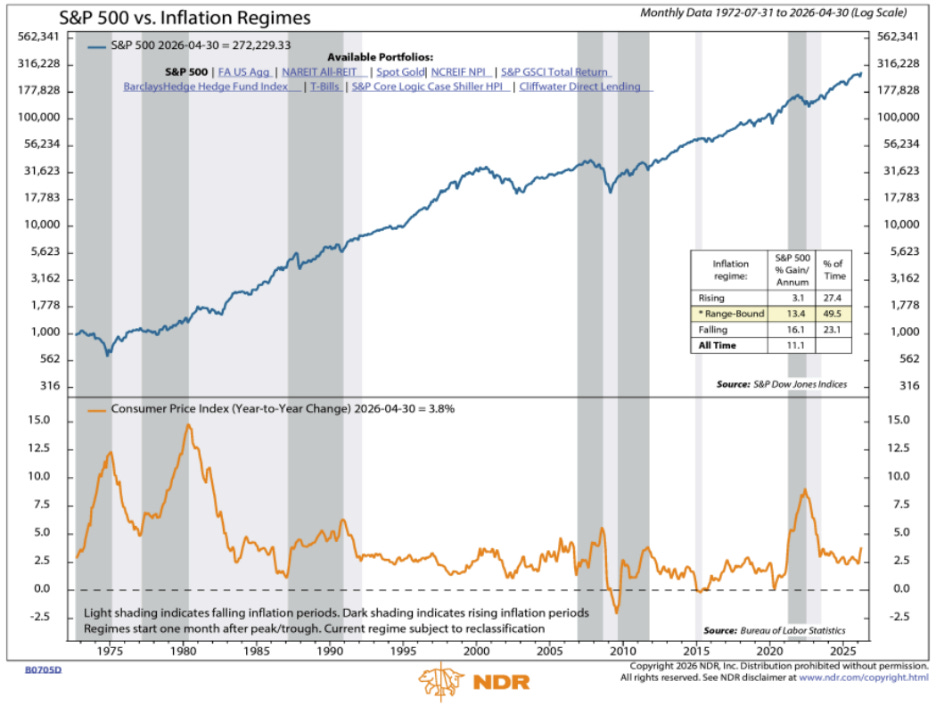
For much of the past two years, markets have benefited from a quiet but important tailwind: inflation was generally moving lower. That mattered because falling inflation helped ease pressure on interest rates, supported stock valuations, and created a friendlier environment for growth-oriented areas of the market.
The chart below highlights a historical pattern: markets have generally performed best during periods of falling or stable inflation, while rising inflation environments have tended to be more challenging.
The keyword here is tended.
We are not declaring a return to the inflation spikes of 2022. But recent developments, including higher energy prices and firmer inflation data, suggest the disinflation trend that has supported markets may be fading. Markets do not just care about the level of inflation; they care about the direction.
The encouraging news is that strong earnings growth and a resilient economy can still support markets, even in a somewhat stickier inflation backdrop. But if inflation proves more persistent than expected, investors may need to adjust to an environment where interest rates stay higher for longer, and market leadership shifts to inflation beneficiaries.
Chart O’ The Week
The Message from Our Indicators
If you only read headlines, you might think the economy is either booming or on the edge of recession. Reality continues to look more nuanced.
Recent data suggests the U.S. economy hit a Spring soft patch, but it is still moving forward. Manufacturing activity improved, services activity softened modestly, and the labor market remains surprisingly resilient. Housing continues to feel pressure from higher mortgage rates, but it is not showing signs of outright collapse. Meanwhile, consumer spending appears steadier than many feared, despite higher gasoline prices and ongoing geopolitical uncertainty.
Perhaps most importantly, the ingredients that typically accompany recessions – falling corporate profits, a rapidly weakening labor market, and broad business retrenchment – remain notably absent. That does not eliminate risks, but it argues for caution against becoming overly pessimistic too quickly.
If there has been one consistent surprise in 2026, it is how strong corporate earnings have remained.
With more than 90% of companies reporting, first-quarter earnings growth for the S&P 500 is tracking near its strongest pace since late 2021, and the vast majority of companies have beaten expectations. Even more encouraging, earnings estimates improved throughout the reporting season.
Nvidia’s earnings this week put an exclamation point on that story. While expectations remain sky high, the company once again delivered strong results, reinforcing that the artificial intelligence investment boom remains very real. Perhaps more importantly, markets have not been driven solely by investors paying ever-higher prices. Technology valuations have been relatively stable, meaning earnings growth, not just excitement, has been doing much of the heavy lifting.
This distinction matters. History shows that markets are generally on firmer footing when profits support prices.
If the economy and earnings stories remain relatively constructive, what has investors nervous?
Interest rates.
Bond yields have moved higher in recent weeks as markets grapple with a difficult question: what happens if inflation stays somewhat sticky while economic growth remains resilient? In that environment, the Federal Reserve may have less flexibility to cut rates than many investors had hoped just a few months ago. Several market-based indicators tied to monetary conditions and inflation expectations have become more cautious as rates climbed.
At the same time, investor sentiment has become more optimistic after the market’s strong rebound, which means expectations are no longer particularly low. That does not mean trouble is imminent, but it does suggest markets may become more sensitive to disappointments, especially if inflation surprises to the upside or rates move materially higher from here.
For now, we continue to see a positive market environment, but inflation and interest rates are worth keeping an eye on in upcoming months.
Happy Memorial Day weekend!
Tim