


Derek Sivers is an entrepreneur, author, and unconventional thinker whose recent book, Useful Not True, explores the stories we mistake for reality. One of the gripping tales he tells in the book dramatically shaped his life. Twice.
When he was 17, he was driving recklessly and had a head-on collision. He learned the other driver, a woman, had broken her spine and would never walk again. He bore the weight of his irresponsibility like a heavy yoke until finally tracking her down almost 20 years later to apologize.
But when he found her, he learned two important facts:
She was able to walk.
She thought the accident was her fault.
She, too, had carried a similar burden, thinking that her distracted driving was the cause of a life-threatening experience for a young teenager.
In this week’s Financial LIFE Planning section, I explore the false precision that we often hope to gain from the exploration of our past and the projection of our future and the uncomfortable truth about what may position us better.
Thereafter, Tony Welch shares his thoughts on the price of oil and its impact on the home front.
Thanks for joining us—in between March Madness basketball games, of course!
Tim Maurer, CFP®, RLP®
Partner
In this Net Worthwhile® Weekly you'll find:
Financial LIFE Planning:
Your Financial Past Isn’t True. Neither Is Your Future.
Quote O' The Week:
Ranier Maria Rilke
Weekly Market Update:
Long-Term, Oil Tracking U.S. Breakeven Costs
Financial LIFE Planning
Your Financial Past Isn’t True. Neither Is Your Future.

Do you remember the story about the downfall of NBC anchor Brian Williams? On multiple occasions, he’d shared vivid recountings of an incident when he was riding in a helicopter that was shot down in Iraq. Except that it never happened.
He was outed, and then ousted by NBC, deemed a liar by the public. But in his podcast, Revisionist History, Malcolm Gladwell offered a great deal more grace, dedicating an entire episode to “Free Brian Williams.”
The Malleability of Memories
He made the case that Williams likely wasn’t lying, but instead, misremembering. Gladwell wondered aloud why we insist that lapses of memory are also lapses in character.
Elizabeth Loftus’ research over 40+ years seems to further shake our convictions that our memories from the past are verbatim recordings, suggesting instead that they are often reconstructions. In her “Lost in the Mall” study, participants were given a booklet with four short stories about their childhood experiences. Three of them were sourced from family members—they were real—but one of the memories was false, suggesting that the participant had been lost in a shopping mall, frightened and crying, and eventually reunited with their family by a helpful elderly stranger.
About 25% of the participants not only “remembered” the fabricated incident; they elaborated on it, proving that we may be regularly rewriting memories even as we remember them.
And while I can totally understand why someone like Brian Williams, trusted as one of the foremost voices of objectivity, would be relieved of his duties when found to be falsifying information for any reason, it did make me wonder, at least a little, about the rock-hard accuracy of my own memories—and maybe especially the memories that have been recounted many times.
The Falsification Of Our Future
For readers bold enough to further question any false sense of precision regarding our past, Sivers also takes aim at our future.
“By definition, ‘the future’ doesn’t exist. It’s what we call predictions in our imagination. People think that the more vivid the image is in their mind, the more likely it’s real. They say, ‘I’m sure it’s going to happen. I can feel it. I can picture it now.’”
Sivers recommends that we ask ourselves (and when appropriate, others), “How confident are you in that prediction, from 0 to 100%?”
Being faced with this question immediately shifts our perspective from one of certainty to probability, requiring us to consider the implications of the options before us.
I’m curious: Do you find the likely imprecision of our past and the uncertainty of our future encouraging or disconcerting? And regardless, how can we use this information to our benefit?
I believe one of the key areas in life in which this information can be beneficially applied is in our financial planning.
Financial Planning Applications
Memory Application 1 - The Financial Identity Story
Most of us are carrying around financial headlines, either of our own making but often someone else’s, that end up mistakenly defining us:
“I’m not good with money.”
“He’s a miser.”
“She’s a hoarder.”
“I’m a saver.”
“She’s a spendthrift.”
These “money scripts” often reside in our subconscious but drive our behavior, while also shaping our identity. These financial self-assessments were often formed in early childhood or vivid episodes later in life—a credit card spiral in our twenties, a painful investment loss, memories of parents fighting over bills—and then retold until they hardened into identity.
For more on money scripts, check this out: out The Crazy Stuff We Do With Money—Explained.
The good news, however, is that an identity built on reconstruction can be gently examined and often revised.
Memory Application 2 - The Reconstructed Financial Trauma
Those who lived through the real estate crisis that led to the 2008-09 financial crisis remember it as an unmitigated institutional and personal catastrophe. I can vividly remember driving to the office, having just crossed the 10-year mark in my career, wondering whether I would have to find a new career, as another company that had survived the Great Depression went belly up that day.
It was truly scary for many of us, creating indelible marks in our money memories. But for many, what actually happened—at least in their portfolios—amounted to little more than a blip in a lifetime of investing. The market, as measured by the S&P 500, lost about 57% from its peak in October 2007 to its trough in March 2009, but in the 12 months that followed that low, the market gained a whopping 70%to reclaim much of its losses.
A 60/40 portfolio (S&P 500/Lehman Agg) had a max drawdown of about 25% in that same stretch, and the total time investors had to wait to go from peak to recovery was a manageable 3 years. But that’s really not how it felt and often how it’s remembered.
The lesson here is that before making a financial decision rooted in past experience, it’s worth asking: What actually happened? Not to the market, not to someone I knew, but to me? And what did I learn from that?
Future Application 1 - The Vivid Catastrophe
It doesn’t take a long look at today’s headlines to conclude that our children (or grandchildren) are screwed. Inflation is making everything more expensive, especially living expenses with doubled interest rates. Social media is rotting our brains and AI is coming for our jobs.
Or forget the kids. You may have a money script running through your mind that you’re irretrievably behind on your retirement planning, picturing yourself eating ramen and cat food in a dingy assisted living facility. You can almost taste it.
But as Derek Sivers notes, vividness is not probability. And every generation prior has laid claim to the imminent disaster that the future could hold. And the antidote isn’t to dismiss the fear, but to quantify it. How confident are you, from 0 to 100%, and then how should we plan?
The gap between the felt probability and the calculated one is often where the best financial decisions get made.
Future Application 2 - The Vivid Dream
The same distortion runs in the opposite direction, too. You may already picture the lake house, the winters abroad, and the grandchildren bounding into the house every idyllic Sunday afternoon.
But good financial planning doesn’t just plan for a future that feels like the future—it plans for a range of probable outcomes. What happens if health changes the picture, if the lake house turns out to be the wrong dream, or if the kids (and grandkids) are on two different coasts, and you’re in the heartland?
Holding the future with a slightly looser grip isn’t pessimism. It’s what makes a plan flexible and genuinely resilient.
A Final Application - For Financial Advisors
Financial psychology luminary, Dr. Ted Klontz, once told me, “You can’t always believe what you think you’ve heard.”
It sounds at first like a caution, but it’s really a call to greater attentiveness and presence in our work. When a client shares their financial history, it may well be the first time they’ve ever voiced it. Therefore, simple and strategic reflection—mirroring back to the client what we think we’ve heard—is a powerful way to help them craft a coherent narrative. And Loftus’ research also reminds us that the recounting of memories may also be the reconstruction of those narratives.
Similarly, we’ve learned from luminaries like George Kinder and Hal Hershfield that there is great power in helping our clients use their imaginations to craft a more concrete vision for their futures, lending more weight to their planning in the present. But even as we work to activate their imaginations, we must invite clients to hold onto the feelings of their desired futures, while not judging themselves on the difference between the dream and their future reality.
Conclusion
Derek Sivers spent nearly 20 years carrying a crippling story that wasn’t event true, and only discovered it by going back to look. That’s an act most of us never take with our financial past. Or our financial future.
What story have you been carrying? How confident are you — from 0 to 100% — that it’s yours to keep? And how might you reimagine your future, writing a new and motivating script, while holding loosely the outcome and planning for contingencies along the way?
BONUS: Would you believe that, way back in 2011, right around the launch of my first book, I asked Derek Sivers to write a guest post about why he chose to give his company away to charity. And he did. You can read it HERE.
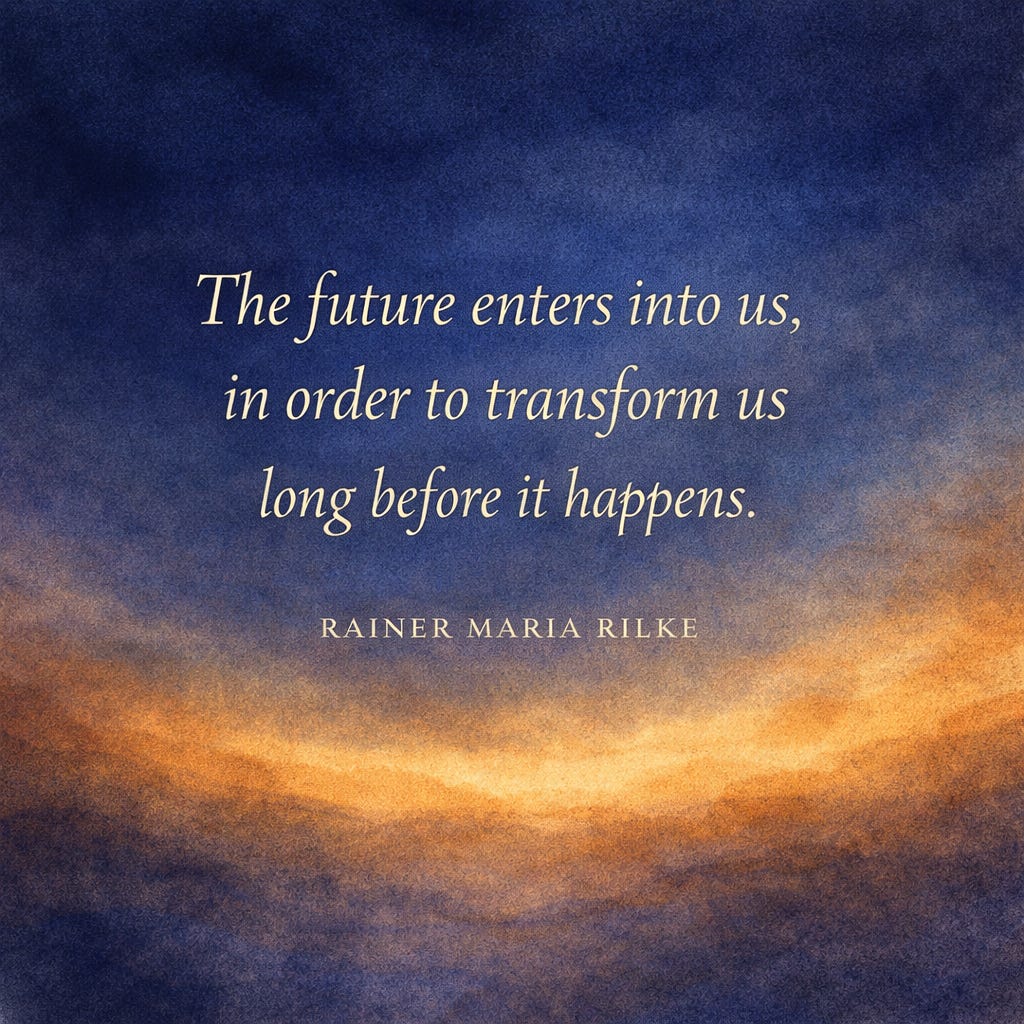
Quote O' The Week
Rainer Maria Rilke (1875–1926) was a Bohemian-Austrian poet widely regarded as one of the most lyrically gifted writers in the German language, best known for Letters to a Young Poet and the Duino Elegies. He wrote with uncommon depth about solitude, beauty, suffering, and the invisible forces that shape a human life — which may be why his words have a way of feeling less like poetry and more like something you already knew but couldn’t say.
Weekly Market Update
Markets continued to struggle with war in the Middle East:
- 1.90% .SPX (500 U.S. large companies)
- 1.60% IWD (U.S. large value companies)
- 1.77% IWM (U.S. small companies)
- 1.71% IWN (U.S. small value companies)
- 2.01% EFV (International value companies)
- 2.45% SCZ (International small companies)
- 0.59% VGIT (U.S. intermediate-term Treasury bonds
Long-Term, Oil Tracking U.S. Breakeven Costs
Contributed by Tony Welch, CFA®, CFP®, CMT, Chief Investment Officer, SignatureFD
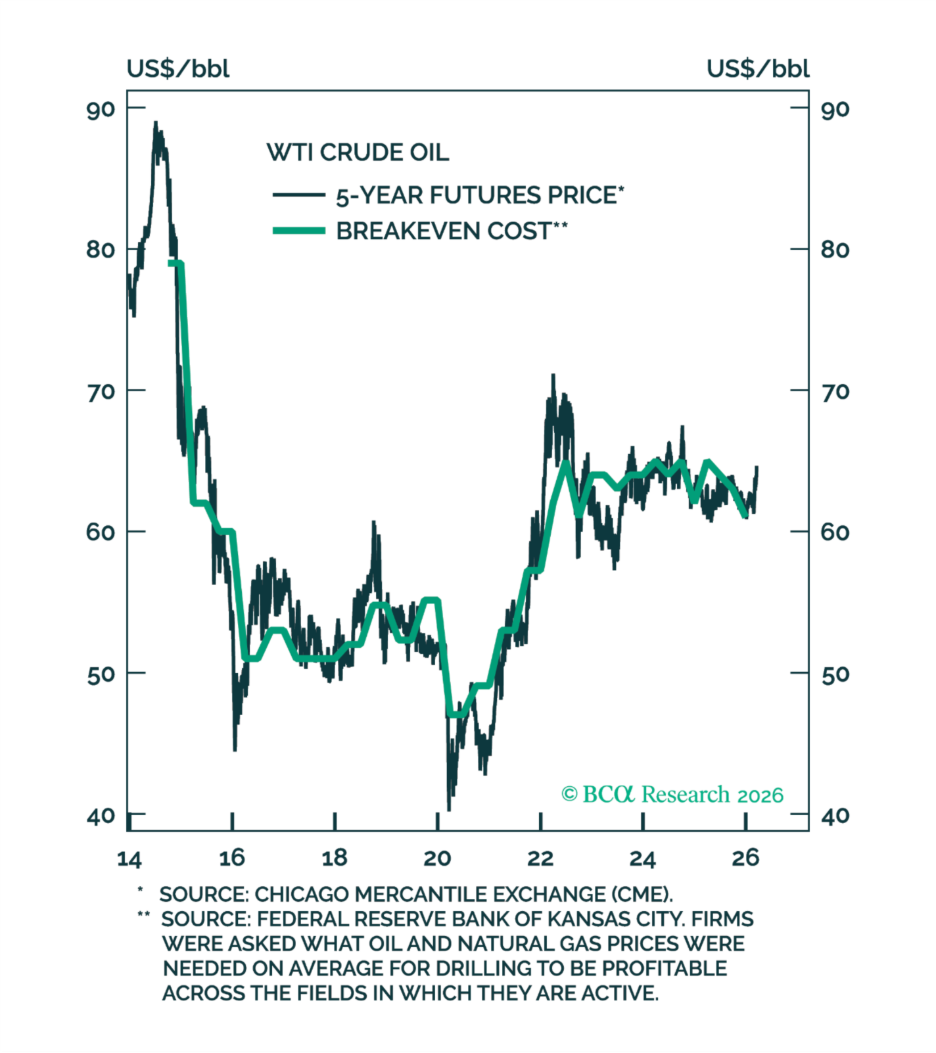
We’ve experienced something of an oil shock in the short term. The rising cost of oil has the potential to negatively impact consumer sentiment, corporate earnings, and economic growth. One interesting trend: the futures curve for oil has not shifted much in the longer term. That implies that market participants expect oil to revert back to pre-conflict pricing in the next few years.
BCA Research shows an interesting chart in which they plot the 5-year futures price for oil against the breakeven price for U.S. oil producers. It has tracked tightly since 2016. That makes intuitive sense as the U.S. has become the largest producer of oil. BCA posits that it isn’t a question of “if” oil reverts to U.S. production costs, but rather “when” it will begin to do so. There are many wildcards in the Iranian conflict, and predicting near-term moves is extremely difficult. But over the longer term, we might expect oil prices to ease, eventually bringing support to consumers. However, that could be a theme for 2027 or beyond.
Chart O’ The Week
The Message from Our Indicators
Consistent with historical midterm year trends, the market has been volatile thus far in 2026. Midterm years have experienced an average correction of -19%, almost a full bear market. That’s the bad news. The good news is that following those midterm year corrections, the market has tended to experience its best 12-month performance. These corrections have typically lasted until late Summer or Fall, before giving way to a new uptrend. Consistent with recent weakness, our trend indicators have also been weakening. The bull market remains intact, but fewer stocks, industries, and global markets have been participating. The degree of trend deterioration will be something worth monitoring.
The important question amid the volatility – will corporate earnings continue to expand? That key question helps to determine whether a correction becomes a bear market. Historically, bear markets have tended to be accompanied by earnings contractions. Today, analysts are still expecting double-digit earnings growth in 2026. Rising input costs and weakening consumer sentiment are risks to those earnings expectations. But before the Iranian conflict, the economic backdrop for earnings was solid.
As far as economic data is concerned, there wasn’t much that was impactful last week. PPI inflation for February came in above economist expectations, indicating that some inflationary pressures were building before the rise in energy prices. The Fed made no change to interest rate policy given the uncertainty around inflation. They have also adjusted their expectations for cuts later in the year. They expect one or fewer cuts now. The Fed has gone from easing to a more neutral policy. That’s ok, as the economy and stock market have performed about average when the Fed has been neutral. But should the central bank turn to rate hikes, rather than cuts, that would present more of a challenge. For now, the economy is still growing, as are corporate earnings. Therefore, we’re viewing recent stock market weakness as a midterm year correction that is likely to resolve toward the end of the Summer or in the Fall, giving way to a renewed uptrend. In that environment, investors should be patient, rather than attempting to time market trends.
It’s ok if your bracket is already busted!
Tim
Thank you for sharing this thought exercise. For me, the takeaway is I'm making decisions today based on less than perfect memories about an uncertain future. This is a jolting thought.
For me, the way to relax the fear is to accept how things are because I can't change them, and to have the confidence in knowing I will make the best decision I can with incomplete or imprecise information. Further, when needed, I will pivot my actions when more reliable information comes to light.
Assuming I'm thinking about this correctly, the application of this approach for me is especially meaningful when planning my spending in retirement. It's letting go of the fear of the unknown and the idea I can control every little aspect of such a complex thing.