

It’s always interesting to me to see which of the posts I write happen to strike a particular chord with you and other readers.
I’ve never written with a design or desire to create something that is clickable, much less viral; I just write whatever inspires me the most in the moment and trust that it will resonate. And regardless of how the newsletter has grown, my litmus test for success has always been the number ONE. That is, if only one person receives a meaningful benefit, that’s a successful post.
And every once in a while, I’ll take a step back and see what concepts seem to be resonating the most—based on stuff you might see, such as likes and shares on Substack and other social media, as well as direct messages, texts, and emails that you don’t see.
One recent trend (almost) surprised me, when I found three posts, written independently on different topics, that nonetheless arrive at a similar conclusion. It was interesting enough (to me) that I decided to share that conclusion with you—along with links to the three posts in case you missed them the first time around.
Our resident investment guru, Tony Welch, also shares a brand new insight with us, noting the relative strangeness of the markets in 2026, even by historical standards.
Thanks for joining us!
Tim
Tim Maurer, CFP®, RLP®
Partner
In this Net Worthwhile® Weekly you'll find:
Financial LIFE Planning:
Byproducts Masquerading As Goals
Quote O' The Week:
Hellen Keller
Weekly Market Update
One of the Most Rotational Years in History
Financial LIFE Planning
Byproducts Masquerading As Goals
The Unifying Theme Of Three Popular Posts
So what, exactly, is this unexpected unifying theme that seemed to resonate with readers? The basic idea is that the thing we’re after often isn’t really the thing. In fact, frustratingly, what we think we’re after often doesn’t show up until we stop reaching for it.
The first post is The Dangerous Lure Of Legacy. Inspired initially by Jim Collins’s newest book, What To Make Of A Life, we learned that leaving a lasting legacy isn’t really a goal, but the outcome of a life well lived. And it’s not just the pursuit of a legacy that can be counterproductive; we see it in many other ways as well. For example:
Love: Neediness tends to repel more than endear.
Respect: The more we demand it, the less deserving we appear.
Sleep: Sleep scientists treat “sleep effort” as a cause of insomnia.
These worthy desires, and many more, are really byproducts masquerading as goals. Here’s the full post:
The Dangerous Lure Of Legacy

Legacy is a word that has gotten a lot of play in the wealth management space, and for good reason. Especially when we differentiate the word “legacy” from the word “estate,” we begin to tap into what I believe is the real essence of the best financial planning.
The second post’s title was directed at the many financial advisors who subscribe to this newsletter, but it’s a syndrome that is certainly not exclusive to that profession, nor is what we learned from this exploration. In the social media age, I think it’s almost impossible NOT to fall prey to a desire to appear interesting.
But it was all the way back in 1936 that Dale Carnegie was teaching that age’s aspiring influencers the formula for being interesting. “To be interesting,” Carnegie said, “be interested.”
This post, therefore, while acknowledging just how difficult it really is, examines several different ways that we can, indeed, become more interesting by being more interested:
Advisors: Stop Trying To Be Interesting

You’ve probably felt what I’ve felt. Even a quick scan of social media—and perhaps even, if not especially, the social lanes that lend themselves to professional connections—leaves us feeling unintentionally exhausted. We’re exhausted because we see everyone else working so hard to differentiate themselves, to stand out, to separate themselves from the …
And finally, the third post was, for me, unavoidable after reading legendary author C. S. Lewis’s definition of hell:
“We must picture Hell as a state where everyone is perpetually concerned about his own dignity and advancement, where everyone has a grievance, and where everyone lives the deadly serious passions of envy, self-importance, and resentment.”
In this post, we cast aside the simple dichotomies that might suggest more—or less—is always better, wondering instead, What do we want more for?
The answer to that question is likely the difference between mere riches and true wealth.
C. S. Lewis On Hell—And Your Financial Plan

Two people can hold the same net worth, the same portfolio, and the same beautifully formatted plan—and only one of them would tell you they have enough. One may live a rich life, filled with gratitude and purpose, while the other seems to gain the whole world while losing everything that made it worth having.
I surely don’t expect you to read three posts this fine, fall Sunday morning, but I hope that one of these draws you enough to inspire some reflection. And if you don’t have time for that, consider this quote featured in the first post that may be the simplest summary of them all, from the great Viktor Frankl:
“Don’t aim at success—the more you aim at it and make it a target, the more you are going to miss it. For success, like happiness, cannot be pursued; it must ensue…as the unintended side-effect of one’s personal dedication to a cause greater than oneself.”
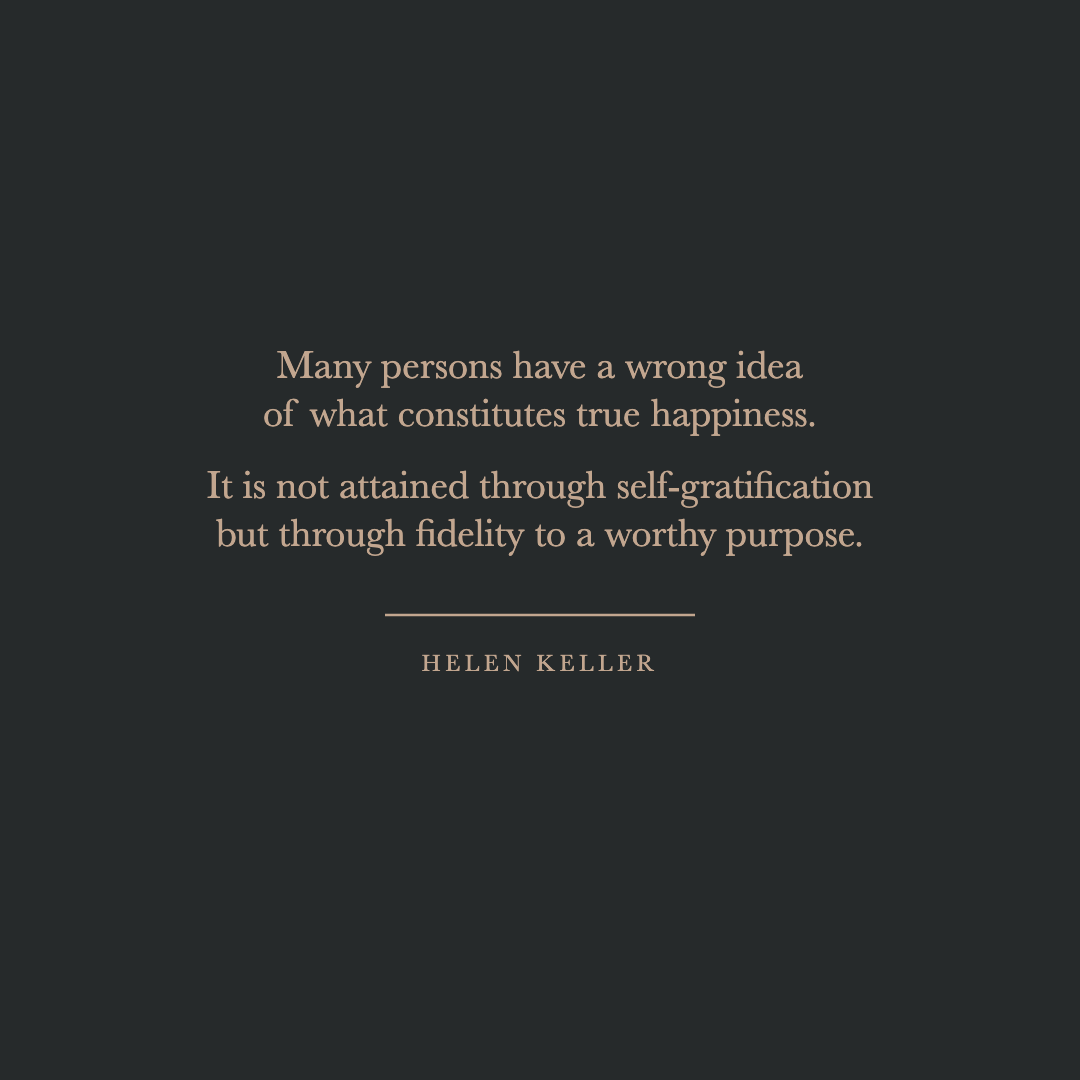
Quote O' The Week
Hellen Keller (1880-1964) was born in Tuscumbia, Alabama, where an illness left her blind and deaf before the age of two. Her teacher and lifelong companion, Anne Sullivan, had an educational breakthrough when she spelled the word W-A-T-E-R into Hellen’s hand while water flowed over her palm. Keller ultimately graduated cum laude from Radcliffe in 1904, the first deafblind person to earn a bachelor’s degree, and visited 39 countries as an advocate for the American Foundation for the Blind.
Weekly Market Update
A volatile week on Wall Street ended with a big down day, especially for tech stocks. But as you’ll see, most of the indices we track were marginally up:
- 0.57% .SPX (500 U.S. large companies)
+ 0.48% IWD (U.S. large value companies)
+ 1.30% IWM (U.S. small companies)
+ 0.74% IWN (U.S. small value companies)
+ 0.51% EFV (International value companies)
+ 0.36% SCZ (International small companies)
+ 0.61% VGIT (U.S. intermediate-term Treasury bonds
One of the Most Rotational Years in History
Contributed by Tony Welch, CFA®, CFP®, Chief Investment Officer, SignatureFD
If it seems like the market has had a little schizophrenia in 2026, you aren’t crazy. It has been an extremely rotational year, mostly between the AI/Tech theme and the rest of the market. Because of the constant rotations, market breadth has not been very healthy this year. Typically, we would expect a weaker year when breadth is poor, but that hasn’t been the case this year. The S&P 500 has returned around 13% this year.
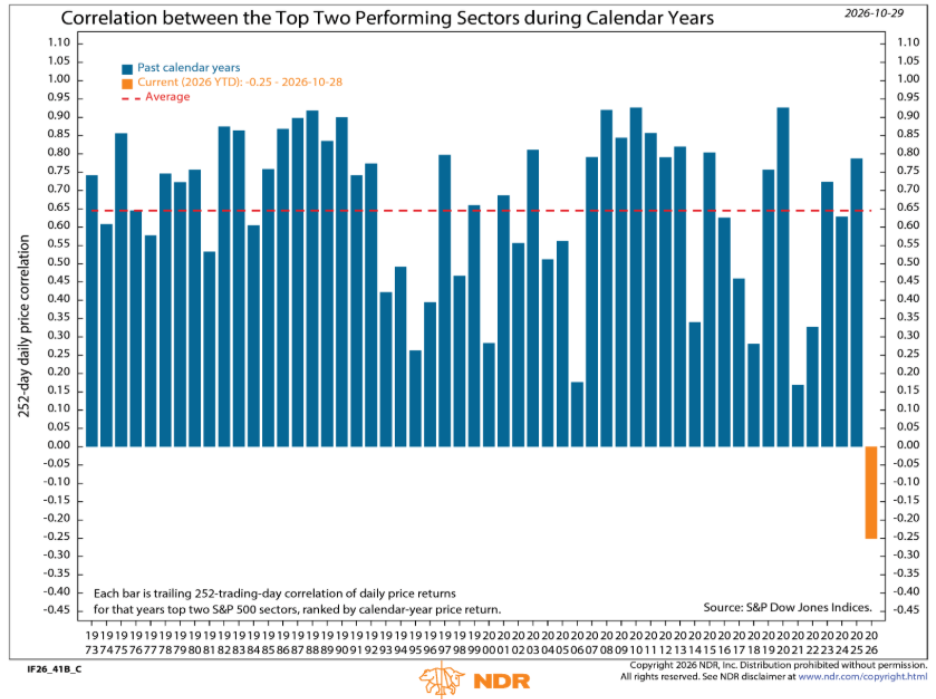
One unique characteristic of 2026 is that the top two performing sectors, Energy and Technology, have a negative correlation to each other. As the chart below shows, it has never been the case that the top two performing sectors move inversely to each other. Perhaps counterintuitively, the negative correlation is likely helping the market hold up despite poor breadth. If the top sectors are positively correlated and they correct, then a correction will materialize in the broad index. But if the top-performing sectors are inversely correlated, when one is correcting, the other is rallying.
As this is an unprecedented year in several ways, we have no way of knowing whether these trends have any forward significance. But it is interesting context nonetheless.
Chart O’ The Week
We had a Fed meeting this week, where the FOMC voted to keep interest rates unchanged in October. If inflation remains stubborn, a hike in December is likely. Whether this is a relatively benign tightening cycle or a quick, more dramatic tightening will likely have a major influence on asset returns over the next 12 months. Historically, when the Fed has been able to raise rates only a few times, and at a measured pace, stocks have performed relatively well. But when the Fed has had to tighten quickly and for a longer period, stocks have tended to struggle. For now, we think this tightening cycle will be more benign.
One of the major reasons we don’t think the Fed will need to be aggressive in this cycle is that incomes haven’t been keeping pace with inflation. Supply shocks tend to recede in the absence of a wage-price spiral.
Corporate fundamentals continue to provide important support for the market. Two hundred eighty-eight S&P 500 companies have reported Q3 results, and thus far, the earnings growth rate has been nearly 30%. Sales growth has been a robust 13%. Profit margins continue to expand, which is a bullish development.
As we turn our attention to 2027, we would note that the market has never been down in the 12 months following the mid-term election date. Seasonality is likely to be a tailwind. But most streaks eventually come to an end. If returns are negative in the next year, it will likely be due to very high expectations that failed to be met. For now, we continue to give this bull market the benefit of the doubt.
And don’t forget—clocks go BACK this morning!
Tim